Revolving Loan: Flexible Financing for Business Growth
Discover how a revolving loan provides flexible capital access for businesses. Learn structures, benefits, and how to choose the right solution.

A revolving loan represents one of the most flexible financing structures available to businesses today, offering continuous access to capital without the need to reapply each time funds are needed. Unlike traditional term loans that provide a single lump sum with fixed repayment schedules, this financing method creates a reusable credit pool that adapts to the ebbs and flows of business operations. For companies managing seasonal inventory swings, unexpected opportunities, or ongoing operational expenses, understanding how revolving credit works can transform cash-flow management and strategic planning. This comprehensive guide explores the mechanics, applications, and considerations surrounding revolving loan facilities for modern businesses.
Understanding the Revolving Loan Structure
A revolving loan functions as a pre-approved credit facility that allows borrowers to draw funds up to a specified limit, repay them, and draw again throughout the life of the agreement. This cyclical structure distinguishes it from installment loans, which close permanently once repaid.
The credit limit represents the maximum amount available at any given time. Businesses access funds as needed, paying interest only on the outstanding balance rather than the entire credit line. When principal is repaid, that capacity becomes available again without additional applications or underwriting.
Key Components of Revolving Credit
Every revolving loan agreement includes several critical elements that define how the facility operates:
- Credit limit: The maximum amount available to draw
- Draw period: The timeframe during which borrowing is permitted
- Interest calculation: Typically variable rates applied to outstanding balances
- Repayment terms: Minimum payments, payoff schedules, and renewal conditions
- Fees: Commitment fees, unused line fees, or annual maintenance charges
- Covenants: Financial ratios, reporting requirements, or business restrictions
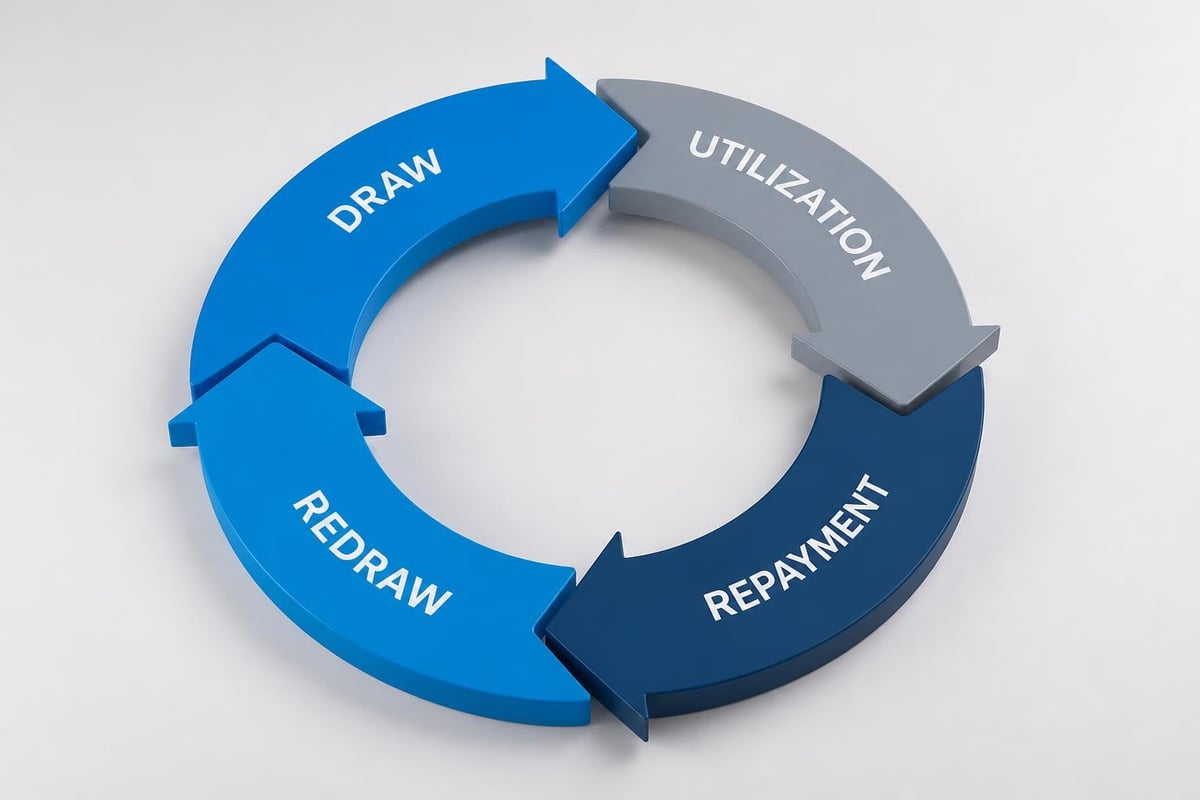
The draw period usually lasts several years, during which businesses can access funds repeatedly. After this period, the facility may convert to term-out provisions requiring full repayment over a specified schedule, or it may renew for another cycle.
Types of Revolving Loan Facilities
Revolving credit comes in several forms, each designed for specific business needs and circumstances. Understanding these variations helps companies select the most appropriate structure for their situation.
| Facility Type | Primary Use | Typical Borrowers | Key Features |
|---|---|---|---|
| Working Capital Line | Operational expenses, inventory, payroll | Small to mid-size businesses | Shorter terms, revenue-based underwriting |
| Asset-Based Revolving | Inventory and receivables financing | Manufacturing, distribution, retail | Secured by current assets, higher advance rates |
| Committed Credit Line | Strategic flexibility, backup liquidity | Established companies | Guaranteed availability, commitment fees |
| Syndicated Revolver | Large-scale corporate needs | Mid-market to enterprise | Multiple lenders, complex documentation |
Working Capital Lines
Working capital revolving loans address day-to-day operational needs. These facilities typically range from $10,000 to several million dollars, with approval based heavily on revenue performance, cash flow, and business stability rather than solely on traditional credit metrics.
Many small and medium-sized businesses utilize working capital lines for inventory purchases ahead of peak seasons, bridging payment gaps between receivables and payables, or covering temporary cash-flow shortfalls. Enterprise Finest Solutions helps businesses explore working capital financing options through a network of funding partners, matching companies with solutions aligned to their revenue, industry, and capital requirements. For businesses that need capital to fill large customer orders, our guide to PO financing explains how purchase order funding works.
Asset-Based Revolving Credit
Asset-based revolving loans secure the credit line against specific collateral, most commonly accounts receivable and inventory. Lenders establish borrowing bases calculated as a percentage of eligible asset values, creating advance rates that adjust as collateral fluctuates.
This structure provides higher credit limits than unsecured facilities, particularly for businesses with substantial receivables or inventory but limited operating history or profitability. Borrowing bases may be recalculated monthly or quarterly, with availability tied directly to collateral performance.
Business Applications and Strategic Uses
The flexibility inherent in revolving loan structures makes them suitable for numerous business scenarios. Companies deploy these facilities strategically to maximize operational efficiency and capitalize on growth opportunities.
Seasonal businesses rely heavily on revolving credit to build inventory ahead of peak demand periods, then repay the balance as receivables convert to cash. This cyclical borrowing pattern aligns perfectly with the revolving structure, minimizing interest costs while ensuring adequate capital availability.
Managing Cash-Flow Volatility
Business cash flow rarely follows perfectly predictable patterns. Client payment delays, unexpected expenses, or timing mismatches between payables and receivables create short-term capital needs that a revolving loan addresses efficiently.
Rather than maintaining excessive cash reserves-which represent idle capital earning minimal returns-businesses can operate with leaner balances and access their revolving facility when gaps emerge. This approach optimizes working capital efficiency while maintaining financial flexibility.
Common cash-flow applications include:
- Covering payroll during slow revenue periods
- Taking advantage of early payment discounts from suppliers
- Managing the float between project expenses and client payments
- Funding marketing campaigns with delayed ROI timelines
- Addressing emergency repairs or equipment failures

Growth and Opportunity Funding
Strategic opportunities rarely arrive on convenient schedules. A competitor's closure, a bulk purchase discount, an unexpected contract award, or a prime real estate opportunity may require rapid capital deployment.
Revolving loans provide the speed and certainty needed to capitalize on these situations. With pre-approved credit already in place, businesses can act decisively without waiting for loan approvals or scrambling to secure financing under time pressure.
Qualification and Underwriting Considerations
Lenders evaluate revolving loan applications differently than term loans, focusing heavily on ongoing performance metrics and repayment capacity from operations. Understanding these criteria helps businesses prepare stronger applications and secure favorable terms.
Financial Metrics Lenders Examine
Revenue consistency ranks among the most critical factors. Lenders want evidence of stable or growing top-line performance, as this indicates reliable cash generation to service debt. Many alternative lenders emphasize revenue and deposit activity over traditional credit scores, particularly for smaller facilities.
Key underwriting factors include:
- Monthly revenue trends: Consistency, growth trajectory, seasonal patterns
- Cash-flow adequacy: Ability to service debt from operations
- Time in business: Operating history demonstrating sustainability
- Industry risk: Sector-specific considerations and volatility
- Existing obligations: Debt service coverage and leverage ratios
- Credit history: Business and personal credit profiles
Lenders also assess how borrowed funds will be deployed. Clear, sensible use-of-proceeds strengthens applications significantly. Vague requests for "general business purposes" raise concerns, while specific plans for inventory purchases, equipment upgrades, or expansion projects demonstrate strategic thinking.
Collateral and Security Requirements
Secured revolving loans typically offer higher limits and lower rates than unsecured facilities. The collateral package depends on the facility type and lender requirements.
Asset-based revolvers require detailed collateral reporting, including accounts receivable aging schedules, inventory reports, and periodic appraisals or audits. These administrative requirements add complexity but unlock substantially higher borrowing capacity.
Blanket liens on all business assets represent another common security approach, providing lenders with broad protection while simplifying documentation compared to asset-specific monitoring. Personal guarantees from business owners frequently accompany small business revolving facilities, particularly for newer companies or those with limited business credit history.
Regulatory Framework and Risk Management
The revolving loan market operates within a comprehensive regulatory framework designed to protect both borrowers and the financial system. Regulatory guidance governs how financial institutions classify, report, and manage revolving credit exposure, particularly regarding capital requirements and risk weighting.
Credit Risk and Capital Treatment
Banks and regulated lenders must maintain capital reserves against potential losses from their loan portfolios. Revolving credit facilities receive specific treatment under banking regulations, with credit conversion factors applied to undrawn commitments to estimate potential exposure.
This regulatory environment influences pricing, structure, and availability of revolving loans. Lenders balance profitability against capital efficiency, which affects the terms they can offer to different borrower segments.
Consumer vs. Commercial Applications
While this article focuses on business revolving loans, the consumer revolving credit market-dominated by credit cards-provides important context for understanding broader market dynamics. Consumer revolving credit products carry significantly higher interest rates than commercial facilities, reflecting different risk profiles, regulatory constraints, and market structures.
Business revolving facilities typically feature lower rates, larger limits, and more customized terms than consumer products. However, very small business lines sometimes blur these categories, particularly when secured by personal assets or guaranteed by business owners.
Comparing Alternatives to Revolving Loans
Understanding how revolving credit compares to alternative financing structures helps businesses make informed capital decisions. Each approach offers distinct advantages and limitations depending on specific circumstances.
| Feature | Revolving Loan | Term Loan | Merchant Cash Advance | Equipment Financing |
|---|---|---|---|---|
| Access Pattern | Continuous reuse | Single disbursement | Lump sum advance | Asset-specific |
| Repayment | Flexible, interest on balance | Fixed installments | Revenue-based repayment | Fixed or seasonal schedule |
| Best For | Ongoing working capital | Specific projects or purchases | Revenue-based funding needs | Equipment acquisition |
| Collateral | Varies by facility | Often required | Revenue stream | Equipment itself |
| Speed | Fast (once established) | Moderate | Very fast | Moderate |
When Term Loans Make More Sense
Fixed-rate term loans excel for specific, one-time capital needs with predictable repayment capacity. Purchasing real estate, financing major equipment, or funding build-outs and renovations align well with term loan structures that match asset life to repayment schedules.
The predictability of fixed payments simplifies budgeting and financial planning. Businesses that value certainty over flexibility often prefer term debt for long-term investments, reserving revolving capacity for working capital and short-term needs.
The Role of Revenue-Based Financing
Some businesses-particularly those with strong revenue but limited assets or credit history-find traditional revolving loans difficult to access. Revenue-based alternatives including merchant cash advances offer faster approval and more flexible qualification criteria, though typically at higher costs.
These structures make sense when speed is critical, when traditional credit isn't available, or when short-term capital needs justify premium pricing. The distinction between formal revolving loans and revenue-based products matters significantly for tax treatment, reporting, and long-term capital strategy.

Optimizing Revolving Credit Management
Securing a revolving loan represents just the beginning. Effective management maximizes value while minimizing costs and maintaining strong lender relationships that facilitate future financing needs.
Strategic Draw and Repayment Practices
Interest accrues only on outstanding balances, making draw timing strategically important. Businesses should borrow only when needed and repay as quickly as cash flow permits, minimizing interest expense while preserving availability for future needs.
Best practices for revolving credit management:
- Maintain detailed cash-flow forecasts to anticipate draw needs
- Repay balances during strong revenue periods to reduce interest costs
- Monitor utilization rates (balance divided by limit) to preserve credit capacity
- Document all draws with clear business purposes for tax and accounting records
- Review facility terms annually and refinance when better options emerge
- Communicate proactively with lenders about business changes or challenges
Understanding Fee Structures
Beyond interest charges, revolving facilities may carry various fees that impact total borrowing costs. Legal frameworks governing revolving credit provide structure around disclosure and fee limitations, but businesses must still carefully evaluate total costs.
Commitment fees compensate lenders for reserving capital, charged on the unused portion of the credit line. Unused line fees follow similar logic but may calculate differently. Annual maintenance fees, draw fees, or late payment penalties add to the cost structure.
Understanding the complete fee schedule enables accurate cost comparisons across different facilities and ensures no surprises during the life of the agreement.
Documentation and Legal Considerations
Revolving loan agreements contain complex legal provisions that govern the relationship between borrower and lender. While working with legal counsel is advisable, understanding key terms helps businesses negotiate effectively and manage their obligations.
Essential Agreement Components
The credit agreement defines the fundamental terms: limit, interest rate calculation, draw procedures, repayment requirements, and maturity date. It also establishes representations and warranties about the business's financial condition, legal status, and authority to borrow.
Financial covenants impose ongoing obligations to maintain certain metrics-minimum cash-flow coverage ratios, maximum leverage ratios, minimum working capital levels, or profitability thresholds. Covenant violations can trigger default provisions, accelerate repayment, or increase interest rates.
Negative covenants restrict certain actions without lender consent: additional debt, asset sales, ownership changes, dividend payments, or fundamental business changes. These protect lenders but may constrain strategic flexibility.
Default Provisions and Remedies
Default clauses specify what constitutes a breach of the agreement and what remedies the lender may pursue. Payment defaults-missing required payments-represent obvious triggers, but cross-default provisions may activate if the business defaults on other obligations.
Material adverse change clauses give lenders discretion to call loans or reduce availability if business conditions deteriorate significantly. These subjective provisions require careful negotiation to balance legitimate lender protection with business operational needs.
Industry-Specific Applications
Different industries leverage revolving loans in unique ways that reflect their operational rhythms, asset profiles, and capital intensity. Recognizing these patterns helps businesses structure facilities that align with industry norms and lender expectations.
Retail and Wholesale Trade
Retailers and wholesalers use revolving credit primarily for inventory financing. The seasonal nature of many retail businesses creates perfect alignment with revolving structures-borrowing to stock up before peak seasons, then repaying as inventory converts to cash.
Asset-based revolving facilities work particularly well in this sector, with inventory and receivables providing natural collateral. Lenders familiar with retail operations understand seasonal patterns and structure facilities accordingly.
Service Businesses
Service companies typically carry less inventory and equipment than product-based businesses, but face different working capital challenges. Project-based service firms often fund labor and expenses before collecting from clients, creating cash-flow gaps that revolving credit bridges efficiently.
Professional service firms, agencies, and consultancies use revolving facilities to smooth cash flow between project milestones, manage payroll during slow periods, and fund growth initiatives like new hires or market expansion.
Manufacturing and Distribution
Manufacturers operate with longer cash conversion cycles than many industries. Raw materials must be purchased, processed, finished, shipped, and eventually paid for-a timeline that may span months. Revolving credit provides the working capital needed to maintain operations while inventory and receivables work through this cycle.
Distribution businesses similarly benefit from revolving structures that finance inventory purchases and bridge payment terms extended to customers. The continuous flow of goods through the supply chain aligns naturally with the revolving facility's continuous availability.
Evaluating Lender Options and Partnerships
The revolving loan market includes diverse lender types, each with distinct underwriting approaches, pricing structures, and service models. Selecting the right lender relationship impacts not just immediate terms but long-term capital access and business flexibility.
Traditional Banks vs. Alternative Lenders
Traditional banks offer the lowest interest rates and most favorable terms for well-qualified borrowers with strong credit, substantial collateral, and established operating histories. Their underwriting processes are typically more rigorous and time-consuming, but the cost savings can be substantial for businesses that qualify.
Alternative lenders-including specialized commercial finance companies, fintech platforms, and business development companies-provide faster approval, more flexible qualification criteria, and greater willingness to underwrite newer businesses or challenging industries. These advantages come at higher costs, but may represent the only accessible option for many small and medium-sized businesses.
The Value of Specialized Brokers
Navigating the complex landscape of lenders, products, and terms can overwhelm business owners focused on operations rather than finance. Business financing brokers provide valuable expertise in matching businesses with appropriate lenders and structuring optimal terms.
Experienced brokers understand lender appetites, underwriting criteria, and market pricing. They can identify which lenders are most likely to approve specific situations, expediting the process and improving approval odds. This expertise proves particularly valuable for businesses with unique circumstances, limited credit history, or urgent capital needs.
Economic Cycles and Revolving Credit Availability
Revolving loan availability and pricing fluctuate with broader economic conditions. Understanding these dynamics helps businesses time their applications strategically and maintain appropriate backup financing.
During economic expansions, lender competition intensifies, credit standards loosen modestly, and pricing becomes more favorable for borrowers. Credit line increases and new facility approvals accelerate as lenders seek to deploy capital in a growing economy.
Economic contractions reverse these trends. Lenders tighten underwriting standards, reduce committed capacity, and may even cut existing credit lines if business performance deteriorates. Interest rates may rise as lenders price in increased risk, and covenant monitoring intensifies.
Strategies for managing through credit cycles:
- Secure or renew facilities during favorable conditions rather than waiting until needed
- Maintain strong lender relationships with consistent communication
- Operate conservatively within credit limits to preserve capacity
- Diversify capital sources to reduce dependence on single relationships
- Monitor covenant compliance proactively to avoid technical defaults
The most dangerous time to need financing is precisely when it becomes hardest to obtain. Forward-looking businesses establish revolving facilities during strong performance periods, creating financial cushions before challenges emerge.
A revolving loan offers businesses the financial flexibility to navigate operational cycles, seize opportunities, and manage cash flow efficiently through a reusable credit structure tailored to real-world business rhythms. Understanding the mechanics, applications, and strategic management of these facilities positions companies to leverage them effectively while minimizing costs and maintaining strong lender partnerships. If your business needs flexible capital access aligned with your revenue, industry, and growth objectives, Enterprise Finest Solutions connects you with funding partners who understand your unique situation and can provide practical financing solutions designed for your success.
Written by
Enterprise Finest Solutions
Content creator and writer sharing insights and stories.