Women's Business Grants: Complete Guide to Funding for Female Entrepreneurs
Discover women's business grants available in 2026. Learn eligibility requirements, application strategies, and funding alternatives for female entrepreneurs.

Female entrepreneurs continue to face unique challenges in securing business capital, despite representing a growing segment of business ownership across the United States. Womens business grants offer non-repayable funding specifically designed to support female-led ventures, helping bridge the persistent funding gap that affects women in business. These grant opportunities range from federal programs to private initiatives, each with distinct eligibility criteria, award amounts, and application requirements. Understanding the landscape of available grants and developing a strategic approach to applications can significantly increase your chances of securing capital to launch or expand your business.
Understanding the Landscape of Womens Business Grants
The ecosystem of womens business grants has expanded considerably over the past decade, reflecting increased recognition of the value female entrepreneurs bring to the economy. These funding opportunities serve multiple purposes beyond simple capital provision.
Grant programs specifically targeting women-owned businesses address historical inequities in capital access. Research consistently shows that female entrepreneurs receive disproportionately less venture capital and traditional financing compared to their male counterparts. Grants help level this playing field by providing funding without equity dilution or debt burden.
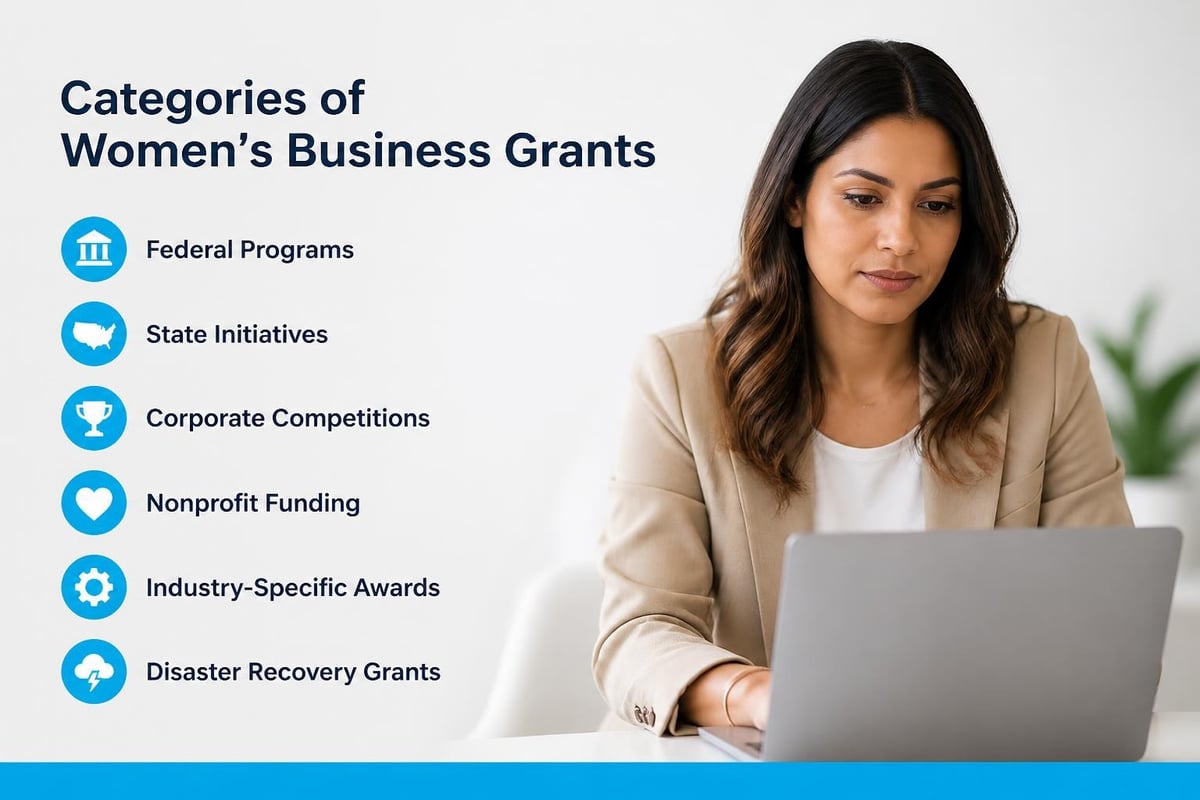
Key categories of womens business grants include:
- Federal government programs supporting women-owned small businesses
- State and local economic development initiatives
- Corporate-sponsored grant competitions and awards
- Nonprofit organization funding programs
- Industry-specific grants targeting women in particular sectors
- Disaster relief and recovery grants for affected female business owners
The Women-Owned Small Business Federal Contracting Program represents one significant federal initiative, though it focuses primarily on contract set-asides rather than traditional grants. Understanding these distinctions helps entrepreneurs target the most appropriate opportunities.
Federal Grant Programs and Certifications
Federal womens business grants often require specific certifications proving majority ownership and control by women. The Women-Owned Small Business (WOSB) certification opens doors to federal contracting opportunities and certain grant programs administered through agencies like the Small Business Administration.
The certification process demands documentation demonstrating at least 51% ownership by one or more women who are U.S. citizens. Additionally, women must control day-to-day operations and make long-term strategic decisions. This verification process can take several weeks to complete.
Beyond certification, federal grant opportunities for women-owned businesses frequently appear through:
- Small Business Innovation Research (SBIR) programs
- Small Business Technology Transfer (STTR) initiatives
- Community development block grants
- Economic development administration programs
- Department of Agriculture rural business grants
Each program maintains specific eligibility requirements, application deadlines, and award structures. Federal grants typically involve competitive application processes with detailed proposal requirements and strict compliance obligations.
Major Private and Corporate Grant Programs
Private sector womens business grants often provide more streamlined application processes compared to federal programs. Many corporate-sponsored initiatives aim to support female entrepreneurs while building brand loyalty and community goodwill.
Notable Grant Opportunities for 2026
The landscape of womens business grants includes several prominent programs that accept applications throughout the year. Understanding their specific focuses helps target applications effectively.
| Grant Program | Award Amount | Focus Area | Application Period |
|---|---|---|---|
| Amber Grant | $10,000 monthly, $25,000 annual | General business | Monthly |
| Cartier Women's Initiative | Up to $100,000 | Social impact businesses | Annual cycle |
| IFundWomen Grants | Varies | Crowdfunding match | Rolling basis |
| Fearless Fund | $20,000+ | Women of color | Quarterly |
| SoGal Foundation | $5,000-$10,000 | Diverse founders | Bi-annual |
Recent philanthropic efforts have also emerged in response to specific crises. For example, Paris Hilton's nonprofit awarded $25,000 grants to 50 women-owned businesses impacted by the Eaton Fire in Los Angeles, demonstrating how targeted relief efforts can provide crucial support to female entrepreneurs facing disaster situations.
Industry-Specific Grant Programs
Certain industries offer specialized womens business grants designed to increase female representation in traditionally male-dominated fields. Technology, manufacturing, construction, and STEM-related businesses often qualify for targeted funding initiatives.
Women in these sectors face additional barriers beyond general funding challenges. Industry-specific grants recognize these unique obstacles and provide both capital and mentorship support. Applications typically require demonstration of relevant industry experience and clear business models aligned with sector growth.
Global initiatives also support women entrepreneurs in specialized industries. Organizations like Nest Inc. support women artisans globally by providing training, funding, and market access, illustrating successful models for empowering female entrepreneurs through comprehensive support beyond just capital.
Strategic Approach to Grant Applications
Successfully securing womens business grants requires more than simply meeting eligibility criteria. A strategic, professional approach significantly increases approval odds and positions your business favorably among competitive applicants.

Research and Preparation Phase
Thorough research forms the foundation of successful grant applications. Female entrepreneurs should maintain an organized database tracking relevant opportunities, deadlines, requirements, and award amounts.
Essential preparation steps include:
- Gathering all required business documentation before applications open
- Obtaining necessary certifications (WOSB, minority-owned business, etc.)
- Developing a compelling business narrative that resonates with grant objectives
- Creating detailed financial projections demonstrating sustainability
- Building a portfolio of supporting materials (testimonials, press coverage, awards)
- Establishing relationships with grant administrators when possible
Many grant programs publish previous winning applications or case studies. Reviewing these materials provides valuable insights into what evaluators prioritize and how successful applicants structured their proposals.
Crafting Compelling Applications
Grant evaluators review numerous applications, often under tight timelines. Your application must immediately communicate your business's value proposition, alignment with grant objectives, and potential for success.
Strong applications share common characteristics regardless of the specific grant program. They tell authentic stories about the entrepreneur's journey, clearly articulate business models, demonstrate market opportunity, and show realistic financial planning.
The narrative component deserves particular attention. Rather than simply describing what your business does, explain why it matters, whom it serves, and how grant funding will catalyze specific growth or impact. Quantify expected outcomes whenever possible.
Budget justifications must align perfectly with stated business goals. Grant evaluators scrutinize how funds will be deployed, seeking evidence that capital will drive measurable progress. Vague spending categories or unrealistic projections undermine otherwise strong applications.
Maximizing Your Success Rate
Female entrepreneurs can significantly improve their odds by approaching womens business grants systematically rather than haphazardly applying to every available opportunity.
Targeting the Right Opportunities
Not all grants equally suit every business. Alignment between your company's stage, industry, mission, and the grant's objectives dramatically impacts success probability. Early-stage businesses should prioritize grants designed for startups, while established companies benefit from expansion-focused programs.
Consider these targeting factors:
- Business stage compatibility - Seed funding versus growth capital grants
- Geographic restrictions - Local, state, regional, or national scope
- Industry alignment - General business versus sector-specific programs
- Mission concordance - Social impact, job creation, innovation focus
- Award size appropriateness - Matching grant amounts to actual capital needs
Resources like comprehensive grant guides for women entrepreneurs help identify programs matching specific business profiles, saving time and increasing application quality through better targeting.
Building Application Momentum
Successful grant seekers often start with smaller, more accessible programs to build track records and refine application skills. Winning even modest grants demonstrates validation that strengthens subsequent applications for larger awards.
Each application provides learning opportunities. Request feedback when possible, particularly after rejections. Many programs offer debriefs that highlight application weaknesses and improvement areas. This feedback proves invaluable for strengthening future submissions.
| Application Best Practice | Impact on Success | Implementation Effort |
|---|---|---|
| Customizing each application | High | High |
| Meeting all deadlines | Critical | Medium |
| Following formatting requirements | High | Low |
| Including requested attachments | Critical | Low |
| Proofreading thoroughly | Medium | Low |
| Demonstrating community impact | Medium | Medium |
Alternative and Complementary Funding Strategies
While womens business grants provide valuable non-dilutive capital, they should form part of a broader funding strategy rather than the sole capital source. Grant competitions remain highly competitive, with many quality applications receiving no funding simply due to limited available awards.
Diversifying Capital Sources
Smart female entrepreneurs pursue multiple funding channels simultaneously. This diversification reduces dependence on any single source and accelerates overall capital access. Different funding types serve different business needs and growth stages.
For businesses with consistent revenue streams requiring operational capital, exploring flexible financing options can provide faster access to funds while grant applications remain pending. Working capital financing offers one complementary approach, particularly for established businesses needing to bridge timing gaps between grants or fund daily operations.
Complementary funding options include:
- Revenue-based financing tied to business performance
- Equipment financing for specific asset purchases
- Business lines of credit for ongoing operational flexibility
- Angel investors and venture capital for high-growth ventures
- Crowdfunding campaigns building community support
- Strategic partnerships providing capital and resources
Leveraging Grants for Additional Capital
Winning womens business grants often creates momentum for securing additional funding. Grant awards serve as third-party validation, demonstrating that experienced evaluators believe in your business model and leadership capability.
This validation effect extends beyond simple credibility. Some financing providers view grant recipients more favorably, sometimes offering better terms or faster approvals. Additionally, grant funding can serve as matching capital for other programs requiring entrepreneurs to demonstrate skin in the game.
Female entrepreneurs should strategically communicate grant wins across all funding conversations. Include awards in pitch decks, loan applications, investor presentations, and marketing materials. This recognition differentiates your business in competitive funding environments.
Common Challenges and Solutions
Navigating womens business grants involves overcoming several recurring obstacles. Understanding these challenges and implementing proactive solutions improves outcomes and reduces frustration throughout the process.
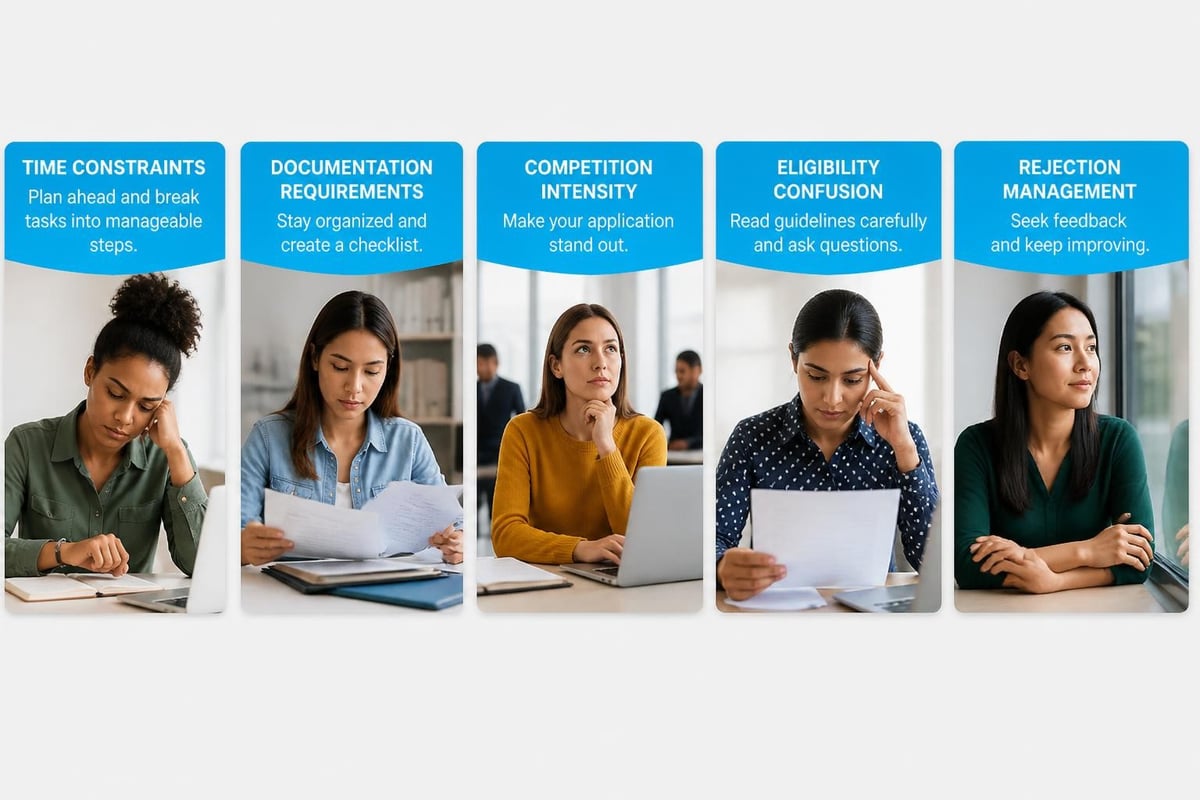
Time and Resource Constraints
Many female entrepreneurs operate businesses while managing other responsibilities, leaving limited time for complex grant applications. Quality applications require substantial time investment, creating difficult prioritization decisions.
Solutions include blocking dedicated application time well before deadlines, delegating certain business tasks to create capacity, and building reusable application components that adapt across multiple opportunities. Creating master documents containing standard information streamlines individual applications significantly.
Some entrepreneurs engage grant writers, though this involves additional costs. When budgets allow, professional assistance can improve application quality while freeing entrepreneurs for other critical activities. However, maintaining authentic voice and deep business knowledge involvement remains essential even when using outside help.
Documentation and Compliance Requirements
Grant programs typically demand extensive documentation proving eligibility, demonstrating business viability, and ensuring compliance with program requirements. Gathering these materials can feel overwhelming, particularly for newer businesses without established systems.
Maintaining organized digital files containing all potentially required documents eliminates last-minute scrambling. Standard documentation needs include:
- Business registration and licensing documents
- Tax returns and financial statements
- Proof of ownership and control
- Business plans and projections
- Certifications and credentials
- Letters of support or recommendation
Setting up proper business documentation systems serves purposes beyond grant applications, strengthening overall business operations and preparing for various funding opportunities.
Managing Rejection and Maintaining Persistence
Most grant applications result in rejection, simply due to the competitive nature and limited available funding. Female entrepreneurs must develop resilience and learn from unsuccessful applications rather than viewing them as personal failures.
Successful grant seekers maintain application pipelines, ensuring that rejection from one program doesn't derail overall funding strategies. They treat applications as learning experiences, continuously refining approaches based on feedback and outcomes.
Connecting with other female entrepreneurs pursuing grants provides emotional support and practical insights. Many communities, both online and local, facilitate these connections through business resources for women offering networking opportunities alongside funding information.
Building Long-Term Grant Success
Securing one grant represents just the beginning. Female entrepreneurs who successfully leverage womens business grants typically develop ongoing relationships with funders and systematically pursue multiple opportunities over time.
Stewardship and Reporting
Grant recipients carry obligations extending beyond simply receiving funds. Most programs require detailed reporting on how money was used and what outcomes resulted. Excellent stewardship builds reputations that facilitate future funding.
Meeting all reporting deadlines, providing thorough documentation, and communicating proactively about challenges demonstrates professionalism. Many grant programs prioritize previous recipients for additional funding rounds when stewardship records prove strong.
Consider reporting opportunities rather than burdens. Documenting grant-funded progress creates compelling content for marketing, future applications, and investor presentations. The discipline of tracking metrics and outcomes strengthens overall business management.
Creating Application Assets
Experienced grant seekers develop libraries of reusable content adaptable across applications. These assets include mission statements, founder biographies, business model descriptions, market analyses, and impact metrics.
While each application requires customization to specific program requirements, having polished base content significantly reduces preparation time. Update these materials regularly to reflect current business status and achievements.
Professional photography, video testimonials, and media coverage provide powerful supporting materials. Invest in creating these assets when budgets allow, as they enhance applications and serve multiple business purposes simultaneously.
Staying Informed About New Opportunities
The womens business grants landscape evolves continuously, with new programs launching and existing ones modifying requirements. Staying informed ensures you don't miss relevant opportunities and can plan applications strategically around deadlines.
Subscribe to newsletters from organizations supporting female entrepreneurs, follow relevant social media accounts, and join entrepreneurial communities where members share opportunities. Setting up Google alerts for terms like "womens business grants" helps capture announcements as they occur.
Resources such as comprehensive overviews of grants for women-owned businesses provide centralized information, though supplementing these with multiple sources ensures comprehensive coverage.
Womens business grants provide valuable capital for female entrepreneurs, though success requires strategic targeting, professional applications, and persistent effort. While grants offer important funding opportunities, maintaining a diversified approach to business financing ensures capital access when needed. Enterprise Finest Solutions helps business owners explore flexible funding alternatives tailored to their revenue, qualifications, and growth objectives, providing options that complement grant strategies and support business success.
Explore Topics
Written by
Enterprise Finest Solutions
Content creator and writer sharing insights and stories.