Business Enterprise Guide: Types, Traits and Examples
Learn what a business enterprise is, the main types and traits, and how owners fund growth with working capital, with clear examples throughout.

A business enterprise is an organization that produces goods or services with the aim of earning a profit, and the term covers everything from a one-person shop to a multinational corporation. In everyday use, "enterprise" can also describe a large company with significant revenue, staff and complexity, so context matters. For a small business owner, the practical question is which kind of business enterprise you run, how its structure affects liability and taxes, and how to fund it as it grows.
This guide explains the definition, the core traits, the common types, and the examples most owners will recognize. It also covers the skills that keep an enterprise moving and the steps to start one.
What does "business enterprise" mean?
The term "business enterprise" refers to any organized commercial activity that combines resources such as labor, capital and equipment to sell goods or services for profit. It is broader than the word "company," because it includes sole proprietors and partnerships as well as incorporated firms.
Two meanings are in common use:
- The general meaning: any profit-seeking organization, regardless of size or legal form.
- The size-based meaning: a large organization, often with hundreds or thousands of employees, multiple locations and complex operations. Software vendors and procurement teams usually use "enterprise" this way.
Most small business owners in the United States and Canada operate under the first meaning. A landscaping company, a restaurant, an e-commerce brand and a trucking firm are all examples of a business enterprise, even if none would be called an "enterprise company" in the corporate sense.
The scale of this sector is considerable. Small businesses make up the overwhelming majority of U.S. firms, which shows how much economic activity runs through small and midsize companies rather than only large corporations.
What are the key characteristics of a business enterprise?
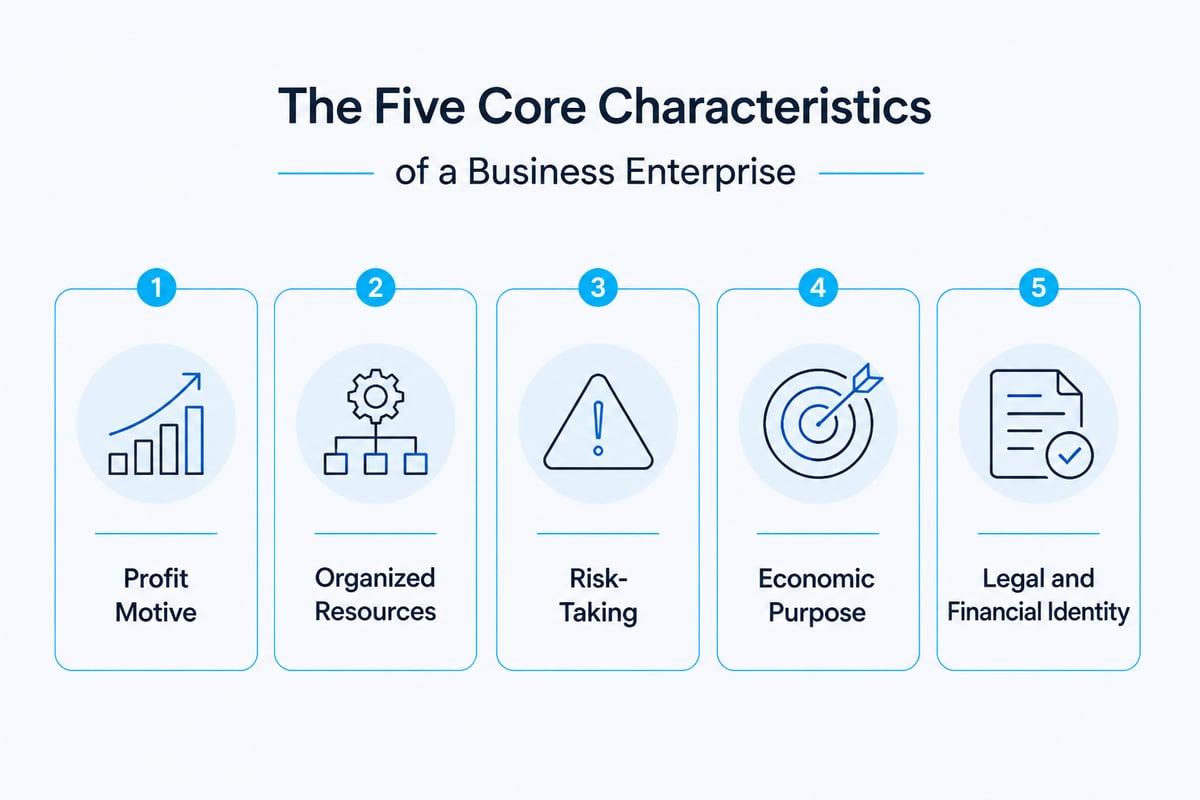
A business enterprise is defined by five characteristics: a profit motive, organized resources, risk-taking, an economic purpose, and a legal identity. Each trait is present whether the firm has two employees or twenty thousand.
- Profit motive. The organization exists to generate revenue that exceeds its costs. Nonprofits may run businesslike operations, but profit is not their reason for existing.
- Organized resources. Owners combine labor, capital, inventory, technology and premises into a repeatable process for delivering a product or service.
- Risk and uncertainty. Demand, costs and cash flow all fluctuate. Owners commit time and money before they know the outcome.
- Economic purpose. The enterprise meets a customer need, whether through manufacturing, retail, professional services or distribution.
- Legal and financial identity. The business has a defined structure, a tax status and, ideally, a dedicated business bank account that separates company finances from personal ones.
That last trait carries practical weight. Lenders and funding providers evaluate a business through its deposits, expenses and balances, so clean records matter. Learning to read a business bank statement the way an underwriter does is a useful habit for any owner.
What are the main types of business enterprise?
The main types of business enterprise are the sole proprietorship, partnership, limited liability company (LLC), C corporation and S corporation, plus specialized forms such as franchises and social enterprises. The legal structure you choose determines personal liability, tax treatment and how easily you can raise money.
The SBA's guidance on choosing a business structure lists these five common structures and notes that an S corporation can have no more than 100 owners. The table below summarizes how they differ.
| Structure | Ownership | Personal liability | Typical fit |
|---|---|---|---|
| Sole proprietorship | One owner | Owner is personally responsible for business debts | Freelancers, solo contractors, small retail |
| Partnership | Two or more owners | Partners share responsibility, depending on type | Professional practices, family businesses |
| LLC | One or more members | Generally limited to the business's assets | Service firms, restaurants, trades |
| C corporation | Unlimited shareholders | Generally limited to the business's assets | Firms seeking outside investors |
| S corporation | Up to 100 owners | Generally limited to the business's assets | Profitable small firms managing tax treatment |
Liability protection and tax treatment vary by state and province, so confirm details with an accountant or attorney before filing. The SBA's launch guide also walks through ownership, liability and tax basics for new owners.
Specialized enterprise models
Beyond the legal forms above, owners often describe their business by its model:
- Start-ups: young firms built for rapid growth, often seeking outside capital.
- Lifestyle businesses: enterprises designed around the owner's income and schedule rather than aggressive scale.
- Franchises: businesses operating under an established brand and system. Financing for these has its own considerations, covered in this guide to a loan for a franchise business.
- Social enterprises: businesses that pursue a social or environmental goal alongside revenue.
How do small businesses differ from large enterprises?
A small business typically has fewer employees, a single location and a simple ownership structure, while a large enterprise operates across multiple markets with layered management and complex systems. The differences show up in five areas.
- Headcount: Small firms may have a handful of staff. Large enterprises often employ thousands.
- Revenue and capital: Large enterprises generate substantial revenue and usually have access to bond markets, investors and bank credit lines.
- Structure: Large firms have departments, subsidiaries and formal governance. Small firms often rely on the owner for most decisions.
- Geographic reach: Enterprises often sell internationally and through several channels at once.
- Technology: Large organizations run integrated systems for finance, supply chain and customer data.
Size categories matter less than people assume, though. Small businesses carry real weight in local economies. According to the SBA Office of Advocacy's 2025 metropolitan area profiles, the New York–Newark–Jersey City area had 2.6 million small businesses employing 4.1 million people, the highest totals among U.S. metro areas, and small businesses accounted for 53.6% of employment in the Miami–Fort Lauderdale–West Palm Beach area.
What are examples of a business enterprise?
Examples of a business enterprise range from a single-location service company to a national manufacturer, and the category is defined by activity rather than size. A few realistic cases illustrate the range:
- A family-owned restaurant organized as an LLC, with 12 employees, steady card sales and seasonal swings in cash flow.
- An e-commerce brand selling through its own website and online marketplaces, buying inventory ahead of peak season.
- A trucking or logistics company with a small fleet, where fuel, maintenance and driver payroll create constant working capital needs.
- A medical or dental practice structured as a partnership or professional corporation, investing in equipment.
- A national retailer or manufacturer with locations in several states, thousands of employees and a corporate structure with shareholders.
The first four are what most owners reading this guide run. The last fits the size-based use of "enterprise." All five share the same core traits: a profit motive, organized resources and exposure to risk.

What are enterprise skills?
Enterprise skills are the abilities that let people spot opportunities, organize resources and carry ideas through to results. They apply to owners, managers and employees alike. The most useful set includes:
- Financial literacy: reading statements, forecasting cash flow and understanding the cost of capital.
- Problem-solving: responding quickly when a supplier fails, a client pays late or demand shifts.
- Communication and negotiation: dealing with customers, vendors, lenders and staff.
- Leadership and delegation: building a team that can run without constant owner input.
- Adaptability: adjusting products, pricing and operations as conditions change.
- Risk assessment: weighing the upside of a decision against what it could cost.
Financial skill deserves emphasis because cash flow decides whether many otherwise sound businesses survive. Practical approaches are collected in this guide on how to improve cash flow.
What is enterprise software?
Enterprise software is a category of business applications built to manage the core processes of an organization at scale, such as accounting, inventory, customer relationships, human resources and supply chain planning. Common examples include enterprise resource planning (ERP) systems, customer relationship management (CRM) platforms and payroll and workforce management tools.
Large organizations adopt these systems to connect departments around a single set of data. Small and midsize businesses increasingly use scaled-down versions, typically cloud-based and billed by subscription, to automate invoicing, track stock and report on performance. If your business is growing past what spreadsheets can handle, software is often the first operational investment, and it frequently needs working capital to implement.
How do you start a business enterprise?
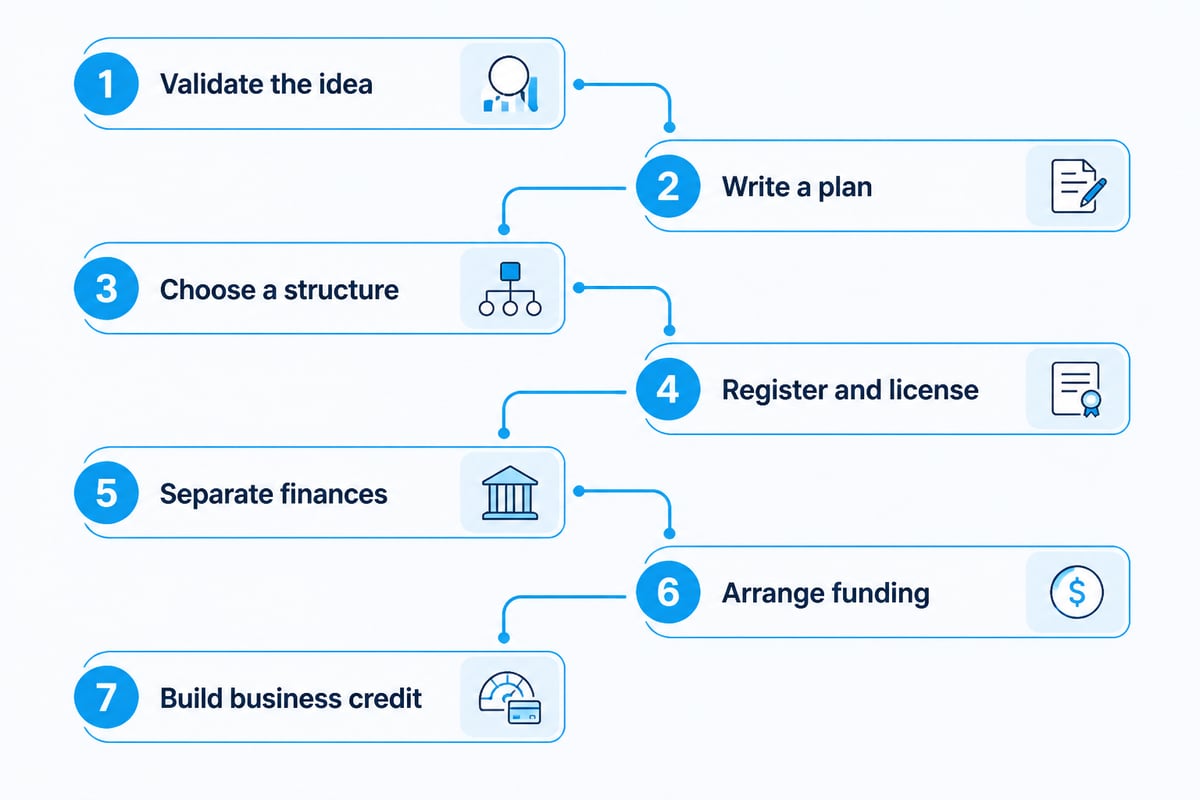
To start a business enterprise, validate demand, choose a legal structure, register the business, open a dedicated business bank account and secure funding. The order below works for most U.S. and Canadian owners.
- Validate the idea. Confirm that customers will pay for your product or service at a price that covers your costs.
- Write a plan. Outline your market, pricing, operating costs and revenue targets. It does not need to be long, but it should be specific.
- Choose a structure. Compare the options in the table above and consult an accountant or attorney.
- Register and license. File with your state or province, obtain an employer identification number or business number, and secure any local licenses.
- Separate your finances. Open a business bank account and route all revenue and expenses through it.
- Arrange funding. Decide how you will cover startup costs, inventory, payroll and the gaps between invoices and payments.
- Build a credit profile. Lenders look at business credit as well as personal credit, so it helps to understand your business credit score.
How do you fund a business enterprise as it grows?
Growing a business enterprise is typically funded through some mix of retained earnings, owner investment, traditional bank loans and alternative financing, with the right choice depending on how much time, revenue and operating history you have. Banks tend to favor established borrowers with strong credit and collateral, and approval can take weeks. Newer or fast-moving businesses often need something quicker.
Working capital financing is designed for the everyday costs of running and expanding a business, including inventory, payroll, equipment, marketing and renovations. Enterprise Finest Solutions works as a brokerage, connecting owners with a network of lenders and alternative funding providers. Funding amounts depend on business revenue, and qualifying merchants can apply with a short application and recent bank statements. Terms and approvals are subject to underwriting.
Fit depends on your numbers. Providers generally look for a business with a meaningful operating history, a dedicated business bank account and steady monthly revenue or card sales. If you meet those thresholds, it helps to prepare your loan application in advance and to know when to take on debt versus waiting. Owners who want to avoid giving up ownership can also review ways to grow without equity.
FAQ
Is a sole proprietorship a business enterprise?
Yes. A sole proprietorship is the simplest form of business enterprise, owned and run by one person with no legal separation between the owner and the business. The owner is personally responsible for its debts, which is why many owners later move to an LLC or corporation.
What is the difference between an enterprise and a company?
"Company" usually refers to a legally organized business entity, while "enterprise" is a broader term for any organized commercial venture, including unincorporated ones. In common business language, "enterprise" can also signal a large organization with significant scale and complexity.
Can a small business qualify for financing without perfect credit?
Often, yes. Many alternative funding providers weigh monthly revenue and bank activity more heavily than credit score alone. Underwriting varies by provider, so it helps to compare options before committing.
Your next step is to pull your last three to six months of business bank statements and confirm your monthly revenue, since that figure shapes nearly every funding option available to you. If your business has a track record and steady revenue, you can review Working Capital Financing to see how funding for inventory, payroll or expansion might work. Enterprise Finest Solutions matches each business with financing that fits its revenue, industry and capital needs, and you can apply now to start the process.
Written by
Enterprise Finest Solutions
Content creator and writer sharing insights and stories.