Loan for Franchise Business: Funding Your Franchise
Discover how to secure a loan for franchise business ownership. Learn about SBA loans, equipment financing, and flexible funding options in 2026.

Owning a franchise offers entrepreneurs the opportunity to operate under a proven business model with established brand recognition, training programs, and ongoing support. However, the upfront investment required to launch a franchise can be substantial, ranging from tens of thousands to millions of dollars depending on the brand and industry. Securing the right loan for franchise business ventures requires understanding the unique financing landscape, lender expectations, and the various capital sources available to prospective franchisees in 2026.
Understanding the Financial Requirements of Franchise Ownership
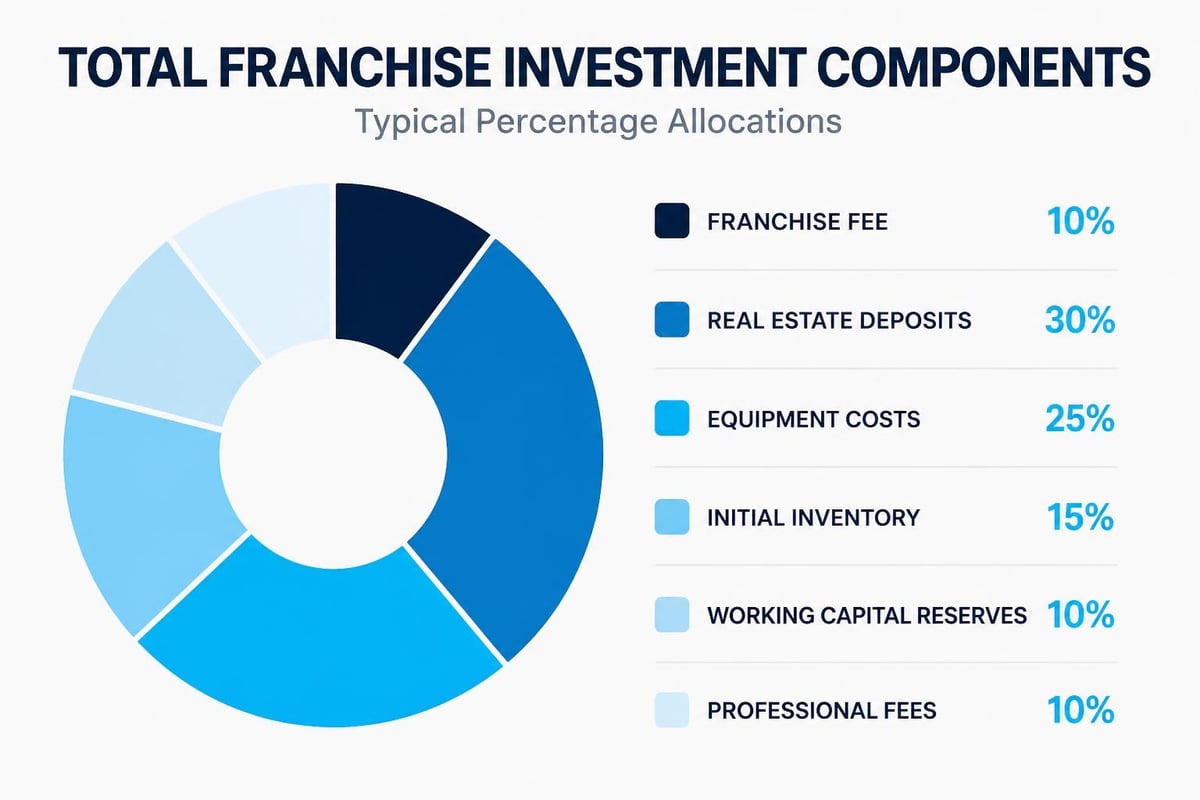
The total investment needed to open a franchise extends well beyond the initial franchise fee. Prospective franchise owners must account for real estate costs, equipment purchases, inventory, working capital, marketing expenses, and professional fees. Most franchisors provide a detailed Franchise Disclosure Document (FDD) that outlines Item 7, which specifies the estimated initial investment range.
Lenders typically require franchise buyers to demonstrate personal liquidity of 20-30% of the total project cost. This means if a franchise requires $300,000 in total investment, you'll likely need $60,000-$90,000 in cash or liquid assets. The remaining capital must come from financing sources.
Net Worth and Credit Requirements
Beyond liquidity, most franchise lenders evaluate:
- Minimum net worth thresholds (often 1.5-2x the total investment)
- Personal credit scores (usually 680 or higher for favorable terms)
- Business experience or transferable management skills
- Debt-to-income ratios to ensure repayment capacity
Financial institutions assess these factors because franchise loans carry different risk profiles than traditional small business loans. The established brand and proven systems reduce some operational risk, but franchisees still face local market conditions, execution challenges, and ongoing royalty obligations.
Primary Loan Options for Franchise Business Buyers
Multiple financing pathways exist for qualified franchise buyers, each with distinct advantages, requirements, and cost structures. Understanding these options helps prospective franchisees make informed decisions aligned with their financial situation and business goals.
SBA 7(a) Loans for Franchises
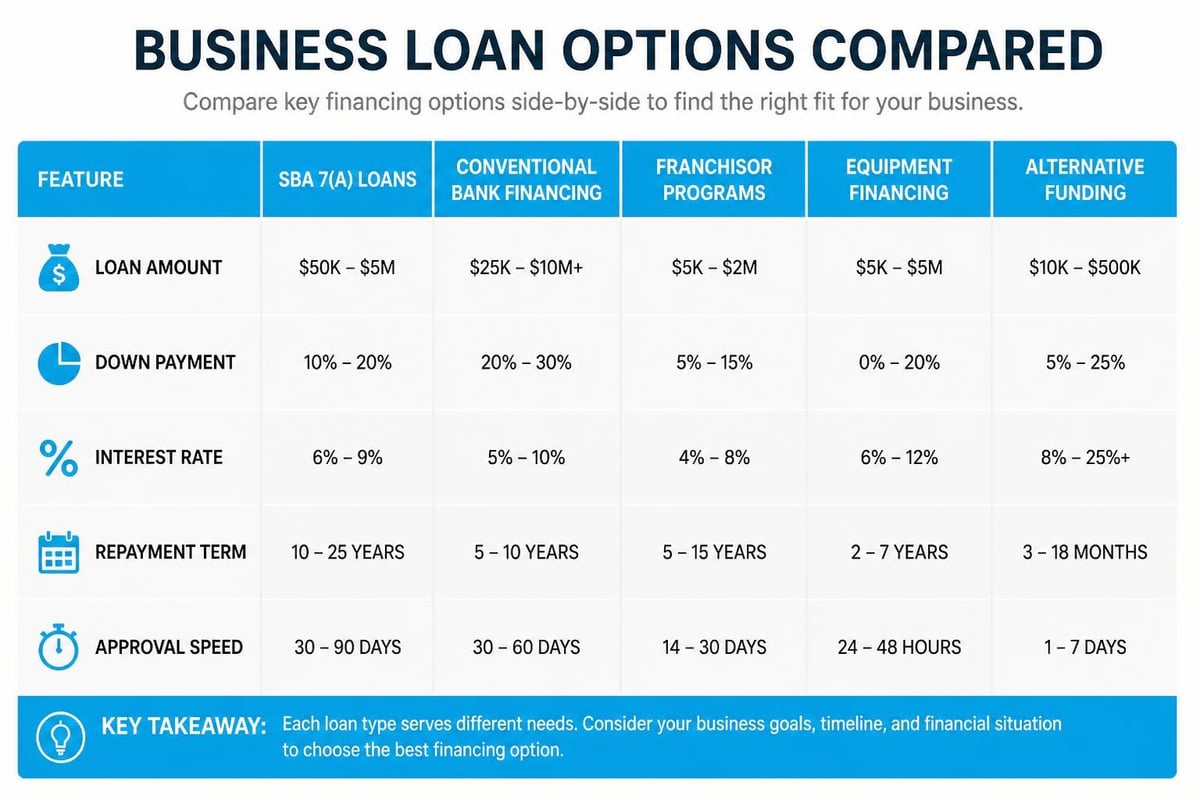
The Small Business Administration's 7(a) loan program represents one of the most popular financing vehicles for franchise purchases. These government-guaranteed loans reduce lender risk, enabling borrowers to access larger loan amounts with longer repayment terms than conventional financing.
Key features of SBA 7(a) franchise loans include:
- Loan amounts up to $5 million (guaranteed portion capped at $3.75 million)
- Repayment terms up to 10 years for working capital and equipment
- Terms up to 25 years for real estate purchases
- Down payments as low as 10% in some cases
- Competitive interest rates tied to prime rate plus a margin
The SBA maintains a Franchise Directory listing brands that have been reviewed and cleared for expedited loan processing. Franchises on this directory have agreements pre-approved by the SBA, streamlining the underwriting process significantly. However, franchises not listed can still qualify for SBA financing through additional review procedures.
Franchisor-Affiliated Financing Programs
Many established franchise systems have developed preferred lender relationships or in-house financing programs to help qualified candidates overcome capital barriers. Franchisor financing arrangements may include direct loans, deferred payment plans for franchise fees, or connections to lenders familiar with the brand's performance metrics.
| Franchisor Program Type | Typical Terms | Best For |
|---|---|---|
| Direct franchise fee financing | 12-36 months, higher rates | Candidates with strong credit, minimal liquid capital |
| Preferred lender networks | Competitive rates, streamlined approval | Buyers of established, proven franchises |
| Veterans programs | Reduced fees, favorable terms | Military veterans and spouses |
| Conversion financing | Customized structures | Independent operators joining franchise system |
These programs often move faster than traditional bank loans because the franchisor has confidence in their own business model and can vouch for the candidate's training and preparation.
Alternative Financing Solutions for Franchise Ventures
Not every franchise buyer fits the traditional lending profile, and some situations demand more flexible capital structures. Alternative financing options have expanded significantly, offering paths to franchise ownership for entrepreneurs who may not qualify for SBA or conventional bank loans.
Equipment Financing for Franchise Operations
Many franchise businesses require substantial equipment investments, whether restaurant kitchen systems, fitness equipment, automotive service tools, or retail point-of-sale technology. Equipment financing structures allow buyers to secure the loan with the equipment itself, often resulting in higher approval rates and competitive terms.
This approach can preserve working capital and SBA loan capacity for other startup costs. Businesses exploring equipment-heavy franchises should consider dedicated equipment financing as part of their overall capital stack rather than rolling all expenses into a single loan for franchise business needs.
Revenue-Based and Non-Traditional Financing
Established business owners adding a franchise location or converting an existing operation may benefit from revenue-based financing structures. These arrangements focus on business performance metrics rather than solely personal credit and collateral. While typically carrying higher costs than bank loans, they offer speed and flexibility for qualified borrowers with strong revenue histories.
Enterprise Finest Solutions helps businesses explore working capital financing options designed for operational needs, expansion projects, and strategic investments. These solutions may complement traditional franchise financing, particularly for working capital reserves, marketing campaigns, or bridge financing during the application process.
The Franchise Loan Application Process
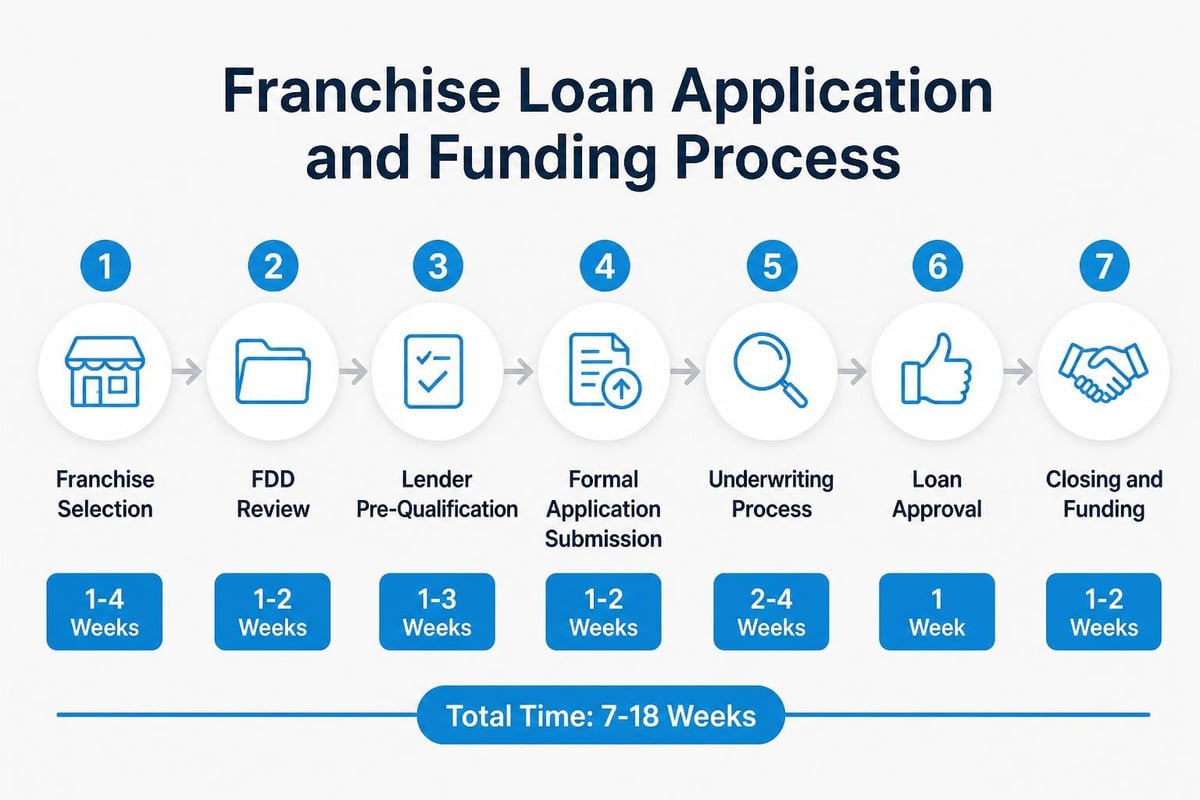
Securing a loan for franchise business ownership requires thorough preparation and documentation. The application process typically spans 60-120 days from initial submission to funding, though timelines vary based on lender type, loan program, and franchise complexity.
Essential Documentation Requirements
Lenders evaluate franchise loan applications based on comprehensive documentation:
- Personal financial statements showing assets, liabilities, and net worth
- Business plan specifically tailored to the franchise location and market
- Complete Franchise Disclosure Document (FDD) from the franchisor
- Franchise agreement draft or executed copy
- Personal and business tax returns (typically three years)
- Credit reports for all owners with 20% or greater ownership
- Lease or purchase agreements for the business location
- Proof of liquid assets and source of down payment funds
The business plan deserves particular attention. While the franchise model is proven, lenders want to see that you understand your local market dynamics, competitive landscape, site selection rationale, and realistic financial projections based on franchise performance representations.
Underwriting Considerations Unique to Franchises
Banks and SBA lenders evaluate franchise applications differently than independent startups. According to the FDIC's small business lending research, financial institutions consider franchise Item 19 earnings claims, brand recognition, franchise support systems, and territory exclusivity when assessing risk.
Underwriters specifically examine:
- Franchise failure rates and litigation history
- Territory saturation and cannibalization risk
- Franchisor financial stability and support quality
- Item 19 financial performance representations
- Your franchise-specific experience or training completion
- Lease terms and location demographics
Strong franchises with transparent Item 19 data and low litigation histories receive more favorable underwriting treatment and may qualify for higher loan-to-value ratios.
Maximizing Approval Odds and Securing Favorable Terms
The difference between loan approval and rejection, or between competitive and expensive terms, often comes down to preparation, presentation, and strategic positioning. Franchise buyers can significantly improve their financing outcomes through deliberate pre-application steps.
Building a Compelling Franchise Loan Package
Start by strengthening your borrower profile well before applying:
- Improve personal credit scores by paying down revolving debt and resolving any negative items
- Increase liquid reserves through savings or liquidating non-essential assets
- Document relevant business experience, even if outside the franchise industry
- Complete franchisor discovery day and training prerequisites to demonstrate commitment
- Secure strong site location with favorable lease terms before loan submission
Working with an experienced franchise consultant or accountant helps you present financial projections that align with lender expectations while remaining realistic. Federal Reserve research on small business credit consistently shows that applicant preparedness and documentation quality directly impact approval rates.
Understanding Regulatory Protections and Lender Obligations
The Consumer Financial Protection Bureau oversees small-business lending practices to ensure fair access to capital and protection against discrimination. Lenders must comply with the Equal Credit Opportunity Act (ECOA), which prohibits discrimination based on protected characteristics.
As a franchise loan applicant, you have the right to:
- Receive a timely decision on your application
- Obtain an explanation if denied credit
- Access your credit reports used in the decision
- Challenge inaccurate information in your credit file
- Freedom from discrimination based on race, religion, national origin, sex, marital status, age, or receipt of public assistance
Understanding these protections empowers borrowers to recognize unfair treatment and advocate for transparent, equitable lending practices.
Cost of Capital and Total Financing Expenses
The advertised interest rate on a loan for franchise business funding represents only one component of the true cost of capital. Sophisticated borrowers evaluate the all-in expense of financing, including fees, points, prepayment penalties, and opportunity costs.
Interest Rates and Fee Structures in 2026
Current market conditions in 2026 show SBA 7(a) loan rates typically ranging from prime plus 2.25% to prime plus 4.75%, depending on loan size and repayment term. Conventional bank loans for strong franchise concepts may price slightly lower but require larger down payments and shorter amortizations.
| Financing Type | Typical Rate Range | Origination Fees | Closing Costs |
|---|---|---|---|
| SBA 7(a) | Prime + 2.25-4.75% | 0-3% | $3,000-$8,000 |
| Conventional Bank | 7.5-10.5% | 0-2% | $2,000-$5,000 |
| Franchisor Direct | 8-15% | 0-5% | Varies widely |
| Equipment Financing | 6-12% | 0-2% | $500-$2,000 |
SBA loans carry a guarantee fee paid to the SBA based on loan amount and term, typically 2-3.75% of the guaranteed portion. While this increases upfront costs, the longer terms and lower down payments often justify the expense through improved cash flow.
Calculating True Return on Investment
Beyond monthly payments, franchise buyers must evaluate whether the projected returns justify the capital cost. Factor in ongoing royalty payments (typically 4-8% of gross revenue), marketing fund contributions (1-3% of revenue), and local advertising requirements when modeling cash flow.
The U.S. Chamber of Commerce guidance on franchise ownership emphasizes understanding your break-even timeline and ensuring sufficient working capital reserves to survive the ramp-up period. Most franchises take 12-24 months to reach sustainable profitability.
Strategic Considerations Before Committing to Franchise Financing
The decision to pursue a loan for franchise business ownership carries long-term implications beyond the immediate funding transaction. Prospective franchisees should conduct thorough due diligence on both the franchise opportunity and the financing structure before signing agreements.
Evaluating the Franchise Opportunity Itself
No amount of favorable financing can rescue a poor franchise choice. Critical evaluation factors include:
- Franchisor financial stability and litigation history in the FDD
- Franchise Item 19 earnings claims and what percentage of units achieve them
- Territory viability based on demographic analysis and competitive density
- Exit strategy and resale market for franchise units
- Operational demands and your personal fit with the business model
Speaking with existing franchisees, particularly those in similar markets, provides invaluable insights beyond what the FDD discloses. Research on the franchisee experience reveals that misaligned expectations about work-life balance, income potential, and operational control represent common sources of franchisee dissatisfaction.
Matching Loan Structure to Business Performance Characteristics
Different franchise models generate revenue on different cycles and with varying margins. A seasonal business like tax preparation requires different financing than a year-round quick-service restaurant. Structure your loan repayment schedule to align with anticipated cash flow patterns.
Consider negotiating seasonal payment adjustments, interest-only periods during startup, or graduated payment structures that increase as revenue stabilizes. Sophisticated lenders understand that rigid payment schedules can stress new franchises during critical early months.
Multi-Unit Franchise Expansion Financing
Successful franchisees often expand to multiple units, and financing strategies shift considerably for growth-stage franchise operators. Multi-unit loans benefit from operational history, proven execution capability, and existing cash flow from established locations.
Leveraging Existing Performance for Better Terms
Second and subsequent location financing typically receives:
- Lower down payment requirements (15% vs. 20-25% for first units)
- Higher loan-to-value ratios based on demonstrated success
- Streamlined underwriting focused on existing unit performance
- Access to portfolio lending structures across multiple properties
- More favorable pricing due to reduced risk profile
Franchisors often provide development incentives for multi-unit operators, including reduced franchise fees, accelerated territory rights, or enhanced support during build-out phases. These incentives should factor into your expansion financing calculations.
Portfolio Considerations and Cross-Collateralization
Lenders may require cross-collateralization across franchise locations, meaning all units secure all loans. While this increases borrowing capacity, it also creates risk concentration. A struggling location could trigger default provisions affecting your entire portfolio.
Structure expansion financing to maintain flexibility and avoid over-leveraging. Conservative franchise operators target debt service coverage ratios of 1.35-1.50x across their portfolio, ensuring adequate cushion for market fluctuations or temporary performance dips.
Working with Financing Partners and Brokers
Navigating the complex landscape of franchise financing options often benefits from professional guidance. Business financing brokers, franchise consultants, and commercial loan advisors can accelerate the process and improve terms by matching borrowers with appropriate lenders.
The Value of Specialized Franchise Financing Expertise
Generic business lenders may not understand franchise-specific dynamics, leading to longer underwriting timelines or inappropriate term structures. Specialists in franchise lending bring relationships with lenders who actively seek franchise deals and understand how to present applications for maximum approval probability.
Professional financing assistance typically provides:
- Access to multiple lender programs through a single application
- Expertise in SBA procedures and documentation requirements
- Negotiation leverage for better terms and lower costs
- Industry knowledge about which franchises receive favorable treatment
- Time savings through streamlined application coordination
Reputable brokers earn compensation from lenders upon successful funding, not from upfront fees charged to borrowers. Verify credentials, ask for references from funded clients, and ensure transparency about compensation structures before engaging assistance.
Questions to Ask Potential Financing Partners
Before selecting a broker or lender relationship, evaluate their franchise financing experience:
- How many franchise loans have you facilitated in the past 12 months?
- Do you have existing relationships with lenders who know my franchise brand?
- What is your typical timeline from application to funding?
- What upfront fees do you charge, and what are they for?
- Can you provide references from franchisees you've helped finance?
- Do you assist with business plan development and financial projections?
Quality financing partners educate clients throughout the process, set realistic expectations about approval probability and timeline, and maintain communication transparency. They should function as advisors helping you make informed decisions rather than salespeople pushing any available loan product.
Securing the right loan for franchise business ownership requires understanding your financing options, preparing comprehensive documentation, and aligning capital structure with your franchise model and growth objectives. Enterprise Finest Solutions connects business owners with a network of lenders and funding partners who specialize in growth capital, operational financing, and strategic business investments. Whether you're launching your first franchise or expanding an existing portfolio, Enterprise Finest Solutions can help you explore financing solutions tailored to your revenue profile, business performance, and capital requirements.
Written by
Enterprise Finest Solutions
Content creator and writer sharing insights and stories.