Working Capital Funding: A Complete Guide for 2026
Discover how working capital funding helps businesses manage cash flow, cover operating expenses, and fuel growth with flexible financing solutions.

Every business faces the fundamental challenge of managing the gap between when cash goes out and when it comes back in. Whether you're paying suppliers before customers settle their invoices, stocking inventory ahead of seasonal demand, or covering payroll during a slower month, the need for available capital to bridge these gaps is constant. Working capital funding exists to solve this precise challenge, providing businesses with the liquidity needed to maintain operations, seize opportunities, and navigate the natural ebbs and flows of commerce.
Understanding Working Capital and Why It Matters
Working capital represents the difference between your current assets and current liabilities. In practical terms, it's the cash and resources available to fund your day-to-day operations. When you have positive working capital, your business can pay bills on time, purchase inventory, meet payroll, and respond to unexpected opportunities or challenges.
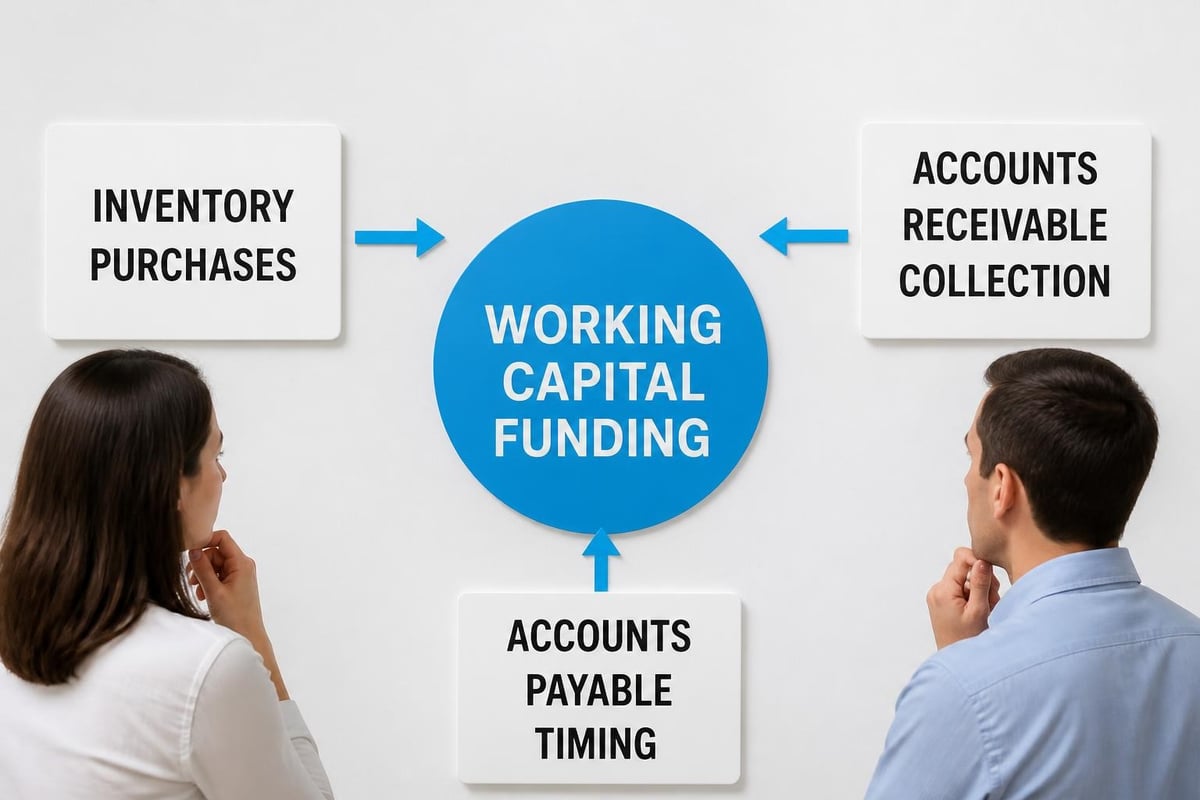
The working capital cycle determines how quickly you convert resources into cash. A company that collects receivables quickly, manages inventory efficiently, and negotiates favorable payment terms with suppliers will typically need less external financing. However, most businesses experience periods when this cycle stretches beyond their available cash reserves.
Common Situations Requiring Working Capital Funding
Businesses across industries encounter scenarios that strain their available capital:
- Seasonal fluctuations that require inventory buildup months before peak revenue arrives
- Rapid growth that outpaces organic cash generation
- Extended payment terms from large customers that create cash-flow gaps
- Unexpected expenses such as equipment repairs, emergency renovations, or regulatory compliance costs
- Opportunity costs when lucrative contracts or bulk-purchase discounts require immediate capital
According to data from the Federal Reserve, small businesses continue to cite access to credit and cash-flow management as critical concerns, particularly during periods of economic uncertainty or rising interest rates.
Types of Working Capital Funding Solutions
The financing landscape offers multiple pathways for businesses seeking capital to support operations. Each option comes with distinct characteristics, approval requirements, and cost structures.
Traditional Bank Financing
Banks remain a primary source of working capital through term loans and revolving credit facilities. These products typically offer:
- Lower interest rates compared to alternative financing
- Longer repayment periods
- Established regulatory frameworks
- Strong borrower protections
However, traditional bank financing often requires extensive documentation, strong credit profiles, collateral, and longer approval timelines. The SBA 7(a) loan program provides government guarantees that help qualifying small businesses access bank financing with more flexible terms.
Business Lines of Credit
A business line of credit functions similarly to a credit card, providing access to a predetermined amount of capital that can be drawn as needed. Businesses pay interest only on the amount actually used, making this an efficient tool for managing variable cash-flow needs.
Key advantages include:
- Flexibility to draw funds only when needed
- Revolving access that replenishes as balances are repaid
- Lower costs during periods when no capital is drawn
- Quick access for time-sensitive opportunities
Lines of credit work particularly well for businesses with predictable revenue patterns and seasonal fluctuations, allowing them to smooth cash flow without maintaining large cash reserves.
Revenue-Based Financing and Merchant Cash Advances
For businesses with strong revenue but limited credit history or collateral, revenue-based financing products offer an alternative path to working capital. These solutions evaluate approval based primarily on business performance rather than traditional credit metrics.
Repayment typically occurs through a percentage of daily or weekly sales, creating a natural alignment between payment obligations and business performance. During slower periods, payments automatically decrease, reducing strain on cash flow.
Invoice Financing and Factoring
Companies with outstanding invoices from creditworthy customers can unlock capital through invoice financing or factoring. Rather than waiting 30, 60, or 90 days for customer payment, businesses receive an advance-often 70-90% of invoice value-within days.
| Financing Type | Speed | Typical Cost | Best For |
|---|---|---|---|
| Bank Term Loan | 2-8 weeks | 6-12% APR | Established businesses, strong credit |
| Business Line of Credit | 1-3 weeks | 10-25% APR | Seasonal needs, variable expenses |
| Revenue-Based Financing | 1-5 days | Factor rate 1.2-1.5x | High-volume businesses, quick needs |
| Invoice Factoring | 1-3 days | 1-5% per month | B2B companies with creditworthy clients |
Strategic Benefits of Working Capital Funding
Beyond simply covering expenses, strategic use of working capital funding can transform business operations and competitive positioning.
Enabling Growth Without Dilution
Equity financing requires giving up ownership stakes in your company. Working capital funding allows business owners to maintain complete control while accessing the resources needed for expansion. Whether opening new locations, launching product lines, or entering new markets, debt-based working capital preserves founder equity.
Negotiating Power with Suppliers
Cash in hand provides leverage. Businesses with available working capital can negotiate early-payment discounts with suppliers-often 2-3% for payment within 10 days rather than net-30 terms. Research from PwC demonstrates that optimizing payment terms can unlock significant value trapped in working capital cycles.
On a $500,000 annual purchase volume, capturing 2% early-payment discounts generates $10,000 in savings-often more than the cost of short-term financing.

Seizing Time-Sensitive Opportunities
Markets reward speed. When a competitor closes and their customers need a new supplier, when a landlord offers a prime location at below-market rates, or when a supplier offers closeout inventory at deep discounts, businesses with available capital can act immediately.
The opportunity cost of unavailable capital often far exceeds the cost of financing. A $50,000 investment in discounted inventory that generates $80,000 in revenue produces a return that dwarfs typical financing costs.
Evaluating Your Working Capital Needs
Accurate assessment of capital requirements prevents both under-capitalization and excessive debt. Several analytical approaches help businesses determine appropriate funding levels.
The Cash Conversion Cycle
Calculate how many days elapse between spending cash on operations and collecting cash from sales:
Cash Conversion Cycle = Days Inventory Outstanding + Days Sales Outstanding - Days Payable Outstanding
A longer cycle indicates greater working capital needs. A company with a 60-day cash conversion cycle requires enough capital to fund two months of operations while waiting for revenue to materialize.
Stress Testing and Scenario Planning
Conservative businesses prepare for multiple scenarios. What happens if a major customer extends payment terms? If a supplier demands faster payment? If seasonal demand exceeds projections by 20%?
Strategic frameworks from Deloitte emphasize that working capital strategy should integrate with broader value-creation initiatives, not simply respond to short-term cash crunches.
Industry Benchmarking
Working capital requirements vary dramatically by industry. Retail businesses carrying significant inventory need more working capital than service businesses with minimal inventory and quick receivables collection. Manufacturing companies with long production cycles face different challenges than restaurants with daily cash transactions.
Comparing your metrics to industry benchmarks reveals whether your working capital position is appropriate or whether operational improvements could reduce financing needs. KPMG's working capital research provides valuable sector-specific insights for benchmarking purposes.
Best Practices for Managing Working Capital Funding
Securing financing represents only the first step. Effective management ensures capital deployment generates maximum value while minimizing costs and risks.
Match Funding Duration to Use Case
Short-term needs deserve short-term financing. Using a five-year term loan to cover a three-month seasonal inventory buildup saddles your business with years of unnecessary interest payments. Conversely, funding long-term growth initiatives with expensive short-term capital creates repayment pressure that can destabilize operations.
Appropriate matching:
- Seasonal inventory → Short-term line of credit or revenue-based financing
- Permanent working capital increase → Term loan or equity
- Bridge financing during rapid growth → Medium-term loan or credit facility
- Emergency repairs or unexpected costs → Line of credit or short-term loan
Maintain Multiple Funding Relationships
Reliance on a single capital source creates vulnerability. Banks change lending criteria, credit lines get reduced, and individual lenders may not offer competitive terms for every use case. Building relationships with multiple funding partners-traditional banks, alternative lenders, and specialized finance companies-provides options and negotiating leverage.
Monitor Key Performance Indicators
Regular tracking of working capital metrics enables proactive management:
- Current ratio (current assets ÷ current liabilities)
- Quick ratio (liquid assets ÷ current liabilities)
- Working capital turnover (revenue ÷ average working capital)
- Cash conversion cycle days
Deteriorating metrics signal the need for operational improvements or additional capital before crisis hits.
Common Mistakes to Avoid
Even experienced business owners make errors that compromise their working capital position or increase financing costs unnecessarily.
Underestimating Capital Requirements
Securing 80% of needed capital creates the same problems as securing none-you still can't complete your initiative. Build safety margins into projections. A 15-20% cushion above calculated requirements protects against unexpected complications.
Ignoring the Total Cost of Capital
Interest rates tell only part of the story. Factor fees, early-payment penalties, personal guarantee requirements, collateral pledges, and operational complexity all contribute to the true cost of financing. A loan with a 12% interest rate but no fees may cost less than an 11% loan with significant origination and maintenance fees.
Neglecting Operational Improvements
As Harvard Business Review research on sustainable growth emphasizes, financing cannot permanently solve problems created by operational inefficiencies. If slow collections, excess inventory, or poor supplier terms strain working capital, address root causes while using financing to bridge temporary gaps.

Over-Leveraging During Favorable Conditions
When revenue is strong and lenders are eager, the temptation to maximize borrowing can prove irresistible. However, economic conditions change, and businesses burdened with excessive debt during downturns face severe pressure. Maintain conservative leverage ratios that allow you to weather unexpected challenges.
Working Capital Funding in Different Business Contexts
The optimal approach to working capital funding varies based on business model, industry dynamics, and growth stage.
Service-Based Businesses
Professional services, consulting firms, and other service providers typically carry minimal inventory but may face significant receivables. Working capital needs concentrate on covering payroll and overhead during the gap between project completion and client payment.
Invoice financing and lines of credit aligned with billing cycles often provide the most efficient solutions.
Retail and E-Commerce
Inventory represents the dominant working capital requirement for retailers. Seasonal businesses may need to purchase 60-80% of annual inventory during a concentrated period months before peak selling season.
Inventory-specific financing, purchase-order financing, and flexible credit facilities that expand during buying seasons and contract during selling seasons match the natural rhythm of retail operations.
Manufacturing and Distribution
Long production cycles and complex supply chains create working capital challenges. Manufacturers often pay for raw materials months before finished goods generate revenue. Distribution businesses must maintain inventory across multiple locations while managing collections from diverse customer bases.
Asset-based lending secured by inventory and receivables, along with supply-chain finance programs, can provide substantial working capital at competitive rates.
High-Growth Technology and Startups
Venture-backed companies and rapidly scaling businesses face unique working capital dynamics. Growth often outpaces profitability, and traditional lenders may hesitate to extend credit to pre-profitable companies despite strong revenue trajectories.
Revenue-based financing, venture debt, and specialized growth-capital providers fill this gap, offering financing structures aligned with high-growth business models.
Preparing to Secure Working Capital Funding
Strong preparation increases approval likelihood, speeds the funding process, and often results in better terms.
Documentation Requirements
While requirements vary by lender and product, expect to provide:
- Financial statements (profit and loss, balance sheet, cash-flow statement)
- Tax returns (business and sometimes personal)
- Bank statements demonstrating revenue patterns and cash management
- Accounts receivable and payable aging reports
- Business plan or use-of-funds statement
- Credit reports (business and personal)
Organizations with clean, current financial records and well-organized documentation move through underwriting faster and present lower perceived risk.
Strengthening Your Application
Several factors improve approval odds and pricing:
- Revenue consistency and growth trajectory
- Time in business (typically 6-12+ months minimum)
- Strong credit profile (business and personal)
- Positive cash flow and profitability trends
- Clear use of funds with credible ROI projections
Addressing weaknesses before applying-resolving credit issues, improving financial record-keeping, or demonstrating revenue stability-pays dividends through better terms and higher approval rates.
Working with Financing Brokers and Advisors
Navigating the complex landscape of working capital funding options requires expertise many business owners lack. Specialized brokers maintain relationships with multiple lenders, understand which funding sources best match specific business profiles, and can expedite the application process.
For businesses exploring working capital financing options, partnering with experienced advisors can save time, increase approval likelihood, and surface options that independent research might miss.
Regulatory and Compliance Considerations
The working capital funding marketplace operates under federal and state regulations designed to protect borrowers and ensure market integrity.
Truth in Lending and Disclosure Requirements
Lenders must disclose terms, costs, and conditions in standardized formats that allow comparison. Review all disclosures carefully, understand the annual percentage rate (APR) or effective cost of capital, and clarify any terms that seem unclear.
State Licensing and Usury Laws
Maximum allowable interest rates and licensing requirements vary by state. While most commercial lending falls outside consumer protection laws, some states impose caps or disclosure requirements on business financing. Ensure your lender operates legally in your jurisdiction.
Personal Guarantees and Collateral
Many working capital funding arrangements require personal guarantees from business owners, making them personally liable if the business cannot repay. Understand exactly what you're pledging-real estate, equipment, inventory, receivables-and the conditions under which lenders can seize collateral.
Negotiate limited guarantees when possible, capping personal exposure at specific amounts or releasing guarantees after meeting performance milestones.
The Future of Working Capital Funding
Technology, data analytics, and alternative financing models continue reshaping how businesses access working capital.
Embedded Finance and Real-Time Capital
Increasing integration between accounting platforms, payment processors, and funding providers enables near-instantaneous credit decisions based on real-time business data. Rather than submitting applications and waiting days or weeks, businesses increasingly access capital through platforms they already use for accounting, payments, or inventory management.
AI-Powered Underwriting
Machine learning algorithms analyze patterns in cash flow, revenue seasonality, customer payment behavior, and industry trends to assess creditworthiness more accurately than traditional methods. This expands access for businesses with strong operational performance but limited credit history.
Supply-Chain Finance Integration
Sophisticated programs from the International Finance Corporation and major financial institutions now connect buyers, suppliers, and financiers in integrated platforms. Suppliers receive faster payment while buyers extend terms, with specialized lenders providing the capital that makes the arrangement work.
Optimizing Return on Working Capital Investment
Simply securing funding accomplishes little unless capital deployment generates returns that justify costs.
Tracking Performance Metrics
Measure outcomes against projections:
| Metric | Target | Actual | Variance |
|---|---|---|---|
| Revenue increase from funded initiative | +$100,000 | $92,000 | -8% |
| Gross margin on funded inventory | 45% | 48% | +3% |
| Customer acquisition cost with marketing spend | $150 | $142 | -5% |
| Time to profitability | 6 months | 7 months | +17% |
Regular performance tracking reveals whether capital is generating expected returns or whether adjustments are needed.
Continuous Improvement Cycles
Working capital management isn't a one-time project. Market conditions change, business models evolve, and new opportunities emerge. Quarterly reviews of working capital metrics, financing arrangements, and operational efficiency maintain optimization over time.
The most successful businesses treat working capital as a strategic asset deserving ongoing attention, not an administrative burden to address only during crisis.
Working capital funding provides the essential liquidity that allows businesses to operate smoothly, capitalize on opportunities, and navigate challenges without compromising growth or stability. By understanding your specific needs, evaluating options strategically, and managing capital efficiently, you position your business for sustainable success. Enterprise Finest Solutions connects business owners with tailored funding solutions that align with their revenue, performance, and capital requirements, helping you identify and secure the working capital financing your business needs to thrive.
Written by
Enterprise Finest Solutions
Content creator and writer sharing insights and stories.