Shopify Loan: Eligibility, Alternatives & Funding Guide
Explore Shopify loan options, repayment terms, eligibility requirements, and alternative funding solutions for e-commerce businesses in 2026.

E-commerce merchants running Shopify stores often need capital to scale inventory, expand marketing campaigns, or invest in new product lines. A shopify loan provides one pathway to access funding, but understanding how these products work, who qualifies, and what alternatives exist is essential before accepting any offer. In 2026, business owners face a dynamic financing landscape with multiple options beyond platform-specific lending. This guide examines Shopify's lending products, compares them to broader market solutions, and explains how merchants can evaluate the best funding strategy for their unique business needs.
What Is a Shopify Loan?
When merchants refer to a "shopify loan," they typically mean Shopify Capital, the platform's embedded financing program. Shopify Capital offers two primary products: merchant cash advances and installment loans. Both are invitation-only, meaning Shopify reviews merchant account performance and extends offers directly within the admin dashboard.
Merchant Cash Advance vs. Installment Loan
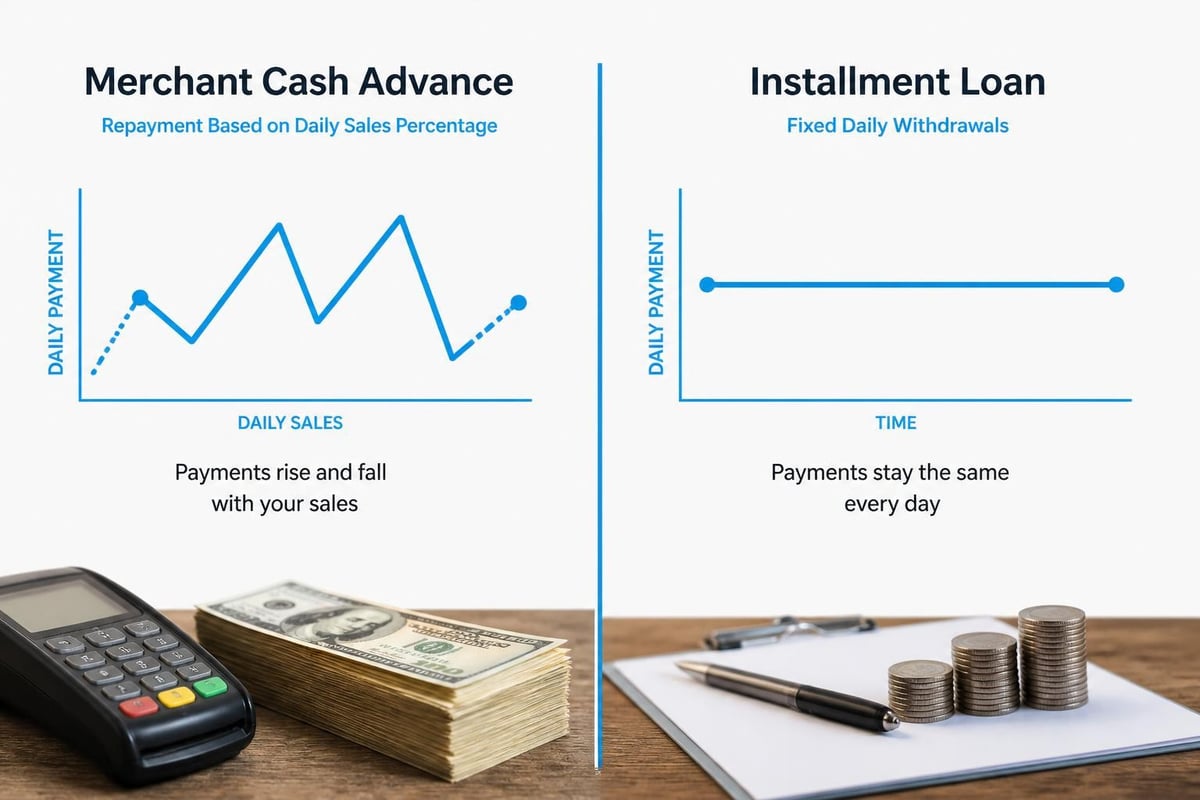
Shopify's merchant cash advance product provides a lump sum of capital in exchange for a percentage of future daily sales. Repayment occurs automatically through a fixed percentage deducted from each day's revenue until the advance plus a fee is repaid in full. This structure means repayment speed fluctuates with sales volume.
The installment loan option works differently. Merchants receive funds upfront and repay through fixed daily or weekly withdrawals from their Shopify sales, regardless of revenue fluctuations. The total repayment amount and schedule are predetermined, offering more predictability than the cash advance model.
Key differences include:
- Cash Advance: Repayment tied directly to sales volume; slower sales mean slower repayment
- Installment Loan: Fixed repayment schedule; same amount withdrawn regardless of sales performance
- Fee Structure: Both include a fixed fee rather than interest; expressed as total repayment amount
- Flexibility: Cash advances adjust to business cycles; loans maintain consistent withdrawal schedules
Eligibility Requirements for Shopify Financing
Shopify does not publicly disclose exact eligibility criteria, but patterns emerge from merchant experiences. The platform evaluates account history, sales volume, processing history, and overall business health before extending offers. Most recipients have operated their Shopify store for at least several months with consistent monthly revenue.
Factors That Influence Approval
| Eligibility Factor | Why It Matters | Typical Threshold |
|---|---|---|
| Account Age | Demonstrates stability and track record | 6-12+ months active |
| Monthly Sales Volume | Indicates repayment capacity | $5,000+ per month |
| Processing History | Shows consistent revenue through Shopify Payments | Regular transaction history |
| Previous Capital Performance | Successful repayment of prior advances improves offers | On-time completion |
| Order Fulfillment | Low chargeback and dispute rates signal healthy operations | Industry-standard metrics |
Merchants who process payments outside Shopify Payments or operate primarily on external platforms typically do not receive offers. The program relies heavily on internal transaction data to assess risk and repayment ability.
Geographic and Business Type Restrictions
Shopify Capital availability varies by region. As of 2026, the program operates primarily in the United States, Canada, and the United Kingdom, with periodic expansion to select additional markets. Certain business categories, particularly those with high chargeback rates or regulatory complexity, may face limited access regardless of sales performance.
How Shopify Loan Repayment Works
Understanding the mechanics of repayment helps merchants evaluate whether a shopify loan aligns with their cash-flow patterns. Both product types deduct funds automatically from Shopify Payments transactions, eliminating manual payment requirements but also reducing immediate working capital from each sale.
Daily Remittance Percentage
For merchant cash advances, Shopify sets a remittance percentage based on the advance amount and merchant profile. Common remittance rates range from 10% to 20% of daily sales. If a merchant has $1,000 in sales on a given day with a 15% remittance rate, Shopify withholds $150 toward the advance balance, depositing the remaining $850.
Repayment timeline varies significantly:
- High-volume periods: Faster repayment during peak seasons or successful campaigns
- Slow periods: Extended repayment during off-seasons or sales slumps
- No fixed deadline: Cash advances have minimum repayment requirements but no final due date
- Prepayment allowed: Merchants can make lump-sum payments to close the advance early
Impact on Cash Flow
The automatic deduction model creates predictable mechanics but requires careful cash-flow planning. Merchants must ensure remaining funds after repayment cover operating expenses, inventory restocking, and vendor payments. For businesses with tight margins or irregular sales patterns, the percentage-based model can strain liquidity.
Comparing Costs: Shopify Loan vs. Traditional Financing
Shopify Capital products use fee-based pricing rather than interest rates, making direct cost comparison challenging. The fee is typically expressed as a factor rate applied to the advance amount. For example, a $10,000 advance with a 1.15 factor rate requires total repayment of $11,500, representing a $1,500 fee.
Calculating the True Cost
| Financing Type | Typical Cost Range | Repayment Term | Effective APR* |
|---|---|---|---|
| Shopify Merchant Cash Advance | 1.10–1.30 factor rate | 3–18 months (variable) | 15%–50%+ |
| Shopify Installment Loan | 1.05–1.20 factor rate | 3–12 months (fixed) | 10%–40%+ |
| Traditional Bank Term Loan | 6%–12% APR | 1–5 years | 6%–12% |
| SBA Loan | 6%–9% APR | 5–25 years | 6%–9% |
*Effective APR varies significantly based on repayment speed and actual term length
The Consumer Financial Protection Bureau has increased scrutiny of merchant cash advances, requiring clearer disclosure of costs and terms. While Shopify provides transparent fee structures, merchants should calculate the annualized cost based on expected repayment timeline.

Alternatives to Shopify Loan Products
While Shopify Capital offers convenience and integration, e-commerce merchants have numerous financing alternatives worth evaluating. Comparing multiple options ensures access to the most cost-effective and flexible capital for specific business needs.
Revenue-Based Financing from External Providers
Third-party lenders offer revenue-based financing similar to Shopify's cash advance model but with different qualification criteria and pricing. These providers often accept merchants from multiple platforms and may offer larger funding amounts based on total business revenue rather than just Shopify sales.
Advantages of external revenue-based financing:
- Multi-channel revenue consideration (Amazon, eBay, direct website sales)
- Potentially larger funding amounts for high-volume businesses
- Competitive fee structures from marketplace competition
- Flexible integration with various payment processors
Traditional Working Capital Solutions
Business owners with strong credit profiles and established financial statements can pursue working capital financing through banks, credit unions, or specialized commercial lenders. These products typically offer lower costs and longer repayment terms than merchant cash advances.
Term loans provide fixed amounts with regular monthly payments and defined interest rates. Lines of credit offer revolving access to funds, allowing merchants to draw capital as needed and repay flexibly. Both options require more extensive documentation than Shopify Capital but deliver significant cost savings for qualified borrowers.
Business Credit Cards and Lines of Credit
For smaller funding needs or ongoing working capital access, business credit cards and lines of credit provide flexibility without sales-based repayment deductions. NerdWallet's merchant financing guide compares these alternatives and outlines scenarios where each option makes strategic sense.
Regulatory Considerations and Consumer Protections
The merchant cash advance industry has faced increased regulatory attention due to pricing practices, disclosure standards, and collection methods. Understanding the regulatory framework helps merchants evaluate provider legitimacy and protection availability.
Recent Enforcement Actions
The Federal Trade Commission has taken enforcement action against merchant cash advance operators for deceptive practices, securing judgments exceeding $20 million in specific cases. These actions highlight the importance of working with reputable providers and understanding all terms before accepting funding.
Additionally, the FTC has facilitated refunds for businesses harmed by unlawful withdrawal practices, demonstrating that regulatory protections exist even in less-regulated financing segments.
Classification Under Federal Regulations
According to federal regulations at 12 CFR §1002.104, merchant cash advances occupy a unique regulatory position. They are generally not classified as traditional loans, which affects disclosure requirements and consumer protection applicability. However, the CFPB's small business lending data collection rules now require reporting on certain merchant cash advance transactions, increasing transparency.
Tax Implications of Business Financing
When evaluating any shopify loan or alternative funding product, merchants should consider tax treatment. The IRS treats different financing types distinctly, affecting deductibility and reporting requirements.
How Merchant Cash Advances Are Taxed
Merchant cash advances are generally not considered taxable income when received, since they represent future revenue purchased at a discount rather than borrowed funds. However, the fees paid are typically deductible as business expenses, reducing overall tax liability.
IRS Publication 334 provides comprehensive guidance on tax treatment for small business financing. Merchants should consult tax professionals to optimize record-keeping and ensure proper classification of financing costs on business tax returns.
Key tax considerations include:
- Advance proceeds: Not reportable as income
- Fees paid: Generally deductible as business expenses
- Repayment tracking: Maintain detailed records of all deductions and payments
- 1099 reporting: Some providers issue 1099 forms; verify with your specific lender
Strategic Use of Shopify Capital
Despite higher costs compared to traditional financing, Shopify Capital serves specific strategic purposes for certain merchants. Understanding when platform-embedded financing makes business sense helps optimize capital structure.
Ideal Scenarios for Shopify Loan Products
Merchants benefit most from Shopify financing when they need quick capital for time-sensitive opportunities, lack credit history for traditional loans, or want repayment flexibility tied to sales performance. Seasonal businesses particularly benefit from sales-based repayment during slower periods.
Best use cases:
- Inventory investment before peak season: Fund stock purchases when sales will rapidly repay the advance
- Marketing campaign testing: Finance ad spend experiments with repayment from resulting sales
- Equipment or software purchases: Acquire tools that immediately enhance revenue generation
- Emergency working capital: Address unexpected cash-flow gaps without lengthy application processes
When to Avoid Platform-Specific Financing
Merchants with access to lower-cost capital should generally avoid higher-fee options. Businesses planning major expansions, requiring large capital amounts, or needing long-term financing typically find better terms through traditional lenders or specialized commercial financing.
Optimizing Your Funding Strategy
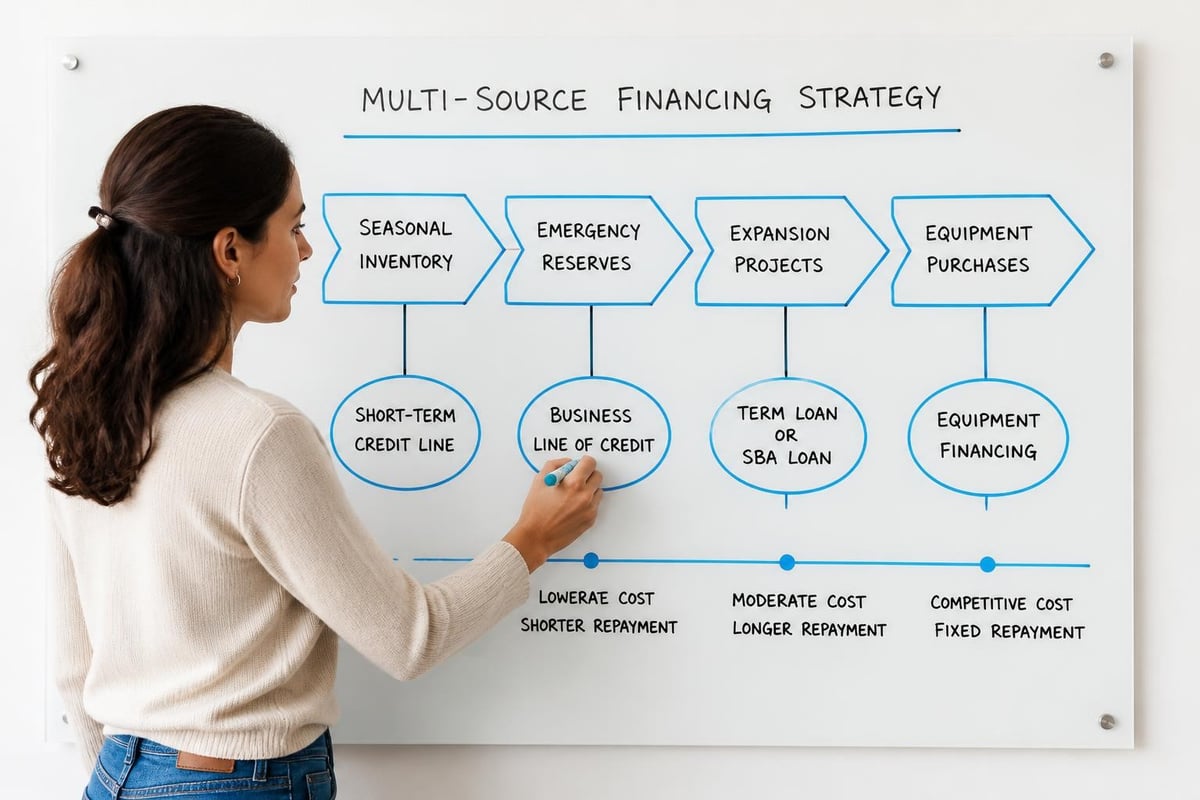
Building a comprehensive financing strategy involves evaluating multiple capital sources and matching them to specific business needs. No single product serves all purposes, and diversifying funding access strengthens financial resilience.
Creating a Funding Mix
| Business Need | Recommended Funding Type | Typical Term | Cost Range |
|---|---|---|---|
| Emergency reserves | Business line of credit | Revolving | 8%–15% APR |
| Seasonal inventory | Revenue-based financing or MCA | 3–12 months | 1.10–1.25 factor |
| Major expansion | Term loan or SBA loan | 3–10 years | 6%–12% APR |
| Equipment purchases | Equipment financing | 2–7 years | 6%–15% APR |
| Short-term marketing | Shopify Capital or business card | 3–9 months | 1.08–1.20 factor or 12%–22% APR |
Working with a financing broker provides access to multiple lenders and product types simultaneously. Brokers evaluate business qualifications against numerous funding sources, identifying options that balance cost, speed, and terms appropriately.
Building Creditworthiness for Better Terms
Merchants who establish strong business credit profiles unlock access to lower-cost financing over time. Steps include maintaining timely vendor payments, separating business and personal finances, establishing trade credit relationships, and building positive payment history with business credit cards.
Application Process and Timeline
Understanding how to access a shopify loan and alternative funding options helps merchants plan capital needs effectively. Each financing type follows different application workflows and approval timelines.
Shopify Capital Invitation Process
Shopify Capital operates on an invitation-only basis. Eligible merchants receive offers directly in their Shopify admin dashboard, typically in the Finances section. The application process is streamlined since Shopify already possesses transaction history and business performance data.
Typical timeline:
- Offer notification: Appears in admin dashboard when eligible
- Review terms: Examine funding amount, fee, and repayment percentage
- Accept offer: Click to accept; funds typically arrive within 1-3 business days
- Automatic repayment: Begins immediately with the next sales settlement
Alternative Lender Applications
External financing providers require more extensive documentation but offer customized underwriting. Applications typically request bank statements, tax returns, business formation documents, and financial projections. Approval timelines range from same-day for revenue-based products to several weeks for traditional bank loans.
Fast-track options exist for merchants with strong revenue profiles. Many alternative lenders specialize in e-commerce businesses and can approve funding within 24-48 hours based primarily on payment processing history and bank deposits.
Managing Multiple Funding Sources
Businesses using multiple capital sources must carefully manage overlapping repayment obligations. Coordination prevents cash-flow conflicts and ensures sufficient liquidity for operations.
Stacking Considerations
"Stacking" refers to holding multiple merchant cash advances or financing products simultaneously. While some lenders prohibit stacking, others allow it with disclosure. Merchants must ensure total repayment obligations do not exceed sustainable percentages of revenue.
Safe stacking practices:
- Limit total daily remittance to 20-25% of average sales
- Maintain 60+ days of operating expenses in reserves
- Stagger repayment schedules to avoid concentrated obligations
- Communicate with all lenders about existing financing
Refinancing and Renewal Strategies
As businesses grow and creditworthiness improves, refinancing higher-cost financing with lower-cost alternatives makes financial sense. Merchants can use new shopify loan offers or external financing to retire expensive existing obligations, reducing total financing costs.
Shopify often extends new Capital offers before existing advances are fully repaid, allowing merchants to consolidate and access additional funds. Evaluate whether the new offer improves terms or simply adds more debt at similar costs.
Industry-Specific Funding Considerations
Different e-commerce verticals face unique financing challenges and opportunities. Understanding industry-specific dynamics helps merchants select appropriate funding products.
High-Ticket vs. High-Volume Businesses
Merchants selling expensive products with lower transaction frequency experience different cash-flow patterns than high-volume, low-margin businesses. High-ticket sellers may prefer installment loans with predictable payments, while high-volume merchants benefit from percentage-based repayment during slower periods.
Subscription and Recurring Revenue Models
Businesses with subscription components or repeat customer bases demonstrate more predictable cash flow, often qualifying for better financing terms. Lenders value recurring revenue streams and may offer preferential pricing or larger funding amounts to subscription-focused merchants.
Seasonal and Event-Driven Businesses
Seasonal merchants benefit significantly from revenue-based repayment models. During off-season periods, lower sales mean reduced repayment obligations, preserving working capital. Peak-season sales accelerate repayment without straining cash flow during high-revenue periods.
Making the Right Financing Decision
Selecting appropriate business financing requires comprehensive analysis of costs, terms, business impact, and strategic alignment. Merchants should evaluate multiple factors beyond just approval speed or funding amount.
Questions to Ask Before Accepting Any Offer
- What is the total repayment amount and effective cost?
- How will daily or weekly deductions affect operating cash flow?
- What happens if sales decline significantly during the repayment period?
- Are there prepayment penalties or benefits?
- Does this financing support revenue-generating activities or just cover shortfalls?
- Have I compared at least three different funding options?
Red Flags to Avoid
Predatory lending practices exist in the merchant financing space. Warning signs include unclear fee structures, pressure tactics during sales calls, requests for personal guarantees without business evaluation, extremely high factor rates exceeding 1.50, and lenders unwilling to provide written terms before funding.
Working with established platforms like Shopify Capital or reputable financing brokers reduces exposure to predatory practices. Always request full disclosure documents and review them carefully before accepting any funding offer.
Understanding your shopify loan options and broader financing alternatives empowers better capital decisions for your e-commerce business. Platform-embedded financing offers convenience and speed, while traditional and alternative lenders provide competitive terms for qualified merchants. Enterprise Finest Solutions helps businesses navigate the full spectrum of funding options, connecting merchants with financing solutions that align with revenue patterns, growth objectives, and industry dynamics. Whether you need quick access to inventory capital or strategic financing for major expansion, evaluating multiple sources ensures you secure the most appropriate funding for your business needs.
Written by
Enterprise Finest Solutions
Content creator and writer sharing insights and stories.