Seed Stage Startup: Funding, Strategy & Growth Essentials
Navigate seed stage startup funding with confidence. Learn about financing options, investor expectations, and strategic planning for early-stage growth.

The journey from innovative idea to sustainable business begins at the seed stage, where founders transform vision into viable commercial operations. A seed stage startup represents the earliest formal phase of company building, characterized by initial product development, market validation, and the pursuit of founding capital to fuel growth. This critical period demands strategic decision-making around funding sources, team building, and establishing product-market fit while managing limited resources and heightened uncertainty.
Understanding the Seed Stage Startup Landscape
A seed stage startup occupies the space between initial concept and Series A funding, typically operating with a minimal viable product or early traction metrics. During this phase, companies focus on proving their business model, validating customer demand, and demonstrating scalability potential to attract institutional investors.
The seed stage differs fundamentally from later funding rounds in scope and expectations. While Series A investors look for proven revenue models and clear growth trajectories, seed investors evaluate founding teams, market opportunities, and early validation signals. This distinction shapes everything from valuation methods to the types of investors who participate.
Typical Characteristics and Milestones
Seed stage startups generally operate with teams of 2-10 employees, often comprising founders and essential early hires. Revenue may be minimal or nonexistent, with many companies still refining their offerings based on customer feedback. Key performance indicators center on user engagement, prototype development, and early market traction rather than profitability.
Common milestones during this phase include:
- Completion of a functional prototype or minimum viable product
- Initial customer acquisition and feedback loops
- Product-market fit validation through early sales or user adoption
- Assembly of core founding team members
- Development of go-to-market strategy and positioning
The timeline for seed stage operations varies considerably, typically ranging from six months to two years depending on industry, product complexity, and market conditions.
Seed Stage Funding Sources and Structures
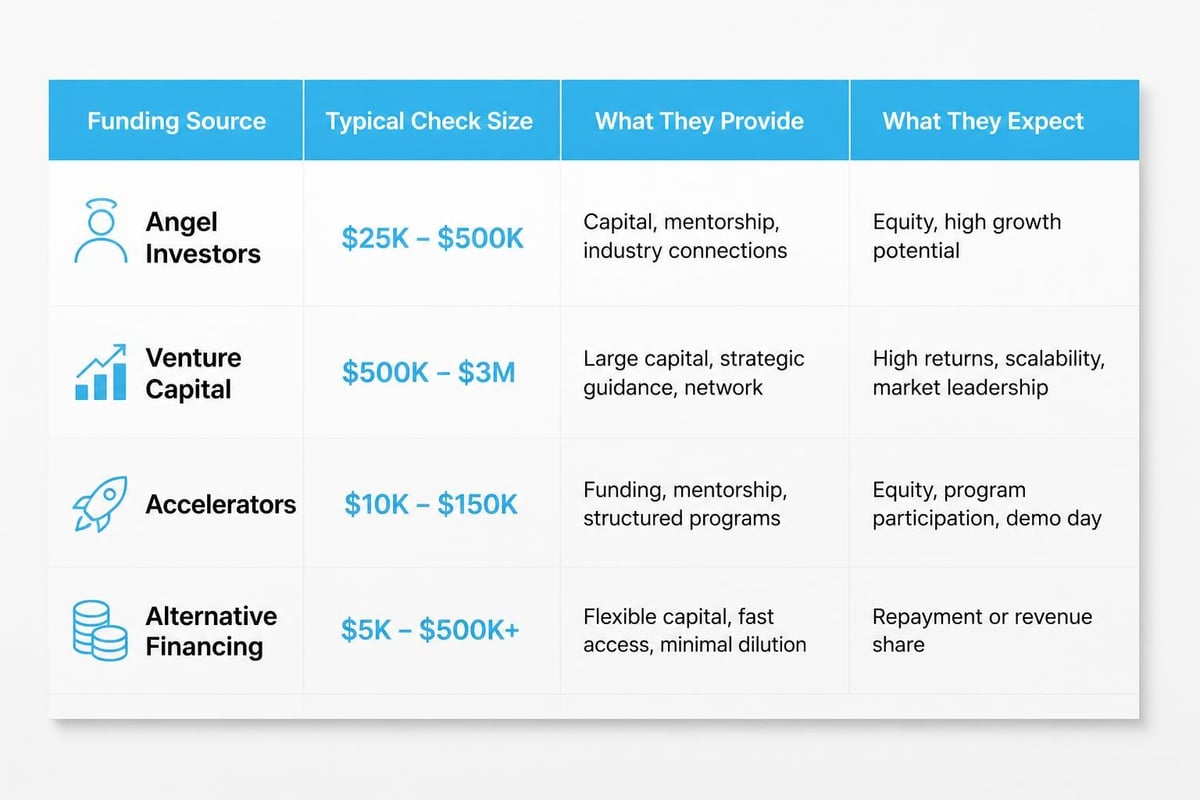
Financing options for early-stage companies extend beyond traditional venture capital, encompassing various instruments and investor types suited to different business models and growth trajectories.
Equity Financing Options
Traditional equity rounds remain the most common seed funding mechanism, with investors purchasing ownership stakes in exchange for capital. According to Y Combinator's guidance on raising seed rounds, typical raises in 2026 range from $500,000 to $3 million, though amounts vary significantly by sector and geography.
Angel investors typically lead or participate in initial seed rounds, bringing both capital and operational expertise. These individuals invest personal funds and often provide mentorship alongside financial support. Micro-venture capital firms have also emerged as specialized seed investors, writing smaller checks than traditional VCs while offering more hands-on guidance.
SAFE Notes and Convertible Instruments
Simple Agreements for Future Equity (SAFEs) and convertible notes provide alternative structures that defer valuation discussions until later rounds. SAFEs, popularized by Y Combinator, allow companies to receive capital that converts to equity during subsequent financing events, typically with valuation caps and discount rates favoring early investors.
The Cooley GO Series Seed financing package offers standardized templates that many seed stage startups use to structure these transactions efficiently. These instruments reduce legal complexity and negotiation time compared to priced equity rounds, making them particularly attractive for companies raising smaller amounts.
| Funding Instrument | Typical Use Case | Key Advantage | Primary Consideration |
|---|---|---|---|
| Priced Equity Round | Clear valuation, larger raises | Straightforward ownership structure | Requires company valuation |
| SAFE | Pre-product or minimal traction | Speed and simplicity | Defers valuation decisions |
| Convertible Note | Bridge to larger round | Debt instrument with conversion option | Includes interest and maturity date |
| Revenue-Based Financing | Consistent revenue streams | Non-dilutive capital | Ongoing payment obligations |
Alternative and Non-Dilutive Funding
Not every seed stage startup pursues venture capital, particularly businesses with clear paths to profitability or those in industries less suited to high-growth venture models. For companies generating early revenue, working capital financing can provide non-dilutive capital to fund operations, inventory, and growth initiatives without surrendering equity ownership.
Grant programs, government-backed initiatives, and industry-specific accelerators offer additional capital sources, particularly for companies developing technologies in priority sectors like healthcare, clean energy, or advanced manufacturing. These programs often provide non-dilutive funding alongside resources and network access.
Valuation Considerations and Term Sheet Essentials
Establishing fair valuation represents one of the most challenging aspects of seed funding, given limited financial history and uncertain future outcomes. Pre-money valuations for seed stage startups in 2026 typically range from $3 million to $12 million, though exceptional teams or technologies command premium pricing.
Key Valuation Drivers
Investors evaluate multiple factors when determining appropriate valuations, weighing quantitative metrics against qualitative assessments of team and opportunity.
Team composition and experience frequently drive valuations more than any other factor at the seed stage. Founding teams with successful prior exits, relevant industry expertise, or complementary skill sets command higher valuations due to perceived execution capability.
Market size and growth potential influence investor appetite and pricing. Companies targeting large, expanding markets benefit from higher valuations, as investors model significant upside scenarios even with modest market share capture.
Traction metrics and validation provide concrete evidence of product-market fit. Early revenue, user growth rates, engagement metrics, or letters of intent from customers strengthen negotiating positions and justify premium valuations.
Understanding Term Sheet Components
The NVCA model legal documents serve as industry standards for seed-stage transactions, establishing common frameworks for rights, preferences, and protections. Founders should understand several critical terms beyond simple valuation and ownership percentages.

Liquidation preferences determine payout order and amounts during exit events, with participating versus non-participating preferences significantly affecting founder returns. Standard seed terms typically include 1x non-participating preferences, meaning investors receive their investment back before common shareholders in acquisition scenarios.
Anti-dilution provisions protect investors from down rounds through price adjustments, with weighted-average formulas being more founder-friendly than full-ratchet mechanisms. These clauses ensure investor ownership percentages remain relatively stable despite future dilution.
Board composition and voting rights establish governance structures, with seed investors sometimes receiving board observation rights or information rights rather than full board seats. Protective provisions may give investors veto power over specific corporate actions like future financings or asset sales.
Building a Fundable Seed Stage Startup
Securing seed funding requires more than an innovative idea. Investors back companies demonstrating clear thinking about markets, execution capabilities, and paths to significant scale.
Developing a Compelling Narrative
A seed stage startup must articulate why now represents the right moment for this solution, who experiences the pain point being solved, and why this team can execute better than alternatives. Effective founders weave market dynamics, customer insights, and competitive positioning into coherent stories that resonate with investor theses.
The pitch should address:
- Problem definition and market validation through customer interviews, data points, or industry trends
- Solution differentiation and defensibility explaining competitive advantages and barriers to entry
- Business model clarity demonstrating how the company captures value and achieves profitability
- Go-to-market strategy outlining customer acquisition channels and unit economics
- Financial projections and use of funds showing how capital accelerates growth and achieves milestones
Traction and Proof Points
Investors increasingly expect seed stage startups to demonstrate meaningful progress beyond slide decks. The strongest candidates show measurable validation through paying customers, active users, partnership commitments, or pilot program results.
Customer development efforts prove founders understand their market deeply. Regular engagement with target users, systematic feedback collection, and iterative product improvements signal customer-centric approaches that reduce execution risk.
Pilot programs and early revenue provide concrete evidence that customers value the solution enough to pay for it. Even modest revenue figures demonstrate commercial viability and reduce perceived risk significantly compared to pre-revenue opportunities.
Strategic partnerships or distribution agreements validate the business model through third-party endorsement. Letters of intent from established companies, integration partnerships, or channel relationships strengthen credibility and accelerate market access.
Financial Planning and Resource Allocation
Capital efficiency separates successful seed stage startups from those that struggle to reach subsequent funding milestones. Founders must balance aggressive growth pursuits with prudent cash management, ensuring sufficient runway to achieve validation milestones that unlock Series A opportunities.
Runway Management and Burn Rate
Most seed stage startups target 18-24 months of runway, providing adequate time to execute product roadmaps, acquire customers, and demonstrate growth without immediate fundraising pressure. Monthly burn rates typically range from $30,000 to $150,000 depending on team size, product complexity, and market requirements.
| Budget Category | Typical % of Seed Capital | Strategic Considerations |
|---|---|---|
| Personnel (salaries, contractors) | 60-70% | Largest expense; prioritize essential roles only |
| Product Development | 15-20% | Technology infrastructure, tools, external development |
| Marketing & Sales | 10-15% | Customer acquisition, content, early campaigns |
| Operations & Admin | 5-10% | Legal, accounting, office, insurance, software |
Milestone-Based Spending
Effective seed stage startups align spending with specific milestones that derisk the business and position it for future funding. Rather than distributing capital evenly across time, strategic founders concentrate resources on achieving clear proof points that increase valuation.
Critical milestones might include launching a beta product, acquiring the first 100 paying customers, achieving specific monthly recurring revenue targets, or validating unit economics through cohort analysis. Each milestone should directly address investor concerns and strengthen the narrative for subsequent rounds.
Preparing for Series A and Beyond
The seed stage serves as preparation for institutional venture capital, requiring founders to build foundations that support scaling. Companies transitioning successfully from seed to Series A demonstrate clear product-market fit, repeatable customer acquisition, and credible paths to significant revenue growth.

Metrics That Matter for Series A
Series A investors evaluate seed stage startups against specific quantitative benchmarks that vary by business model but generally center on growth rates, customer economics, and market momentum.
Software-as-a-Service companies typically need $1-2 million in annual recurring revenue with month-over-month growth rates of 15-25%. Strong SaaS metrics include low customer acquisition costs relative to lifetime value, high gross margins above 70%, and net revenue retention exceeding 100%.
Consumer technology platforms demonstrate value through user growth, engagement metrics, and network effects. Series A investors look for hundreds of thousands to millions of users, strong retention curves, and clear monetization strategies even if revenue remains modest.
Marketplace businesses must prove both supply and demand liquidity with balanced growth on both sides. Key metrics include gross merchandise volume, take rates, repeat usage, and contribution margins that indicate scalability.
Building Institutional Relationships
Successful seed stage startups cultivate relationships with Series A investors long before formal fundraising begins. Regular updates to interested investors, requests for introductions or advice, and informal conversations build familiarity and trust that facilitate smoother future fundraising.
Founders should research firms' investment theses, portfolio compositions, and partner backgrounds to identify best-fit investors aligned with their industry, business model, and geographic focus. Warm introductions through existing investors, advisors, or portfolio company founders significantly improve response rates and meeting quality.
Common Pitfalls and Risk Mitigation
The seed stage presents numerous challenges where inexperienced founders frequently stumble. Understanding common mistakes helps teams navigate this period more successfully and preserve resources for growth rather than correction.
Equity Preservation and Cap Table Management
Excessive dilution during seed rounds constrains future fundraising flexibility and reduces founder motivation. While standard seed rounds typically involve 15-25% dilution, some founders surrender majority control early by raising too frequently, accepting unfavorable terms, or granting excessive advisor equity.
Maintaining organized cap tables, understanding fully-diluted ownership calculations, and projecting dilution across multiple funding rounds helps founders make informed decisions about equity allocation. Professional legal counsel specializing in venture transactions provides essential guidance on market-standard terms and common negotiating points.
Market Timing and Competition
Many seed stage startups fail not because of execution deficiencies but due to poor market timing. Entering too early risks educating markets without reaping rewards, while entering too late faces entrenched competitors with resource advantages.
Competitive analysis should extend beyond direct competitors to include substitute solutions and customer inertia. Founders must articulate compelling reasons why customers would switch from existing alternatives, whether incumbents, manual processes, or competitor offerings.
Resource Constraints and Priority Management
Limited capital forces difficult tradeoffs between competing priorities. Seed stage startups cannot simultaneously pursue multiple market segments, build comprehensive feature sets, and experiment with various customer acquisition channels. Focus separates successful companies from those that dilute efforts across too many initiatives.
Strategic founders identify the single most important question their business must answer during the seed stage, then concentrate resources on definitively answering that question. Whether proving customers will pay premium pricing, demonstrating unit economics profitability, or validating a specific distribution channel, clarity about critical uncertainties drives effective resource allocation.
Team Building and Organizational Development
The founding team represents the most important investment area for any seed stage startup. While products evolve and strategies pivot, exceptional teams adapt and execute through changing circumstances.
Hiring Early Employees
First hires disproportionately impact company culture, execution velocity, and future recruiting success. Seed stage startups should prioritize versatile generalists over narrow specialists, given limited resources and evolving responsibilities.
Key considerations for early hires include:
- Cultural alignment and values fit beyond technical skills or experience
- Comfort with ambiguity and rapid change inherent to early-stage environments
- Self-direction and ownership mentality rather than needing extensive management
- Complementary skills that fill founding team gaps rather than duplicating existing expertise
Equity compensation plays a critical role in attracting talent to resource-constrained startups. Competitive option pools typically represent 10-20% of fully-diluted ownership, with early employees receiving grants ranging from 0.5% to 5% depending on seniority and contribution expectations.
Advisory Boards and External Expertise
Strategic advisors provide specialized knowledge, network access, and credibility without full-time commitment or cost. Effective advisory relationships involve clearly defined expectations, regular engagement, and appropriate equity compensation typically ranging from 0.25% to 1% vesting over two to four years.
Advisors prove most valuable when they possess specific expertise relevant to immediate challenges, such as regulatory navigation, enterprise sales processes, technical architecture decisions, or fundraising strategy. Generic business advice holds less value than targeted guidance applicable to current priorities.
Successfully navigating the seed stage requires balancing aggressive growth ambitions with pragmatic resource management while building foundations for institutional funding and sustainable scaling. Whether pursuing venture capital or exploring alternative financing paths, seed stage startups benefit from strategic planning around funding structures, milestone achievement, and team development that position them for long-term success. Enterprise Finest Solutions helps businesses at every stage access flexible financing solutions tailored to their revenue, performance, and capital needs, connecting entrepreneurs with funding partners who understand the unique challenges of growing companies.
Written by
Enterprise Finest Solutions
Content creator and writer sharing insights and stories.