Raising Capital for Business: A Complete 2026 Guide
Discover proven strategies for raising capital for business in 2026. Explore debt, equity, and alternative funding options to fuel growth.

Raising capital for business remains one of the most critical challenges facing entrepreneurs and established companies alike. Whether you're launching a startup, expanding operations, purchasing equipment, or managing cash flow gaps, access to the right funding at the right time can determine your company's trajectory. In 2026, business owners have more financing options than ever before, from traditional bank loans and venture capital to revenue-based financing and merchant cash advances. Understanding which capital source aligns with your business model, growth stage, and financial situation is essential for making informed decisions that support sustainable growth without compromising your long-term vision.
Understanding Different Capital Sources
The landscape of business financing has evolved significantly, offering entrepreneurs multiple pathways to secure funding. Each capital source comes with distinct advantages, requirements, and implications for your business structure and ownership.
Debt Financing Options
Debt financing allows businesses to raise capital while maintaining full ownership and control. Traditional bank loans, term loans, and credit facilities require repayment with interest over a predetermined period. The SBA loan programs provide government-backed options that often feature competitive rates and extended repayment terms for qualified small businesses.
Key debt instruments include:
- Term loans with fixed repayment schedules
- Business lines of credit for flexible, revolving capital
- Equipment financing secured by the asset being purchased
- Commercial real estate loans for property acquisition
- Merchant cash advances based on future revenue
The primary advantage of debt financing is retaining equity. However, debt service requires consistent cash flow and often demands collateral or personal guarantees. The distinction between debt and equity carries significant tax implications, as outlined in IRS guidance on debt versus equity treatment, making it essential to structure financing appropriately.

Equity Financing and Investment Capital
Equity financing involves selling ownership stakes in your company to investors in exchange for capital. This approach eliminates repayment obligations but dilutes founder ownership and introduces new stakeholders with governance rights.
Common equity sources include angel investors, venture capital firms, private equity groups, and strategic corporate investors. Each investor type brings different expectations regarding return timelines, involvement level, and exit strategies. Venture capital firms typically seek high-growth companies with scalable business models, while angel investors may invest earlier with smaller check sizes.
| Investor Type | Typical Investment | Involvement Level | Timeline to Exit |
|---|---|---|---|
| Angel Investors | $25K - $500K | Advisory to hands-off | 5-7 years |
| Venture Capital | $1M - $50M+ | Board seat, strategic | 7-10 years |
| Private Equity | $5M - $500M+ | Operational control | 3-7 years |
| Strategic/Corporate | $500K - $100M+ | Partnership-focused | Variable |
Alternative and Revenue-Based Financing
Alternative financing has emerged as a vital middle ground for businesses that don't fit traditional lending criteria or want to avoid equity dilution. Revenue-based financing, merchant cash advances, invoice factoring, and crowdfunding platforms offer flexible solutions based on business performance rather than credit scores or collateral alone.
For businesses with consistent revenue streams, Working Capital Financing provides fast access to capital for inventory, payroll, expansion, and operational expenses. These solutions often feature streamlined approval processes and qualification based primarily on revenue performance rather than traditional lending metrics.
Revenue-based financing allows companies to raise capital by committing a percentage of future revenue until a predetermined amount is repaid. This structure aligns repayment with business performance, providing breathing room during slower periods while accelerating payoff during growth phases.
Preparing Your Business to Raise Capital
Success in raising capital for business depends heavily on preparation and positioning. Investors and lenders evaluate opportunities through multiple lenses, assessing both quantitative metrics and qualitative factors.
Building a Compelling Business Case
Every capital raise begins with a clear articulation of why you need funding, how you'll deploy it, and what returns stakeholders can expect. Your business plan should demonstrate market opportunity, competitive advantage, revenue model, unit economics, and growth projections grounded in realistic assumptions.
Sequoia Capital's guidance on writing a business plan emphasizes clarity, specificity, and addressing potential objections proactively. Your pitch materials should tell a compelling story while backing claims with data and evidence.
Essential components include:
- Executive summary highlighting the opportunity and ask
- Market analysis demonstrating size, growth, and trends
- Product or service differentiation and value proposition
- Business model showing how you generate revenue
- Financial projections with detailed assumptions
- Team credentials and relevant experience
- Use of funds with specific allocation and timeline
- Exit strategy or repayment capacity
Financial Documentation and Metrics
Lenders and investors conduct rigorous due diligence on financial health and operational metrics. Prepare comprehensive financial statements, tax returns, bank statements, accounts receivable/payable aging reports, and revenue projections.
Key performance indicators vary by industry and business model, but commonly scrutinized metrics include monthly recurring revenue, customer acquisition cost, lifetime value, gross margin, burn rate, and cash runway. Demonstrating strong unit economics and a clear path to profitability strengthens your position significantly.

Valuation and Term Negotiation
For equity raises, determining appropriate valuation balances attracting investment with minimizing dilution. Valuation methodologies include comparable company analysis, discounted cash flow, venture capital method, and Berkus method for pre-revenue startups.
The NVCA's model legal documents provide industry-standard templates for term sheets and investment agreements, helping founders understand market norms for liquidation preferences, anti-dilution provisions, board composition, and voting rights.
For debt financing, negotiate favorable terms regarding interest rates, repayment schedules, covenants, prepayment penalties, and collateral requirements. Understanding the total cost of capital across all terms rather than focusing solely on interest rates ensures better decision-making.
Navigating the Capital Raising Process
Raising capital for business requires strategic execution, persistence, and relationship building. The process varies significantly based on capital source, but several principles apply universally.
Identifying the Right Funding Partners
Not all capital is equal. Beyond the dollars, consider what else potential partners bring: industry expertise, network connections, operational guidance, and strategic value. Align with partners whose goals, timeline, and values match yours.
Research potential investors or lenders thoroughly. Review their portfolio companies, investment thesis, typical check size, and reputation among founders. For lenders, understand their underwriting criteria, approval timelines, and flexibility in structuring deals.
Building relationships before you need capital strengthens your position when you're ready to raise. Attend industry conferences, participate in accelerator programs, engage in entrepreneurial communities, and nurture warm introductions through trusted intermediaries.
Timing and Market Conditions
Capital markets fluctuate based on economic conditions, industry trends, and investor sentiment. As explored in this Harvard Business Review article on building a startup in a tough funding environment, adapting strategy to market realities separates successful raises from failed attempts.
In strong markets, capital flows freely with aggressive valuations and flexible terms. During downturns, investors become more selective, valuations compress, and terms favor capital providers. Raising more capital than immediately needed during favorable conditions provides cushion for uncertain times.
Market timing considerations:
- Raise capital when your business shows momentum and growth
- Secure funding before you desperately need it
- Monitor industry-specific investment trends and cycles
- Maintain relationships with capital sources continuously
- Build financial runway to avoid raising under pressure
Managing the Due Diligence Process
Once you've attracted interest, due diligence begins in earnest. Investors and lenders verify claims, assess risks, and validate assumptions. Prepare for extensive document requests covering financials, legal matters, intellectual property, customer contracts, employee agreements, and operational details.
Organize information in a virtual data room with logical structure and easy navigation. Respond promptly and transparently to questions, addressing concerns directly rather than deflecting. Red flags during due diligence can derail deals, so honesty about challenges demonstrates integrity and judgment.
Legal review examines corporate structure, capitalization table, existing agreements, litigation history, regulatory compliance, and potential liabilities. Engage experienced legal counsel to navigate complex negotiations and protect your interests while maintaining deal momentum.
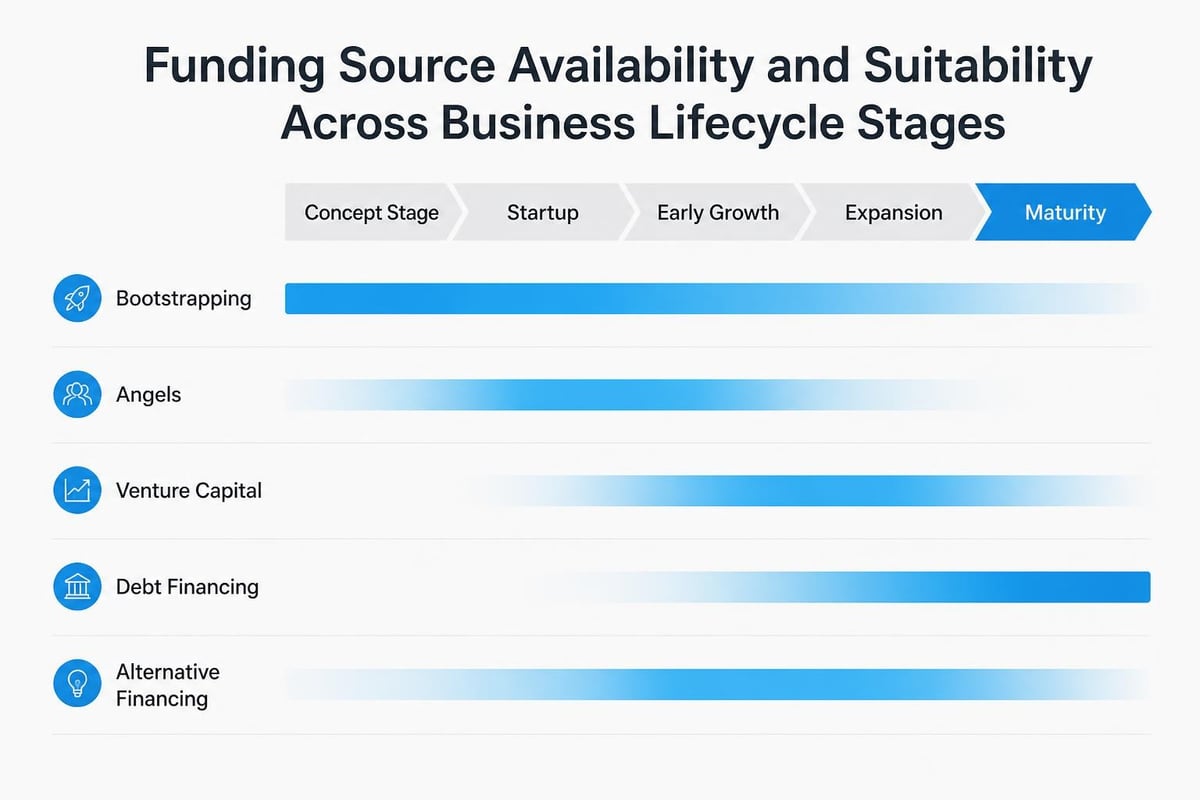
Funding Strategies by Business Stage
Capital needs and available sources vary dramatically based on where your business sits in its lifecycle. Matching funding strategy to stage improves success rates and optimizes terms.
Early-Stage and Startup Funding
Pre-revenue and early-stage businesses face the greatest challenge raising capital for business ventures. Without proven traction, founders rely on personal savings, friends and family, angel investors, accelerators, and crowdfunding.
Bootstrapping retains maximum ownership but limits growth speed. Friends and family capital provides accessible funding but risks personal relationships. Angel investors contribute both capital and mentorship, typically investing $25,000 to $500,000 in exchange for equity stakes between 10-25%.
Accelerators offer small investments ($25,000-$150,000) plus intensive mentorship, resources, and investor introductions in exchange for modest equity (typically 5-10%). Programs like Y Combinator, Techstars, and 500 Startups have launched thousands of successful companies.
The Kauffman Foundation provides extensive resources on early-stage capital access, cap table management, and founder education through their Founders School program.
Growth-Stage Expansion Capital
Established businesses with proven revenue and growth trajectories access broader capital sources. Venture capital becomes viable for high-growth technology and innovation companies, while traditional lenders consider businesses with consistent cash flow and asset bases.
Growth equity investors target profitable or near-profitable companies seeking expansion capital without full buyouts. These firms invest $5-50 million for minority stakes, supporting geographic expansion, product development, or market penetration.
Revenue-based financing has gained significant traction for growth-stage companies wanting capital without equity dilution or restrictive debt covenants. By tying repayment to revenue performance, this structure accommodates growth volatility while providing meaningful capital.
Mature Business and Acquisition Financing
Mature businesses with stable cash flows access the full spectrum of financing options. Bank loans, asset-based lending, and equipment financing provide efficient capital for specific needs at competitive rates.
Private equity firms target mature companies for buyouts, recapitalizations, or succession planning. These transactions typically involve significant leverage, management partnerships, and operational improvements to drive returns.
Strategic acquisitions require specialized financing combining equity, debt, and earnouts. Seller financing, where previous owners carry notes on sale proceeds, has become increasingly common in middle-market transactions.
Sector-Specific Considerations
Different industries face unique capital access challenges and opportunities. Understanding sector dynamics improves positioning and selection of appropriate funding sources.
Service-Based and Professional Businesses
Service companies with minimal physical assets often struggle securing traditional asset-based lending. However, strong cash flow, recurring revenue models, and low capital intensity make these businesses attractive for revenue-based financing and working capital solutions.
Professional services firms (consulting, agencies, legal, accounting) typically bootstrap or use lines of credit tied to receivables. Private equity has increasingly targeted healthcare services, dental practices, and specialized professional services through roll-up strategies.
Retail and E-Commerce
Retail and e-commerce businesses require significant capital for inventory, marketing, and technology. Inventory financing, purchase order financing, and merchant cash advances provide tailored solutions addressing seasonal fluctuations and growth demands.
Amazon sellers and e-commerce operators access specialized lenders offering advances against marketplace receivables or inventory. These products recognize that traditional lenders often undervalue digital assets and marketplace revenue streams.
Manufacturing and Distribution
Capital-intensive manufacturing and distribution businesses leverage equipment financing, asset-based lending, and term loans secured by machinery, inventory, and receivables. The World Bank's SME finance resources highlight how small and medium manufacturers globally access capital through supply chain financing and trade credit programs.
Government programs supporting domestic manufacturing offer favorable terms for businesses creating jobs or utilizing advanced technologies. State and local economic development incentives can supplement private capital with grants, tax credits, or low-interest loans.
Common Pitfalls and How to Avoid Them
Even experienced entrepreneurs make mistakes when raising capital for business operations. Awareness of common pitfalls improves outcomes and preserves valuable time and resources.
Overvaluation and Unrealistic Projections
Inflated valuations create down-round risks in subsequent raises and make investor returns difficult to achieve. Aggressive projections that miss targets damage credibility and complicate future fundraising efforts.
Ground valuations in comparable transactions and realistic growth assumptions. Build financial models with conservative, moderate, and aggressive scenarios, highlighting the assumptions driving each outcome. Investors appreciate transparency about risks and challenges more than unfounded optimism.
Taking Capital from Wrong Sources
Desperate founders sometimes accept capital from poorly aligned investors or on unfavorable terms. Misaligned investors create governance conflicts, strategic disagreements, and pressure for premature exits.
Evaluate investors beyond their check size. Speak with founders in their portfolio, understand their decision-making process, and assess cultural fit. Terms that seem acceptable during negotiation can become burdensome as circumstances change.
Inadequate Use of Funds Planning
Raising capital without detailed deployment plans leads to inefficient spending and premature burn. Investors want confidence that capital will achieve specific milestones justifying next-round valuations.
Create detailed use of funds allocations:
- Product development and technology investments
- Sales and marketing initiatives with CAC targets
- Team expansion with specific roles and timing
- Working capital for inventory and operations
- Professional services and overhead
- Reserve for contingencies (typically 10-15%)
Neglecting Existing Stakeholder Communication
Current investors, board members, and key employees deserve transparency about fundraising activities. Surprising stakeholders with term sheets or new investors creates unnecessary friction and potential opposition.
Keep stakeholders informed throughout the process. Seek input on potential investors, share term sheet highlights, and address concerns proactively. Pro rata rights, preemptive rights, and information rights require managing existing investor expectations during new raises.
Building Long-Term Capital Relationships
Successful entrepreneurs view raising capital for business as relationship building rather than one-time transactions. Cultivating ongoing partnerships with capital providers creates advantages throughout your company's lifecycle.
Maintaining Investor and Lender Relationships
Regular communication builds trust and opens doors for follow-on funding. Share monthly or quarterly updates highlighting progress, challenges, metrics, and learnings. Transparency about difficulties demonstrates maturity and judgment, while consistent wins build credibility.
Invite investors to participate in strategy discussions, introduce them to key hires, and leverage their networks for customer and partnership introductions. Active investors who feel engaged become powerful advocates and sources of support beyond their initial investment.
Creating Competitive Tension
Multiple term sheets create negotiating leverage and improve terms. Running competitive processes requires careful orchestration, ensuring all parties move through diligence simultaneously and receive comparable information.
Avoid auction dynamics that alienate potential partners or create adversarial relationships. Frame the process as finding the best mutual fit rather than extracting maximum value. The best investors appreciate fair competition and respect transparent processes.
Planning for Future Capital Needs
Each funding round should position you for subsequent raises or profitability. Achieve milestones that derisk the business and increase valuation before returning to market. Strategic use of bridge financing can extend runway to reach critical inflection points.
Build capitalization tables that preserve sufficient ownership for founders and reserve adequate equity for future team members. Complex cap tables with multiple share classes, liquidation preferences, and participation rights complicate later rounds and exit transactions.
Raising capital for business success requires matching the right funding source to your company's stage, needs, and objectives while navigating complex markets and relationships. Whether you pursue debt financing that preserves ownership, equity investment that brings strategic value, or alternative solutions that align with revenue performance, thorough preparation and clear strategy increase your likelihood of securing favorable terms. If you're exploring funding options for your small or medium-sized business, Enterprise Finest Solutions connects you with a network of lenders and alternative funding providers, helping you identify financing solutions that align with your revenue, performance, industry, and capital requirements.
Written by
Enterprise Finest Solutions
Content creator and writer sharing insights and stories.