Pre Seed Startup Funding: What Founders Need to Know
Learn how pre seed startup funding works, from SAFE notes to angel investors. Discover key milestones, funding sources, and strategies for 2026.

Launching a business from nothing more than an idea and ambition requires capital, conviction, and careful planning. For founders in 2026, the pre seed startup phase represents the critical bridge between concept and market validation. This earliest stage of venture financing occurs before traditional seed rounds, when founders are building their first products, validating assumptions, and proving that their vision can translate into a viable business. Understanding how pre seed funding works, what investors expect, and how to position your venture can mean the difference between gaining traction and running out of runway before you've had a chance to prove your model.
Understanding the Pre Seed Startup Landscape
A pre seed startup operates in the earliest phase of the venture lifecycle, typically before achieving product-market fit or significant revenue. At this stage, founders are usually working with prototypes, conducting customer discovery, and iterating rapidly based on early feedback. The business may consist of nothing more than a founding team, a compelling pitch deck, and initial validation signals.
Pre seed funding typically ranges from $50,000 to $500,000, though some exceptional teams or technical founders can secure larger amounts. These funds bridge the gap between personal savings, friends and family contributions, and the more substantial seed rounds that follow once traction is evident.
Key Characteristics of Pre Seed Stage
The pre seed startup phase has distinct markers that differentiate it from later stages:
- Team composition: Often just founders or a very small team (1-5 people)
- Product status: MVP in development or early testing phase
- Revenue: Usually pre-revenue or minimal early sales
- Customer base: Initial pilot users, design partners, or early adopters
- Burn rate: Typically $20,000-$75,000 monthly
- Runway target: 12-18 months to reach seed-fundable milestones
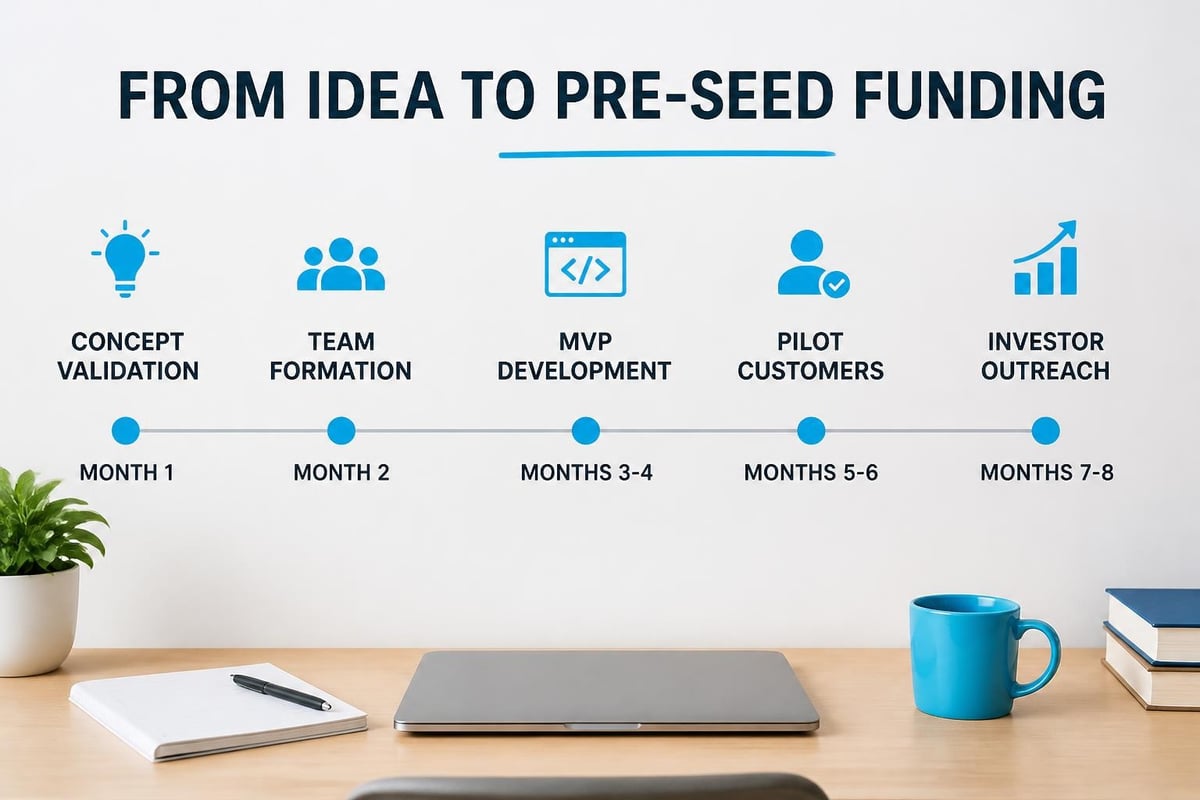
Companies at this stage are proving fundamental assumptions about their market, solution, and business model. According to Crunchbase data on early-stage investing trends, pre seed rounds have grown in both frequency and size over recent years, reflecting investor recognition that supporting founders earlier can yield better outcomes.
Primary Sources of Pre Seed Startup Capital
Finding the right funding sources requires matching your startup's stage, industry, and needs with investors who specialize in pre seed opportunities.
Angel Investors
Individual angel investors remain the backbone of pre seed financing. These high-net-worth individuals invest their own capital, often bringing operational expertise and industry connections alongside their checks. Angels typically invest $25,000-$100,000 per deal, though some write larger checks for exceptional opportunities.
Benefits of angel investors include:
- Faster decision-making than institutional funds
- Flexible terms and founder-friendly deal structures
- Hands-on mentorship and network access
- Willingness to take risks on unproven concepts
Pre Seed Venture Funds
Specialized pre seed funds have emerged to serve this market segment professionally. These institutional investors raise dedicated funds to write initial checks into very early companies, typically investing $100,000-$500,000.
| Fund Type | Typical Check Size | Decision Timeline | Key Focus |
|---|---|---|---|
| Micro VC | $50K-$250K | 2-6 weeks | Specific thesis or geography |
| Accelerator | $25K-$150K | 3 months (cohort-based) | Mentorship + capital |
| Pre Seed Fund | $100K-$500K | 4-8 weeks | Team + early traction |
| Rolling Fund | $50K-$200K | 2-4 weeks | Flexible, LP-driven |
Accelerators and Incubators
Programs like Y Combinator, Techstars, and hundreds of specialized accelerators provide pre seed capital combined with intensive mentorship, network access, and structured programming. Most accelerators invest $100,000-$150,000 for 7-10% equity, though terms vary significantly.
The value extends beyond capital. Accelerators compress years of learning into months, connect founders with experienced mentors, and provide warm introductions to seed-stage investors upon graduation.
Strategic and Corporate Investors
Some corporations run venture arms that invest in pre seed startups aligned with their strategic interests. While these investors can provide unique distribution partnerships and industry expertise, founders should carefully evaluate whether strategic alignment might limit future options or create conflicts.
Structuring Your Pre Seed Startup Financing
The legal and financial structure of your pre seed raise significantly impacts future fundraising flexibility and founder control.
SAFE Notes vs. Convertible Notes vs. Priced Rounds
Most pre seed startups choose between three primary instruments:
SAFE (Simple Agreement for Future Equity) notes have become the dominant pre seed instrument. Created by Y Combinator, SAFEs provide a straightforward framework that converts to equity in a future priced round. They avoid setting a current valuation and minimize legal complexity.
Key SAFE terms include:
- Valuation cap: Maximum valuation at which the investment converts
- Discount rate: Percentage discount on the next round price (typically 10-25%)
- MFN (Most Favored Nation): Rights to adopt better terms from future SAFEs
- Pro-rata rights: Option to maintain ownership percentage in future rounds
Convertible notes function similarly but include debt characteristics like interest rates and maturity dates. While less common in 2026 than previously, some investors still prefer the added protections of debt instruments.
Priced equity rounds establish a clear valuation and issue preferred stock immediately. While this provides clarity, the legal costs ($15,000-$40,000) and complexity often make priced rounds impractical for pre seed amounts under $1 million.
Typical Deal Terms at Pre Seed Stage
Understanding market-standard terms helps founders negotiate effectively without alienating investors or creating future complications.

According to Osler's venture capital deal points analysis, typical pre seed terms in 2026 include:
- Valuation caps: $3 million to $8 million for most companies
- Discount rates: 15-20% when used alongside caps
- Equity dilution: 10-20% total for the full pre seed round
- Board composition: Founders retain full board control
- Information rights: Regular financial updates to major investors
- Pro-rata rights: Often granted to investors above certain thresholds
The NVCA's model documents provide standardized templates that many attorneys use as starting points, helping reduce legal costs and negotiation friction.
Building a Compelling Pre Seed Startup Pitch
Investors see thousands of pitches annually. Standing out requires clarity, credibility, and compelling evidence that you're building something significant.
Essential Elements of Your Pitch Deck
A strong pre seed pitch deck typically follows a 10-12 slide framework addressing:
- Problem: What critical pain point are you solving?
- Solution: How does your product address this problem uniquely?
- Market size: How large is the total addressable market?
- Product: What have you built or what will you build?
- Traction: What validation signals demonstrate progress?
- Business model: How will you make money?
- Competition: Who else addresses this problem and why will you win?
- Team: Why is your team uniquely positioned to execute?
- Financials: High-level projections and unit economics
- Ask: How much you're raising and what you'll accomplish
Following proven frameworks like Sequoia's pitch deck template provides structure while allowing you to customize content for your specific business.
Demonstrating Early Traction
Even at the pre seed stage, evidence of progress dramatically improves your odds. Y Combinator's fundraising guidance emphasizes that traction trumps nearly everything else in early fundraising.
Meaningful traction signals include:
- Revenue, even if minimal ($5,000-$50,000 MRR)
- User growth metrics showing consistent adoption
- Letters of intent from potential customers
- Pilot programs with name-brand companies
- Waitlist growth demonstrating demand
- Product engagement metrics (retention, frequency, depth of use)
For pre-revenue companies, qualitative validation matters: customer interviews, design partner feedback, and evidence that you deeply understand your market can substitute for quantitative metrics.
Financial Planning for Pre Seed Startups
Effective financial management extends your runway and demonstrates operational discipline that investors value.
Creating a Realistic Budget
Your pre seed budget should account for 12-18 months of operations with clear milestones mapped to capital consumption. Breaking expenses into categories helps identify where to optimize:
| Expense Category | Typical % of Budget | Key Considerations |
|---|---|---|
| Personnel | 60-75% | Founding team salaries, early hires |
| Product development | 10-20% | Tools, software, contractors |
| Marketing & sales | 5-15% | Early customer acquisition, pilots |
| Professional services | 5-10% | Legal, accounting, compliance |
| Operations | 5-10% | Office, insurance, miscellaneous |
Managing Burn Rate and Runway
Your burn rate (monthly cash consumption) determines how long your capital lasts. Most pre seed startups target 15-18 months of runway to reach their next fundraising milestone without desperation.
Strategies to extend runway include:
- Prioritizing ruthlessly: Focus only on activities that directly prove or disprove key hypotheses
- Deferring compensation: Many founders take minimal or no salary initially
- Leveraging free/low-cost tools: Take advantage of startup programs and credits
- Hiring selectively: Bring on only critical roles; use contractors for specialized needs
- Negotiating payment terms: Extend vendor payment terms where possible
Tracking weekly metrics through frameworks like this pre-seed KPI dashboard helps founders maintain visibility into their financial position and operational health.

Alternative and Complementary Funding Strategies
While equity financing dominates pre seed discussions, smart founders often blend multiple capital sources to optimize dilution and flexibility.
Revenue-Based Financing for Early Revenue Companies
Pre seed startups that generate even modest revenue may qualify for non-dilutive capital through revenue-based financing arrangements. These structures advance capital in exchange for a percentage of future revenue until a predetermined multiple is repaid.
For businesses showing $10,000+ in monthly revenue with growth trajectories, exploring revenue-based financing options can supplement equity rounds and extend runway without additional dilution.
Grants and Non-Dilutive Capital
Government grants, innovation programs, and industry-specific funding opportunities provide capital that doesn't dilute ownership. While often requiring significant application effort and having specific use restrictions, grants can fund research, product development, or initial hiring.
Customer-Funded Growth
The ultimate non-dilutive funding comes from customers. Pre-selling products, securing advance commitments, or structuring pilot programs with payment upfront can fund development while validating market demand simultaneously.
Preparing Your Pre Seed Startup for Fundraising Success
Successful fundraising requires months of preparation before you begin active investor conversations.
Building Investor Relationships Early
The best pre seed investments often come from relationships built over months, not cold outreach. Attending industry events, participating in accelerator programs, engaging with angel networks, and creating content that demonstrates expertise all build awareness and credibility.
Effective relationship-building tactics:
- Share regular updates via newsletter or blog
- Request feedback sessions (not fundraising pitches) with target investors
- Make warm introductions through mutual connections
- Demonstrate progress through public metrics or milestones
- Participate in communities where your target investors are active
Organizing Your Data Room
Even though pre seed due diligence is lighter than later stages, having organized documentation signals professionalism and accelerates the process.
Essential data room contents include:
- Incorporation documents and cap table
- Any existing contracts or agreements
- Financial model and current financials
- Product roadmap and technical architecture
- Customer pipeline or traction data
- Team backgrounds and org chart
- Any IP documentation or patents
Timing Your Fundraise Appropriately
Fundraising while building product creates significant distraction. Most successful founders concentrate their fundraising into focused 6-8 week sprints rather than perpetual fundraising mode.
Ideal timing considerations:
- Raise before you desperately need capital (6+ months of runway remaining)
- Align your raise with achieving a meaningful milestone
- Consider market conditions and seasonal patterns (Q4 often slows)
- Plan for 2-3 months from first conversation to closed round
Common Pre Seed Startup Mistakes to Avoid
Learning from others' mistakes saves time, money, and equity.
Critical errors that derail pre seed companies:
- Raising too little: Insufficient capital to reach meaningful milestones forces rushed follow-on fundraising from weak positions
- Raising on unrealistic terms: Excessive valuations or unusual terms create problems in subsequent rounds
- Neglecting legal foundations: Poor cap table management, inadequate founder agreements, or IP issues create expensive problems later
- Burning through capital without validation: Spending on premature scaling before proving core assumptions
- Hiring too quickly: Building large teams before product-market fit multiplies burn without proportional value
- Ignoring unit economics: Focusing exclusively on growth while ignoring fundamental business model viability
- Founder conflicts: Failing to align on vision, equity splits, or roles before accepting investor capital
The stakes at pre seed stage are enormous. Decisions made now about structure, investors, and strategy ripple through your company's entire lifecycle.
The Pre Seed to Seed Transition
Understanding what seed-stage investors expect helps you set appropriate pre seed milestones.
Seed-Fundable Metrics by Industry
Different business models require different proof points to attract seed investment:
| Business Type | Key Pre-Seed Metric | Seed-Ready Target |
|---|---|---|
| B2B SaaS | Design partners / pilots | $10K-$50K MRR, 3+ paying customers |
| Consumer app | DAU/MAU engagement | 10K+ active users, strong retention |
| Marketplace | GMV or transaction volume | $50K+ monthly GMV with growth |
| Hardware | Working prototype | Manufacturing partners, pre-orders |
| Enterprise | Customer commitments | 2-3 POCs, 1+ signed contract |
Building Toward Your Seed Round
Your pre seed funding should accomplish specific objectives that make your seed raise achievable:
- Validate that your solution solves the problem for real customers
- Demonstrate initial product-market fit through qualitative and quantitative signals
- Prove your team can execute and iterate effectively
- Show a credible path to building a large, defensible business
- Establish unit economics that could scale profitably
Most successful seed raises happen 12-18 months after the pre seed round, giving founders adequate time to hit these milestones without rushing or running out of capital.
Navigating pre seed startup financing requires balancing speed, dilution, and strategic positioning for future growth. Understanding your options, from SAFE notes to angel investors, helps you structure raises that provide adequate runway while preserving upside. When your pre seed startup has established initial traction and you're ready to scale operations with additional working capital, Enterprise Finest Solutions can help you explore flexible financing options tailored to your business performance and growth objectives.
Written by
Enterprise Finest Solutions
Content creator and writer sharing insights and stories.