Merchant Funding Guide: How It Works and Who Qualifies
Merchant funding explained: how advances and revenue-based financing work, what lenders look for, how to calculate true cost, and who qualifies.

Merchant funding is capital provided to a business based mainly on its sales and revenue rather than its credit score or collateral, most often through a merchant cash advance or revenue-based financing. Established businesses with steady monthly deposits and consistent revenue can often qualify within days, and repayment is tied to the money the business brings in.
That speed and flexibility come with trade-offs in cost and structure. This guide explains how the funding works, who qualifies, how to calculate what it really costs, and which alternatives deserve a look before you sign.
What Is Merchant Funding?
Merchant funding is a category of business financing in which a provider advances a lump sum and recovers it from a share of your future revenue or card sales. The most common form is the merchant cash advance (MCA), which is a purchase of future receivables rather than a traditional loan.
Revenue-based financing works on a similar principle. Instead of a fixed monthly payment, the amount you repay moves with your sales volume. When revenue is strong, you pay back faster. When sales slow, the payment shrinks with them.
This answers the common question "What is an MCA loan?" Technically an MCA is not a loan. It is an advance against future sales, which is why it is priced with a factor rate instead of an annual percentage rate and why approval leans on your deposit history more than your credit report.
Typical uses include:
- Purchasing inventory ahead of a busy season
- Covering payroll during a slow stretch
- Replacing or adding equipment
- Funding a marketing push or a second location
- Handling an unexpected repair or cash-flow gap
How Does Merchant Funding Work Step by Step?
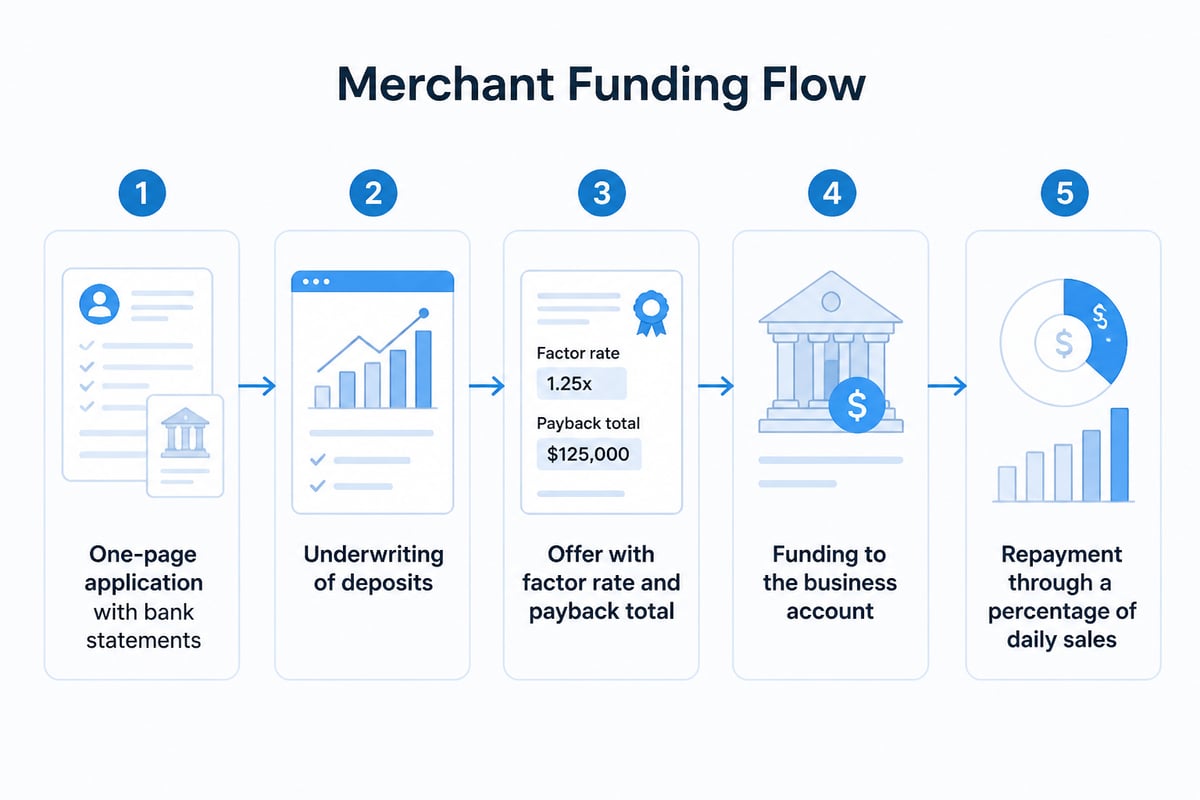
A merchant funding transaction moves from application to repayment in five stages, and the whole process often takes days rather than weeks.
- Application. You submit a short application along with recent business bank statements, and sometimes processing statements if you accept cards.
- Underwriting. The funder reviews your deposits, average daily balance, and revenue trends to estimate how much you can repay comfortably.
- Offer. You receive an advance amount, a factor rate, a total payback figure, and a repayment structure.
- Funding. Once you accept and sign, funds are deposited into your business account.
- Repayment. The provider collects a fixed percentage of daily card sales, or a set daily or weekly debit from your bank account, until the full payback amount is met.
The percentage withheld from sales is called the holdback. A holdback is not an interest rate. It is the portion of your revenue directed to repayment, and it determines how quickly the advance is cleared.
A short application and fast turnaround are the main draw. Enterprise Finest Solutions, for example, works from a short application and recent bank statements to evaluate eligibility.
Who Qualifies for Merchant Funding?
Businesses qualify for merchant funding mainly by showing consistent revenue, not by presenting a high credit score. Requirements vary by provider, but common expectations include the following:
- Time in business: an operating history that gives the funder enough revenue data to evaluate
- Revenue: consistent monthly revenue or card sales
- Banking: a dedicated business bank account with regular deposits
- Location: a business operating in the United States
Funders pay close attention to the pattern of your deposits. Steady daily or weekly inflows, a healthy average balance, and few overdrafts all improve your standing. A business with strong revenue but frequent negative balances can still be declined.
Funding amounts usually scale with revenue, and the amount available depends on each business's performance.
Businesses that generally will not qualify include very new startups, companies without a business bank account, and those with weak or irregular revenue. Personal loans are a different product altogether and fall outside merchant funding.
If you are unsure how a funder will read your account activity, learn how to read a business bank statement the way an underwriter does before you apply.
How Do You Calculate the True Cost of Merchant Funding?
You calculate the true cost of merchant funding by comparing the total payback amount to the advance, then converting the result to an annualized figure so it can be compared with other products.
The math starts with the factor rate, typically expressed as a decimal such as 1.2 to 1.5. Multiply the advance by the factor rate to get the total you will repay.
| Item | Example |
|---|---|
| Advance received | $50,000 |
| Factor rate | 1.30 |
| Total payback | $65,000 |
| Cost of capital | $15,000 |
| Expected repayment period | 6 months |
A $15,000 cost over six months is not a 30 percent annual rate. Because you repay in daily or weekly increments, you hold less than the full amount for most of the term, and the effective annualized cost is considerably higher than the factor rate suggests. Always ask for the total payback figure and the expected term, then convert to an annual percentage so you can compare it fairly against a term loan or line of credit.
Also confirm these details in writing:
- Whether fees are deducted from the advance before funding
- Whether early repayment earns any discount
- How the holdback adjusts if your sales drop
- What happens in the event of a default
The cost is the price of speed and approval flexibility. It makes sense when the capital produces a return that clearly exceeds it, such as inventory that turns quickly or equipment that adds immediate capacity.
What Are the Pros and Cons of Merchant Funding?
Merchant funding trades higher cost for speed, flexibility, and easier approval. Weighing both sides against your actual need is the sound way to decide.
Advantages
- Fast decisions and funding, often within days
- Approval based on revenue rather than credit score
- Minimal paperwork compared with bank loans
- Repayment that flexes with sales when structured as a percentage of card receipts
- No requirement to pledge real estate or equipment
Drawbacks
- Higher effective cost than most term loans and lines of credit
- Daily or weekly withdrawals that reduce available cash
- Short repayment windows
- Risk of stacking multiple advances, which can strain cash flow quickly
A useful test is margin. If the project funded by the advance will not generate returns well above the cost of capital within the repayment period, a slower and cheaper product is the better fit.

Is Merchant Funding Better Than a Bank or SBA Loan?
Merchant funding is faster and easier to obtain than a bank or SBA loan, but SBA and bank products are usually cheaper for businesses that can wait and meet stricter requirements.
The U.S. Small Business Administration describes its 7(a) loan program as its primary business-loan program, with a maximum loan amount of $5 million, and notes that proceeds can fund short- and long-term working capital. To qualify, a business generally must operate for profit in the United States, meet SBA size standards, and be creditworthy with a reasonable ability to repay. Eligibility also considers what the business does to earn income, its credit history, and where it operates.
For smaller needs, the SBA's Microloan program offers loans of $50,000 or less. Bank of America's overview of how SBA loans are evaluated and approved outlines qualification factors and common uses, which helps you judge whether the wait is realistic for your situation.
The practical comparison comes down to urgency and credit profile:
- Need capital in days, and revenue is strong: merchant funding is built for this situation.
- Can wait weeks or months, and credit and financials are solid: an SBA or bank loan will likely cost less.
- Need a flexible, reusable credit source: a line of credit may suit better. See how business lines of credit work.
What Are the Alternatives to Merchant Funding?
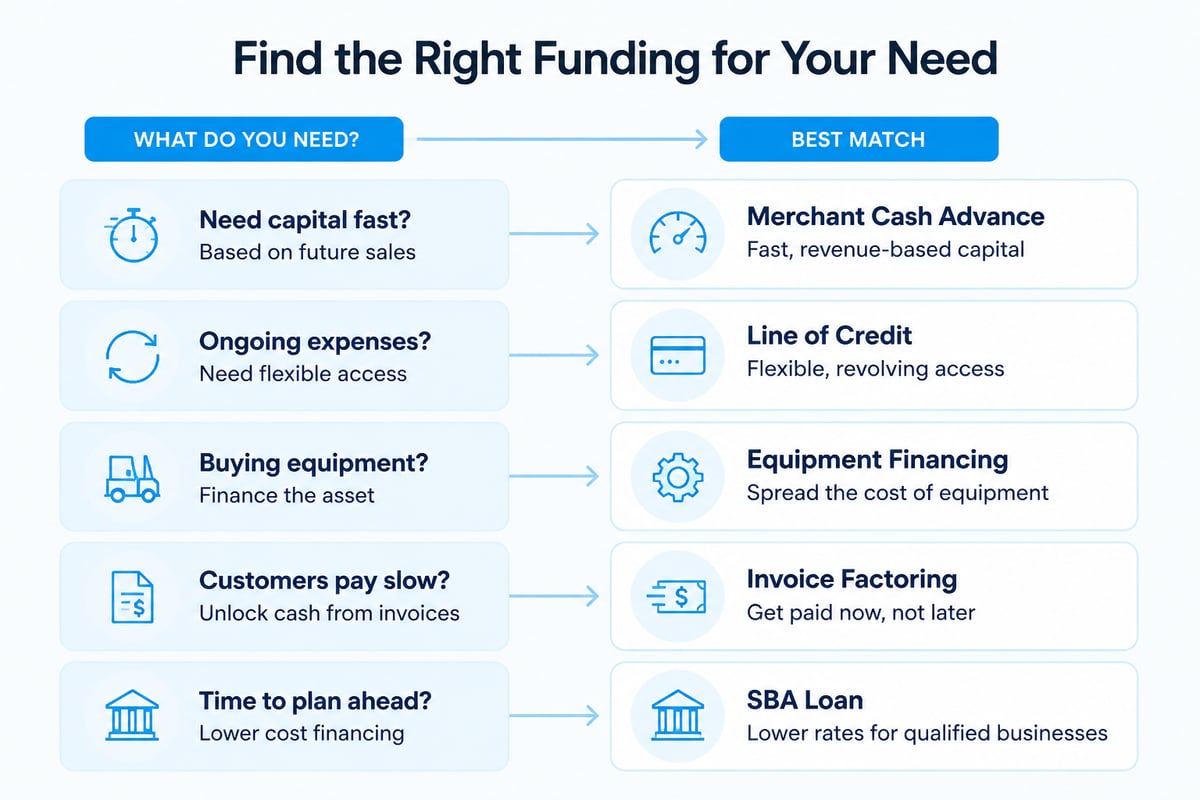
The main alternatives to merchant funding are working capital loans, lines of credit, equipment financing, and invoice factoring, each matched to a different cash-flow problem.
- Working capital loans provide a lump sum with fixed repayments. Review the working capital loan guide for typical terms.
- Lines of credit let you draw and repay as needed, paying only for what you use.
- Equipment financing uses the purchased asset as security, which often lowers the cost. Details are in the equipment financing guide.
- Invoice factoring converts unpaid invoices into immediate cash, suited to businesses that wait 30 to 90 days for customers to pay. See invoice factoring.
Matching the product to the problem matters more than chasing the lowest headline number. A seasonal inventory gap, a delayed receivable, and a one-time equipment purchase each call for a different structure.
How Do You Prepare for Merchant Funding Approval?
You prepare for merchant funding approval by organizing your financial records and strengthening the deposit patterns that underwriters examine.
- Gather bank statements. Have the most recent three to six months of business statements ready.
- Separate business and personal money. A dedicated business account is a baseline requirement.
- Reduce overdrafts. Frequent negative balances signal cash-flow stress.
- Know your number. Decide the exact amount you need and the return it will generate before requesting an offer.
- Check existing obligations. Outstanding advances or loan payments reduce what a funder will extend.
A short checklist of documents saves time and shortens the path to an offer.
How Can a Broker Help You Compare Merchant Funding Options?
A funding broker compares offers from multiple providers on your behalf, so you see structures and pricing side by side instead of evaluating a single lender's terms in isolation.
Enterprise Finest Solutions (EFS) is a business financing brokerage that connects owners with a network of lenders and alternative funding providers. The goal is to match a financing option to your revenue, business performance, industry, and capital needs. For merchants with consistent revenue, merchant cash advance and revenue-based financing through EFS's funding partners is one route for covering inventory, payroll, expansion, marketing, or cash-flow gaps. Qualification centers heavily on revenue and overall performance.
EFS clients have left several five-star reviews on Google, and the process is built around minimal paperwork. Whichever route you choose, compare at least two offers by total payback and expected term, not by factor rate alone.
FAQ
What website will let you borrow money instantly?
No reputable business funder moves money truly instantly, because underwriting and identity checks are required. Online funding providers and brokers can often return a decision within hours and release funds in one to two business days once documents are in order.
Is it hard to get a startup business loan?
It is often difficult, because most lenders want a track record of revenue. A very new business has little operating history to evaluate, so options are limited and typically rely on personal credit, collateral, or SBA microloans. Once a business builds consistent monthly revenue, more funding paths open up.
What are merchant services in banking?
Merchant services are the tools a business uses to accept customer payments, including card processing, payment terminals, and online checkout. They are separate from merchant funding, though a business's card processing history is often used to size an advance.
Start by pulling your last three to six months of business bank statements and calculating your average monthly revenue, since that single number drives most funding decisions. From there, you can compare offers by total payback and term instead of by headline rate. If your business has a solid operating history and consistent monthly revenue, the team at Enterprise Finest Solutions can review your options, including merchant cash advance and revenue-based financing, and you can Apply Now through Enterprise Finest Solutions to see which funding fits your numbers.
Written by
Enterprise Finest Solutions
Content creator and writer sharing insights and stories.