Hard Money Business Loans: Fast Financing for Growth
Discover how hard money business loans work, who qualifies, typical terms, costs, and when asset-based financing makes sense for your company.

Hard money business loans represent a specialized segment of commercial financing that prioritizes asset value over traditional creditworthiness. Unlike conventional bank loans that heavily scrutinize credit scores, financial statements, and operational history, hard money business loans focus primarily on the value of collateral-typically real estate, equipment, or other tangible assets. This fundamental difference makes these loans accessible to businesses that might not qualify through traditional channels, though the convenience comes with distinct trade-offs in cost and structure.
Understanding Hard Money Business Loans
Hard money business loans originated in the private lending sector as a solution for real estate investors and developers who needed capital quickly or couldn't meet conventional lending standards. The "hard" designation refers to the hard asset-usually property-that secures the loan, not the difficulty of obtaining one.
These loans are primarily funded by private investors, specialized lending firms, or investment groups rather than traditional banks. The underwriting process differs dramatically from conventional financing. Lenders evaluate the current value and potential of the collateral first, with the borrower's creditworthiness playing a secondary role.
Key Characteristics
Hard money business loans typically share several defining features:
- Asset-based approval: Collateral value drives the lending decision
- Speed: Funding often available within days or weeks, not months
- Flexibility: Terms negotiated directly with private lenders
- Higher costs: Interest rates and fees exceed traditional financing
- Shorter duration: Terms usually range from 6 months to 3 years
The growth of private credit markets has expanded significantly over the past decade. According to Federal Reserve analyses on private credit and nonbank lending, private lending now represents a substantial portion of commercial financing, particularly for borrowers seeking alternatives to traditional banking relationships.
Who Uses Hard Money Business Loans

Several business scenarios make hard money business loans particularly attractive despite their higher costs.
Real Estate Investors and Developers
Property investors represent the largest user group. Businesses purchasing commercial real estate, flipping properties, or developing land often turn to hard money when timing matters more than cost. A retail business acquiring its storefront location before a competitor, or a developer securing a demolition property at auction, may need capital before traditional bank underwriting could conclude.
Businesses with Credit Challenges
Companies rebuilding after financial difficulties, startups without established credit history, or businesses with recent collections or judgments may find conventional doors closed. Hard money business loans look past these issues when sufficient collateral exists.
Time-Sensitive Opportunities
When opportunity knocks loudly, speed matters. A restaurant equipment liquidation sale, a competitor's going-out-of-business inventory, or a limited-time vendor discount might justify higher borrowing costs if conventional approval timelines would mean missing the chance entirely.
Bridge Financing Needs
Businesses awaiting long-term financing approval, pending asset sales, or expecting large receivables payments sometimes use hard money business loans as temporary bridges. The short-term nature aligns with these situations, even though the costs accumulate quickly.
Cost Structure and Terms
Understanding the true cost of hard money business loans requires looking beyond just interest rates.
| Cost Component | Typical Range | Notes |
|---|---|---|
| Interest Rate | 8% - 18% annually | Depends on collateral quality, loan-to-value ratio, borrower strength |
| Origination Fee | 2% - 5% of loan | Charged upfront; sometimes called "points" |
| Closing Costs | $500 - $3,000+ | Appraisals, title work, legal fees |
| Prepayment Penalty | 0% - 6 months interest | Some lenders charge penalties for early payoff |
| Loan Term | 6 - 36 months | Shorter terms more common; extensions may be available |
Interest Calculation Methods
Hard money lenders may calculate interest differently than traditional loans. Some charge simple interest on the outstanding balance, while others use more complex formulas. Borrowers should clarify whether interest accrues monthly or daily, how payments are applied, and whether any minimum interest guarantees exist.
For businesses considering these loans, understanding the tax treatment of loan interest becomes important. Interest paid on business loans is generally tax-deductible, which provides some offset to the higher rates, though borrowers should consult tax professionals about their specific situations.
Collateral Requirements
The collateral backing hard money business loans determines both approval likelihood and loan terms.
Real Estate Collateral
Commercial property, office buildings, retail space, warehouses, and even owner-occupied business real estate commonly secure these loans. Lenders typically advance 50% to 70% of the property's appraised value, creating a cushion protecting their investment if foreclosure becomes necessary.
Loan-to-value ratios (LTV) represent the central metric. A $400,000 property might support a $280,000 loan at 70% LTV, but only $200,000 at 50% LTV. Properties in desirable locations with strong markets command better ratios than those in declining areas.
Equipment and Business Assets
Some hard money business loans use equipment, machinery, vehicles, or inventory as collateral. These typically receive less favorable terms than real estate because equipment depreciates and becomes harder to liquidate. LTV ratios for equipment often range from 40% to 60% of assessed value.
Businesses exploring equipment as collateral might compare hard money options against equipment financing structures that spread costs over longer terms with potentially lower rates.

Personal Guarantees
Even though hard money business loans emphasize assets over credit, many lenders still require personal guarantees from business owners. This creates dual recourse-the lender can pursue both the collateral and the guarantor personally if default occurs.
Application and Approval Process
Hard money business loans follow a streamlined but still rigorous process.
Initial Evaluation
- Submit collateral information: Property address, estimated value, existing liens
- Provide business overview: Nature of business, use of funds, repayment source
- Preliminary underwriting: Lender reviews for basic feasibility
- Letter of intent: If promising, lender issues terms outline
Documentation Phase
While less extensive than conventional loans, hard money business loans still require documentation:
- Business formation documents (LLC operating agreement, articles of incorporation)
- Property details (legal description, recent appraisal if available, photos)
- Existing mortgage statements and lien information
- Business financial overview (may be informal for strong collateral)
- Borrower identification and background
Closing Timeline
Experienced hard money lenders can close in 7 to 14 business days when borrowers provide documentation promptly and no title issues emerge. Complex situations-multiple owners, title clouds, or unusual properties-may extend timelines to 3 to 4 weeks.
State regulations significantly impact the hard money lending process. For example, California's robust licensing requirements under the California Financing Law impose specific disclosure and operational standards on lenders, adding compliance layers that protect borrowers but may affect timing and terms.
Risks and Considerations
Hard money business loans carry substantial risks that warrant careful evaluation.
Cost Accumulation
The combination of high interest rates, origination fees, and short terms means costs accumulate rapidly. A $100,000 hard money loan at 12% annual interest with 3 points upfront costs $3,000 immediately plus $12,000 annually in interest. Over a 12-month term, total costs reach $15,000-15% of the borrowed amount-before considering any other fees.
Refinancing Requirements
Most businesses cannot sustain hard money business loan costs long-term. Borrowers typically need an exit strategy: securing conventional financing after credit improves, selling the collateral property, or receiving expected revenue that enables payoff. Without a realistic exit plan, businesses risk defaulting and losing their collateral.
Foreclosure Speed
Hard money lenders include provisions enabling rapid foreclosure upon default. Unlike conventional lenders who may work through lengthy modification processes, private lenders often act quickly to protect their capital. Some jurisdictions allow non-judicial foreclosure that can conclude within months of missed payments.
Regulatory oversight of hard money business loans varies by state and situation. The FDIC's examination of risks associated with nonbank lending highlights supervisory concerns about rapid growth in private credit markets and potential systemic risks, though most regulatory frameworks currently apply less stringent requirements to commercial lending than consumer loans.
Alternatives Worth Considering
Before committing to hard money business loans, businesses should explore other options that might better serve their needs.
Revenue-Based Financing
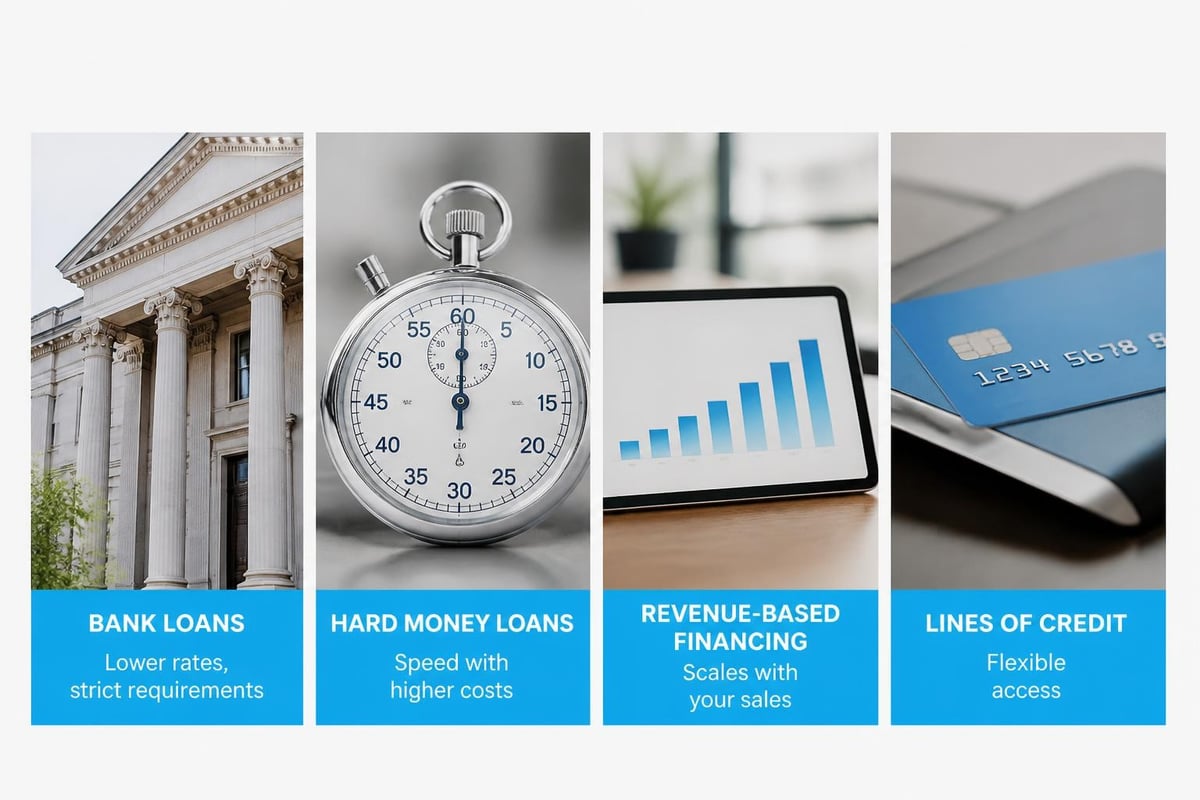
Companies with strong, consistent revenue streams might qualify for revenue-based financing or merchant cash advances. These products repay through a percentage of daily or weekly sales rather than fixed monthly payments. While costs can be high, they align repayment with business performance. Businesses interested in this approach can explore merchant cash advance and revenue-based financing options that match funding to revenue patterns.
Working Capital Solutions
General working capital financing addresses many of the same needs as hard money business loans-covering operational expenses, purchasing inventory, managing cash flow gaps-but may offer better terms for qualified businesses. The approval process typically takes longer but results in more sustainable cost structures.
Business Lines of Credit
A business line of credit provides flexible access to capital for recurring or unexpected expenses without the high costs and short terms of hard money business loans. Businesses draw funds as needed and pay interest only on outstanding balances, making lines of credit efficient for managing variable capital needs.
SBA and Conventional Bank Loans
Businesses that can wait 60 to 90 days for approval should investigate Small Business Administration loan programs and conventional bank financing. These options deliver significantly lower rates-often 6% to 10% annually-and longer repayment periods that reduce monthly obligations.
Strategic Use Cases
Despite their costs, hard money business loans serve legitimate strategic purposes when used appropriately.
Value-Add Real Estate Plays
A business purchasing property requiring immediate renovation to become profitable might use hard money during the improvement period, then refinance into conventional financing once renovations increase property value and create stable cash flow. The higher short-term costs enable capturing value that justifies the expense.
Auction and Foreclosure Purchases
Properties sold at auction often require all-cash purchases or very rapid closings. Hard money business loans enable businesses to compete in these markets, potentially acquiring assets below market value that offset financing costs.
Credit Rebuilding Bridge
Businesses emerging from bankruptcy, financial restructuring, or credit challenges can use hard money business loans strategically while rebuilding creditworthiness. Successfully managing a hard money loan-making payments on time and repaying as agreed-demonstrates renewed financial responsibility that helps secure better financing later.
According to market analysis of private lending trends, hard money and private lending markets have grown substantially, with more specialized lenders entering the field and creating competitive pressure that has modestly improved terms for borrowers in recent years.
Due Diligence and Lender Selection
Choosing the right hard money lender significantly impacts the experience and outcome.
Lender Vetting
Research potential lenders thoroughly:
- Experience and track record: How long have they operated? Do they specialize in your property type or business situation?
- Transparent terms: Do they clearly explain all fees, rates, and conditions?
- References: Can they provide references from recent borrowers?
- Licensing and compliance: Are they properly licensed in your state?
- Funding source: Do they lend their own capital or broker to others?
Red Flags
Avoid lenders who:
- Request upfront fees before approval
- Pressure immediate decisions without time for review
- Provide vague or changing terms
- Lack physical office locations or verifiable business history
- Offer terms that seem too good compared to market rates
Consumer advocacy organizations like the National Consumer Law Center publish research on lending practices that, while often focused on consumer loans, highlight problematic practices that can appear in commercial lending as well.
Term Negotiation
Hard money business loan terms are more negotiable than conventional financing. Borrowers with strong collateral or relationships can often negotiate:
- Lower origination fees: Especially for larger loans or repeat borrowers
- Rate reductions: Based on LTV ratio, exit strategy clarity, or business strength
- Extension options: Pre-negotiated terms for extending maturity if needed
- Prepayment flexibility: Eliminating or reducing prepayment penalties
Market Trends and Future Outlook
The hard money business loan market continues evolving in response to regulatory changes, market conditions, and competitive dynamics.
Institutional Entry
Traditional institutional investors increasingly allocate capital to private lending funds, bringing more capital to the market and potentially moderating rates. This institutionalization also introduces more standardized underwriting and documentation practices.
Technology Integration
Digital platforms now connect borrowers with multiple hard money lenders simultaneously, increasing transparency and competition. Automated valuation models and digital documentation streamline processes that previously required extensive manual work.
Regulatory Attention
Federal and state regulators show increasing interest in nonbank lending growth and potential systemic risks. The U.S. Treasury's examination of nonbank mortgage servicing reflects broader policy focus on private lending markets that may lead to enhanced oversight, potentially affecting availability and terms of hard money business loans.
Compliance requirements continue expanding. The Consumer Financial Protection Bureau's guidance primarily addresses consumer lending, but commercial lenders increasingly face scrutiny around disclosure practices, fee transparency, and fair dealing standards that influence operational practices.
Hard money business loans fill a specific niche in commercial financing, providing rapid access to capital when conventional options aren't viable or timing demands urgency. While costs exceed traditional lending, strategic use of these loans can help businesses seize opportunities, bridge temporary gaps, or rebuild creditworthiness. If your business needs fast, flexible financing and you're evaluating all available options, Enterprise Finest Solutions connects business owners with a network of lenders and funding providers to identify solutions aligned with your revenue, assets, and capital requirements.
Written by
Enterprise Finest Solutions
Content creator and writer sharing insights and stories.