Funding Loans: A Complete Business Guide for 2026
Discover how funding loans work for businesses in 2026. Learn about types, eligibility, application strategies, and how to secure capital.

Funding loans represent one of the most critical resources for businesses seeking to grow, manage cash flow, or navigate operational challenges. As the financial landscape evolves in 2026, understanding how to access and leverage these financing tools has become essential for business owners across industries. Whether you're looking to expand your operations, purchase equipment, or simply maintain healthy working capital, knowing the mechanics of business funding can make the difference between seizing opportunities and missing them entirely.
Understanding the Fundamentals of Business Funding Loans
Funding loans serve as the financial backbone for countless small and medium-sized enterprises across North America. These capital solutions come in various forms, each designed to address specific business needs and circumstances.
At their core, funding loans provide businesses with capital that must be repaid over time, typically with interest or fees. Unlike equity financing, where you give up ownership stakes, debt-based funding allows you to maintain full control of your business while accessing necessary resources.
The landscape of business financing has expanded considerably beyond traditional bank loans. Today's business owners can explore:
- Term loans with fixed repayment schedules
- Lines of credit offering flexible, revolving access to capital
- Revenue-based financing tied to business performance
- Equipment financing for asset acquisition
- Invoice factoring to accelerate cash flow
Each option carries distinct advantages, qualification requirements, and cost structures that business owners must carefully evaluate.
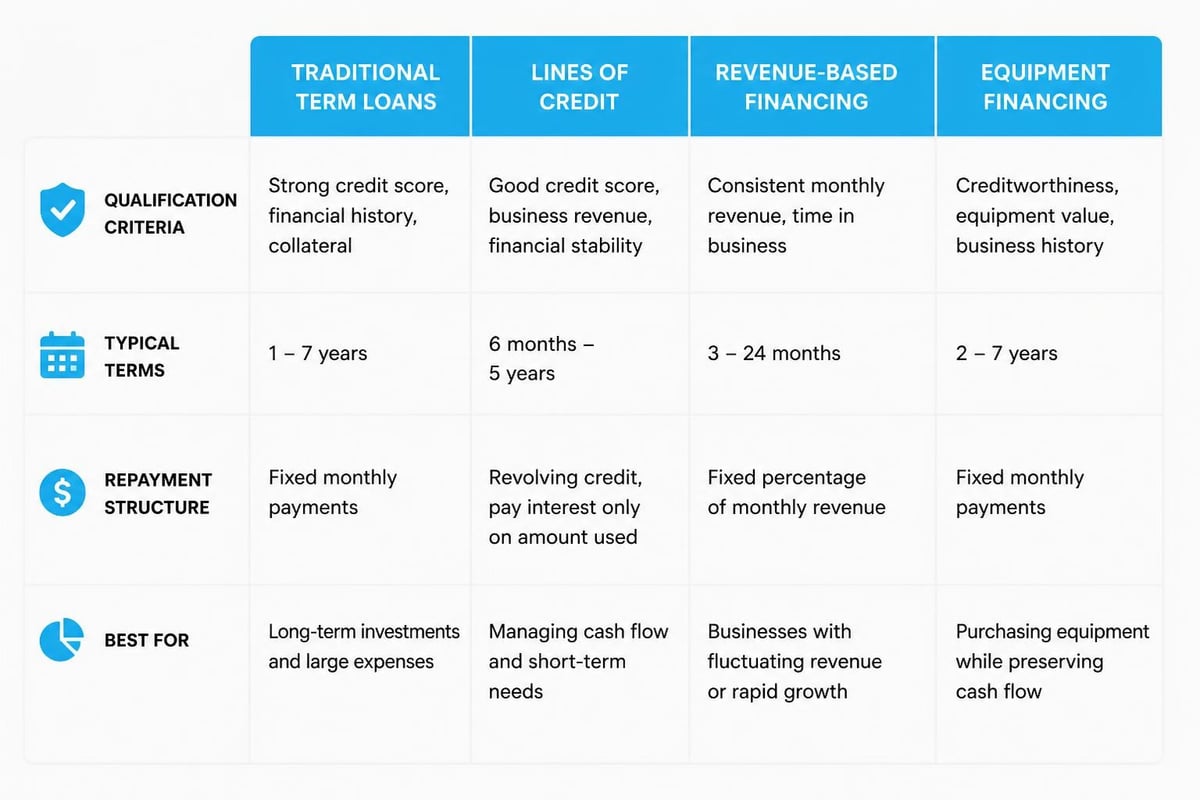
Traditional Bank Loans vs. Alternative Funding
Traditional bank lending remains a cornerstone of small business financing. The SBA loan programs offer government-backed options that reduce lender risk while providing favorable terms to qualified borrowers. These include 7(a) loans for general business purposes, 504 loans for real estate and equipment, and microloans for smaller capital needs.
However, traditional funding loans often require extensive documentation, strong credit profiles, and collateral. The FDIC's 2024 small business lending survey reveals shifting patterns in how banks evaluate small business applications, with increasing emphasis on digital documentation and automated underwriting.
Alternative lenders have filled gaps left by traditional institutions. These providers often prioritize business revenue and performance over personal credit scores, enabling faster approvals and more flexible qualification standards.
Qualification Criteria and Application Strategies
Securing funding loans requires understanding what lenders evaluate during the underwriting process. While specific requirements vary across lenders and products, several core factors consistently influence approval decisions.
Key Evaluation Factors
| Factor | Traditional Lenders | Alternative Lenders |
|---|---|---|
| Credit Score | 680+ typically required | 550+ often acceptable |
| Time in Business | 2+ years preferred | 6-12 months minimum |
| Annual Revenue | $250,000+ common threshold | $100,000+ may qualify |
| Collateral | Often required | Sometimes optional |
| Documentation | Extensive financial statements | Streamlined process |
Personal and business credit history forms the foundation of most lending decisions. Lenders review payment histories, outstanding debts, and credit utilization to assess risk. However, the weight placed on credit varies significantly across funding sources.
Revenue demonstrates your ability to service debt. Many funding loans, particularly revenue-based options, focus heavily on monthly or annual sales figures. Consistent revenue patterns signal stability and repayment capacity.
Industry and business model also influence approval odds. Some sectors carry higher perceived risk, affecting both approval rates and pricing. Understanding how lenders view your industry helps set realistic expectations.
Documentation Requirements
Preparing comprehensive documentation accelerates the application process and improves approval chances. Most lenders request:
- Business formation documents (articles of incorporation, operating agreements)
- Financial statements (profit and loss, balance sheets, cash flow statements)
- Bank statements (typically 3-6 months)
- Tax returns (business and personal, 1-2 years)
- Business plan (for larger loan amounts)
Alternative funding providers may streamline these requirements, sometimes approving applications based primarily on bank statements and revenue verification.
Cost Analysis and Terms Structure
Understanding the true cost of funding loans requires looking beyond headline interest rates. Various fee structures, repayment terms, and pricing models impact the total capital cost and cash flow implications.
Interest Rates and Factor Rates
Traditional term loans typically quote annual percentage rates (APR), making comparison straightforward. In 2026, small business loan rates generally range from 6% to 30% depending on creditworthiness, loan size, and term length.
Alternative products often use factor rates instead of APR. A factor rate of 1.2, for example, means you repay $1.20 for every dollar borrowed. While this seems simple, comparing factor rates to APR requires calculating the effective cost over the repayment period.
Origination fees represent one-time charges assessed at closing, typically ranging from 1% to 6% of the loan amount. Processing fees, underwriting fees, and draw fees may apply depending on the product structure.
For businesses exploring flexible capital access, working capital financing provides options that align funding costs with business cash flow and revenue cycles, often offering more manageable repayment structures than traditional fixed-term loans.

Repayment Structures and Cash Flow Impact
Repayment terms significantly affect business cash flow management. Common structures include:
- Monthly installments with fixed payment amounts
- Daily or weekly ACH debits based on revenue percentages
- Seasonal payment schedules accommodating revenue fluctuations
- Interest-only periods followed by principal and interest payments
Shorter terms reduce total interest costs but increase payment amounts. Longer terms lower periodic payments but increase cumulative interest. Matching repayment schedules to your revenue patterns and cash flow cycles optimizes financial management.
The Federal Reserve's 2024 annual report highlights trends in business credit conditions, showing how macroeconomic factors influence both availability and pricing of funding loans across market segments.
Specialized Funding Options for Different Business Needs
Different business objectives require tailored funding solutions. Understanding specialized loan products helps match capital sources to specific use cases.
Asset-Based Lending
Equipment financing and asset-based loans tie funding directly to tangible property. These arrangements often offer favorable terms because the purchased asset serves as collateral, reducing lender risk.
Equipment loans typically finance 80% to 100% of the asset value with repayment terms matching the equipment's useful life. This alignment ensures you're not paying for equipment long after it becomes obsolete.
Growth and Expansion Capital
Businesses pursuing growth opportunities need flexible funding that accommodates varying capital needs. Expansion might involve:
- Opening new locations
- Launching product lines
- Entering new markets
- Scaling operations
- Acquiring competitors
Growth-focused funding loans often feature larger amounts, longer terms, and may include revenue-based components that scale payments with business performance.
Working Capital Solutions
Day-to-day operational expenses require readily accessible capital. Working capital financing addresses:
- Inventory purchases ahead of seasonal demand
- Payroll during slow periods
- Marketing campaigns
- Unexpected repairs or equipment replacement
- Bridging gaps between payables and receivables
Lines of credit excel for recurring working capital needs, providing revolving access to funds as you need them. Unlike term loans requiring full drawdown at closing, credit lines let you access only what you need when you need it.
Regulatory Framework and Consumer Protections
The regulatory environment governing funding loans has evolved significantly, with increased focus on transparency and borrower protection. Understanding these frameworks helps business owners navigate the lending landscape more effectively.
Truth in Lending and Disclosure Requirements
Federal regulations mandate specific disclosures for consumer and business loans. Regulation Z under the Truth in Lending Act establishes disclosure requirements and limitations on certain loan products, ensuring borrowers receive clear information about costs and terms.
While some regulations primarily cover consumer loans, many disclosure principles have extended to small business lending through state-level requirements and industry best practices.
Lender Standards and Risk Management
Banks and regulated lenders operate under strict capital requirements and risk management frameworks. The Basel Framework on credit risk establishes international standards for measuring and managing credit risk, influencing how institutions structure and price funding loans.
Understanding these frameworks explains why different lenders offer varying terms and why some business models face higher costs or limited access to traditional funding.

Strategic Considerations for Funding Selection
Selecting appropriate funding loans requires analyzing both immediate needs and long-term business strategy. Short-term thinking can lead to costly mistakes that strain finances and limit future options.
Matching Capital to Use Cases
Different business expenses warrant different funding approaches. A simple framework helps guide decisions:
| Expense Type | Recommended Funding | Reasoning |
|---|---|---|
| Long-term assets (property, major equipment) | Term loans, SBA loans | Match repayment to asset life |
| Short-term needs (inventory, seasonal payroll) | Lines of credit, revenue-based funding | Flexibility for fluctuating needs |
| Urgent opportunities (time-sensitive deals) | Alternative funding | Speed and accessibility |
| Growth initiatives (expansion, acquisition) | Combination approaches | Layered capital structure |
Preservation of future borrowing capacity matters significantly. Overleveraging with expensive short-term funding can limit access to favorable long-term financing when larger opportunities arise.
Building Lender Relationships
Establishing relationships with funding sources before urgent needs arise provides advantages. Regular communication, transparent reporting, and reliable repayment build trust that translates to better terms and faster approvals when you need capital.
The SBA's lender resources outline how approved lenders participate in government programs, demonstrating the infrastructure supporting small business funding loans and helping business owners identify reputable partners.
Market Trends Shaping Business Funding in 2026
The funding landscape continues evolving rapidly, driven by technology, regulatory changes, and shifting economic conditions. Staying informed about trends helps business owners anticipate opportunities and challenges.
Technology-Driven Underwriting
Automated underwriting platforms increasingly supplement or replace traditional manual reviews. These systems analyze:
- Bank account transaction patterns
- Payment processing data
- Online reviews and digital presence
- Supply chain relationships
- Industry benchmarking data
This technology enables faster decisions while expanding access for businesses with limited traditional credit history but strong operational metrics.
Alternative Data in Credit Decisions
Lenders increasingly incorporate non-traditional data sources into funding loan evaluations. Utility payment history, rent payments, subscription management, and supplier relationships provide insights beyond conventional credit reports.
This expanded view particularly benefits newer businesses and those rebuilding credit after previous challenges.
Syndicated and Marketplace Lending
The growing complexity of syndicated loan markets affects larger businesses and demonstrates how credit risk distributes across institutional investors. While most small businesses don't directly participate in syndicated markets, these trends influence overall credit availability and pricing.
Online lending marketplaces connect borrowers with multiple funding sources simultaneously, increasing competition and potentially improving terms. These platforms streamline comparison shopping while maintaining competitive tension among lenders.
Risk Management and Financial Planning
Responsible use of funding loans requires comprehensive risk assessment and financial planning. Capital should strengthen your business, not create unsustainable obligations.
Scenario Planning and Stress Testing
Before committing to funding, model various scenarios:
- Base case: Expected revenue and expense patterns
- Optimistic case: Strong performance and accelerated growth
- Conservative case: Revenue decline or unexpected expenses
- Worst case: Severe downturn or major disruption
Ensure you can service debt obligations even in conservative scenarios. If only the optimistic case works, the funding structure carries excessive risk.
Covenant Compliance and Reporting
Many funding loans include financial covenants requiring maintenance of specific metrics:
- Minimum debt service coverage ratios
- Maximum debt-to-equity ratios
- Minimum working capital thresholds
- Revenue or profitability targets
Tracking these metrics proactively prevents violations that can trigger default provisions or additional fees.
Exit Strategies and Refinancing
Plan how you'll exit or refinance funding before committing. Consider:
- Prepayment penalties or restrictions
- Refinancing triggers (credit score improvements, revenue milestones)
- Balloon payments requiring refinancing or asset sales
- Conversion options or rate adjustments
Building relationships with multiple funding sources creates options when refinancing becomes advantageous or necessary.
Application Optimization and Approval Acceleration
Securing funding loans quickly and efficiently requires strategic preparation and presentation. Small optimizations in your application approach can significantly impact both approval odds and terms offered.
Financial Statement Preparation
Present financial information clearly and professionally. Inconsistencies, errors, or confusing formats raise red flags and slow underwriting. Consider:
- Professional bookkeeping: Clean, accurate records inspire confidence
- Reconciliation: Ensure bank statements match accounting records
- Explanatory notes: Proactively address anomalies or unusual patterns
- Forward-looking projections: Demonstrate planning and strategic thinking
Many lenders now accept read-only access to accounting software, streamlining verification while reducing documentation burdens.
Narrative and Business Context
Numbers tell part of the story, but context matters. A compelling business narrative explaining your funding needs, repayment plan, and growth trajectory strengthens applications.
Address potential concerns proactively. If your credit shows past difficulties, explain circumstances and demonstrate corrective actions. If revenue fluctuates seasonally, highlight patterns and show historical recovery.
Multi-Source Strategy
Don't put all eggs in one basket. Applying to multiple compatible funding sources simultaneously provides:
- Comparison leverage for negotiating better terms
- Backup options if primary choices fall through
- Faster access to capital through competitive timelines
- Insight into how different lenders value your business
Avoid applying to numerous lenders within narrow product categories, as this can trigger multiple credit inquiries and signal desperation. Instead, strategically target diverse options aligned with your needs and qualifications.
Securing the right funding loans positions your business for sustainable growth while maintaining healthy cash flow and financial flexibility. The key lies in matching capital sources to specific business needs, understanding true costs beyond headline rates, and building relationships with reputable lenders who align with your long-term objectives. Enterprise Finest Solutions connects business owners with a network of lenders and alternative funding providers, helping you identify financing options that align with your revenue, business performance, industry, and capital needs-ensuring you access the right funding at the right time.
Written by
Enterprise Finest Solutions
Content creator and writer sharing insights and stories.