Enterprise Funding: Strategies to Fuel Business Growth
Discover enterprise funding strategies, from private equity to debt financing. Learn how businesses secure capital, structure deals, and scale.

Enterprise funding represents the lifeblood of business expansion, enabling companies to move from modest operations to market-leading positions. Whether pursuing aggressive growth, acquiring competitors, upgrading infrastructure, or simply maintaining healthy cash flow, businesses require access to capital that matches their ambitions and operational realities. Understanding the landscape of enterprise funding options, deal structures, and qualification criteria empowers business leaders to make informed decisions that accelerate growth while managing risk effectively.
Understanding the Enterprise Funding Landscape
The modern business finance ecosystem offers far more than traditional bank loans. Enterprise funding encompasses a spectrum of capital sources, each with distinct characteristics, costs, and strategic implications.
Equity-based financing involves selling ownership stakes to investors who provide capital in exchange for partial control and future returns. This category includes venture capital, private equity, angel investors, and strategic corporate investors. According to NVCA's annual Yearbook, venture capital deployment continues to concentrate in technology, healthcare, and climate sectors, with median deal sizes varying significantly by stage and geography.
Debt financing allows businesses to borrow capital while retaining full ownership, repaying the principal plus interest over time. Commercial loans, lines of credit, equipment financing, and revenue-based financing all fall under this umbrella. Debt structures range from traditional term loans with fixed monthly payments to flexible arrangements tied to business performance.
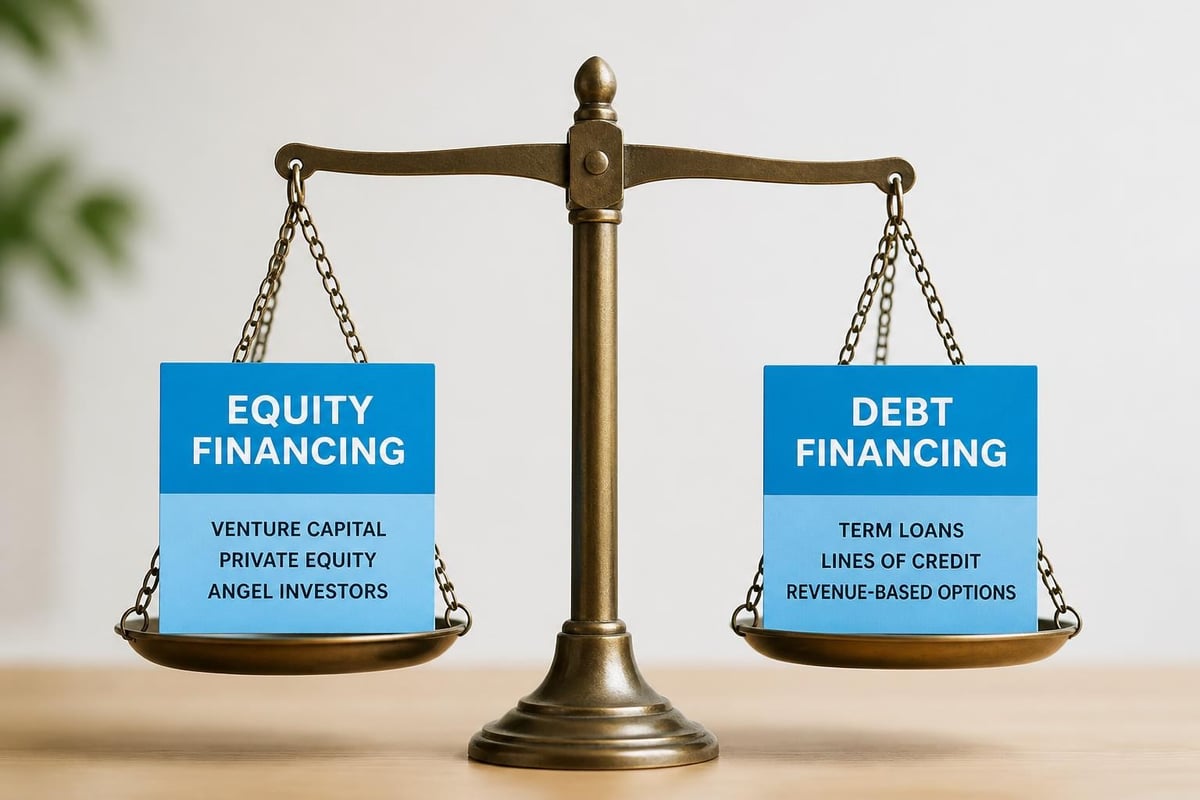
Hybrid and alternative structures blend equity and debt characteristics. Convertible notes start as debt but may convert to equity under specific conditions. Mezzanine financing combines subordinated debt with equity warrants. Revenue-based financing offers debt-like repayment without fixed schedules, instead taking a percentage of monthly revenue until a cap is reached.
Capital Source Selection Criteria
Choosing the right enterprise funding source requires evaluating multiple factors that extend beyond simple cost comparisons.
| Factor | Equity Funding | Traditional Debt | Alternative Debt |
|---|---|---|---|
| Ownership dilution | Yes, permanent | No | No |
| Approval timeline | 3-12 months | 2-8 weeks | 1-2 weeks |
| Revenue requirements | Varies widely | Strict minimum | Moderate minimum |
| Use restrictions | Strategic focus | Broad business use | Broad business use |
| Qualification focus | Growth potential | Credit & collateral | Revenue performance |
Business maturity plays a crucial role in determining appropriate funding sources. Early-stage ventures with unproven business models typically cannot access traditional debt financing and must pursue equity investors willing to accept higher risk for potentially exponential returns. Established businesses with predictable revenue streams can leverage their performance history to secure debt financing at competitive rates.
Industry dynamics influence funding availability and terms. Capital-intensive sectors such as manufacturing, construction, and transportation often require equipment financing solutions that align loan terms with asset useful life. Service businesses with minimal physical assets may find revenue-based structures more accessible than asset-backed loans.
Private Equity and Venture Capital in Enterprise Funding
Private equity represents a dominant force in enterprise funding, particularly for established businesses pursuing significant growth, operational transformation, or ownership transition. Bain's Global Private Equity Report highlights how private equity firms deploy capital across buyouts, growth equity, and special situations, often bringing operational expertise alongside financial resources.
Buyout transactions typically involve private equity firms acquiring controlling stakes in mature businesses with stable cash flows. These deals emphasize operational improvements, strategic acquisitions, and financial engineering to generate returns over 3-7 year holding periods. Buyouts provide enterprise funding that enables ownership transition, recapitalization, or take-private transactions for public companies.
Growth equity targets companies with proven business models seeking capital to accelerate expansion without surrendering control entirely. Growth equity investors typically acquire minority stakes, providing patient capital for geographic expansion, product development, team building, or market share capture. This enterprise funding approach suits businesses generating revenue but requiring substantial investment to reach their full potential.
Venture Capital Deployment Strategies
Venture capital focuses on high-growth potential enterprises in technology, biotechnology, and innovative service sectors. VC firms deploy enterprise funding across stages:
- Seed stage: Concept validation, product development, initial market testing ($500K-$2M typical range)
- Series A: Product-market fit, go-to-market strategy, team expansion ($2M-$15M typical range)
- Series B-C: Scaling operations, market leadership, geographic expansion ($10M-$100M+ typical range)
- Late stage: Pre-IPO growth, market dominance, acquisition positioning ($50M-$500M+ typical range)
Venture capital enterprise funding introduces complexities beyond simple capital infusion. Term sheets specify liquidation preferences, board composition, anti-dilution protections, and exit rights that significantly impact founder economics and control. Understanding these provisions and negotiating favorable terms requires experienced legal counsel and financial advisors.

Debt Financing Structures for Enterprise Growth
Debt-based enterprise funding offers businesses the ability to access capital while maintaining complete ownership control. The trade-off involves contractual repayment obligations regardless of business performance, making cash flow predictability essential.
Term loans provide lump-sum funding repaid over fixed periods with regular installments. Commercial term loans typically range from $50,000 to $5,000,000+ with terms extending 1-10 years depending on loan purpose and business qualifications. Interest rates reflect prime rate benchmarks plus spreads determined by creditworthiness, collateral, and loan-to-value ratios.
Revolving credit facilities establish borrowing capacity that businesses can draw upon, repay, and re-borrow as needed. Working capital financing through revolving structures provides operational flexibility for seasonal businesses, project-based enterprises, and companies managing variable cash flow cycles.
Revenue-Based Financing Models
Revenue-based enterprise funding has gained prominence as an alternative to traditional debt and equity financing. These arrangements provide capital in exchange for a fixed percentage of future revenue until a predetermined cap is reached.
Key characteristics of revenue-based financing include:
- Repayment flexibility: Payment amounts fluctuate with revenue performance, declining during slow periods and accelerating during growth phases
- No equity dilution: Business owners retain full ownership while accessing growth capital
- Revenue focus: Qualification emphasizes revenue consistency and growth trajectory rather than credit scores or physical collateral
- Speed: Approval and funding processes typically complete within days rather than weeks or months
- Use flexibility: Capital can be deployed across marketing, inventory, hiring, equipment, or other strategic priorities
The World Bank's MSME financing resources document how revenue-based and alternative financing structures improve capital access for small and medium enterprises in both developed and emerging markets, particularly for businesses with strong performance metrics but limited traditional collateral.
Structuring Enterprise Funding Transactions
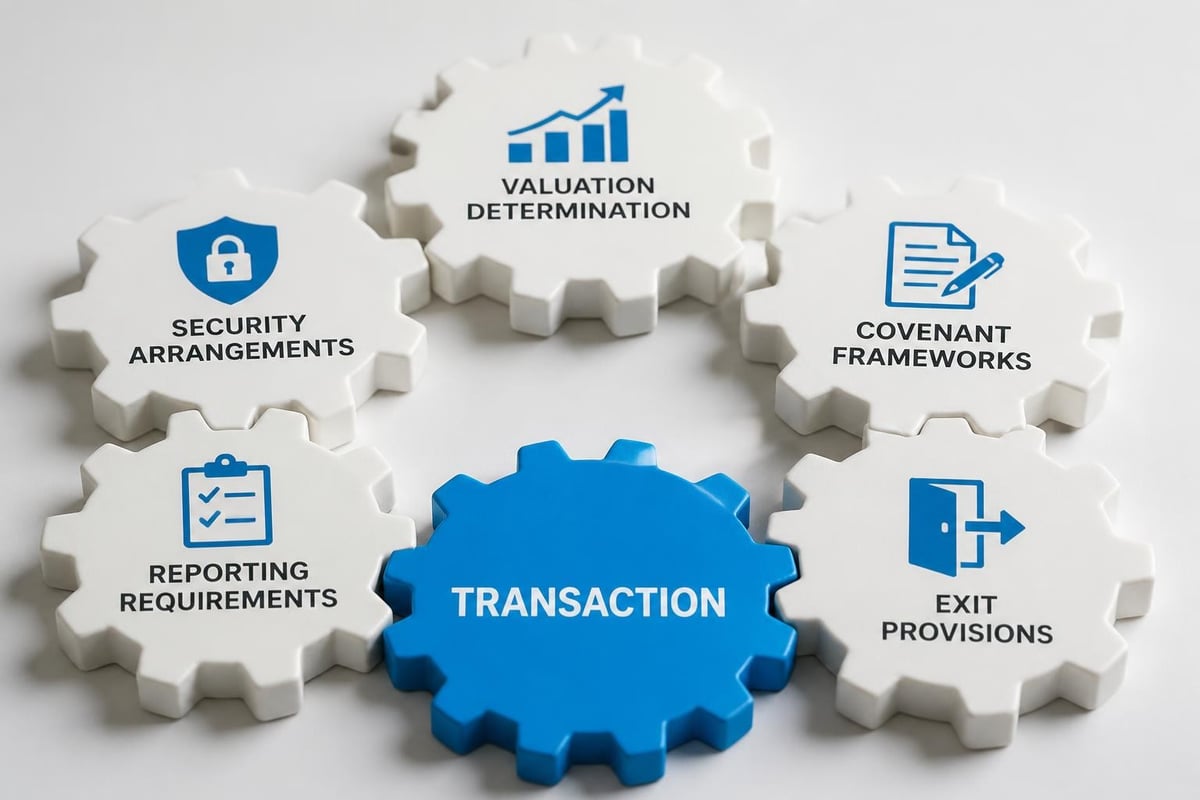
Deal structure significantly impacts both immediate capital access and long-term business trajectory. Sophisticated enterprise funding transactions involve multiple components working together to balance investor protection with business flexibility.
Valuation methodologies determine what percentage of equity investors receive for their capital or what interest rates and terms debt providers require. Common approaches include:
| Valuation Method | Application | Key Drivers |
|---|---|---|
| Comparable transactions | Early-stage equity | Recent deals in similar sectors/stages |
| Discounted cash flow | Mature businesses | Projected future cash flows, risk-adjusted |
| Asset-based | Collateralized debt | Fair market value of pledged assets |
| Revenue multiples | Growth companies | Industry-specific multiples of ARR/revenue |
Security and collateral provisions protect lenders and investors while constraining business flexibility. Personal guarantees make business owners personally liable for debt obligations, creating significant risk but often enabling better terms or larger facilities. Asset liens grant lenders rights to specific equipment, inventory, or accounts receivable if defaults occur. Blanket liens cover all business assets, providing maximum lender security but restricting future financing options.
Covenants and Restrictions
Enterprise funding agreements typically include affirmative and negative covenants that govern business behavior throughout the funding period.
Affirmative covenants require specific actions:
- Maintaining minimum liquidity or working capital levels
- Providing regular financial statements and performance reports
- Maintaining insurance coverage on pledged assets
- Complying with applicable laws and regulations
- Preserving corporate existence and good standing
Negative covenants prohibit certain activities without lender consent:
- Taking on additional debt beyond specified thresholds
- Selling major assets or changing business focus
- Making distributions to owners above defined limits
- Entering into significant lease obligations
- Acquiring other businesses or making major investments
Understanding these restrictions before accepting enterprise funding prevents future conflicts and ensures the capital structure supports rather than constrains growth plans. Negotiating appropriate covenant flexibility based on business model and growth trajectory represents a critical success factor.
Qualification and Due Diligence Processes
Securing enterprise funding requires thorough preparation and understanding of what capital providers evaluate during underwriting.
Financial performance metrics form the foundation of most funding decisions. Lenders and investors examine revenue trends, profitability, cash flow generation, working capital management, and leverage ratios. Growing businesses should maintain clean, organized financial records using professional accounting systems and ideally reviewed or audited statements for larger transactions.
Business model viability receives intense scrutiny, particularly for equity investors. Capital providers assess market size, competitive positioning, customer acquisition costs, lifetime value, churn rates, unit economics, and scalability. Demonstrating clear paths to sustainable profitability and market leadership strengthens enterprise funding proposals significantly.
Documentation Requirements
The enterprise funding process demands comprehensive documentation that varies by capital source and transaction size:
- Tax returns (typically 2-3 years for businesses, personal returns for guarantors)
- Financial statements (P&L, balance sheet, cash flow) with interim updates
- Bank statements demonstrating operational cash flow and deposit patterns
- Business plan articulating growth strategy, market opportunity, and capital deployment
- Legal documents including articles of incorporation, operating agreements, contracts
- Industry licenses, permits, and regulatory compliance documentation
Personal credit profiles influence many enterprise funding decisions, particularly for small and medium-sized businesses where owner creditworthiness signals management capability and financial responsibility. Credit scores above 650 typically meet minimum thresholds, though competitive rates often require scores exceeding 700.
The World Economic Forum's work on broadening private market access examines how transparency, standardization, and technology can reduce information asymmetries that currently limit enterprise funding access for deserving businesses.
Strategic Capital Deployment
Obtaining enterprise funding represents only the first step; deploying capital effectively determines whether the financing accelerates growth or simply delays inevitable challenges.
Revenue growth investments often deliver the highest returns when businesses possess proven unit economics and clear scaling paths. Marketing campaigns, sales team expansion, and market penetration initiatives can generate compounding returns if customer acquisition costs remain below lifetime values with adequate margins.
Infrastructure and capacity building becomes essential when existing operations cannot support additional volume. Equipment purchases, facility expansion, technology system upgrades, and team development create foundations for sustainable scaling. This enterprise funding application requires careful ROI analysis since benefits may take quarters or years to fully materialize.
Working capital and cash flow management addresses the operational reality that revenue doesn't always arrive when expenses come due. Inventory purchases for seasonal businesses, receivables financing for B2B companies with extended payment terms, and general operating cushions prevent growth from consuming available liquidity.
Measuring Return on Capital
Disciplined businesses track specific metrics to evaluate whether enterprise funding generated appropriate returns:
- Revenue growth rate: Comparing pre-funding and post-funding revenue trajectories
- EBITDA margin: Assessing whether growth sacrificed or improved profitability
- Customer acquisition cost: Monitoring efficiency of revenue growth investments
- Cash conversion cycle: Tracking working capital efficiency improvements
- Market share: Measuring competitive position changes post-funding
Quarterly reviews comparing actual performance against projections identify early warning signs and enable course corrections before minor issues become major problems.
Alternative Enterprise Funding Channels
Beyond traditional private equity, venture capital, and bank lending, numerous specialized enterprise funding sources serve specific business types and needs.
Strategic corporate investors provide capital alongside industry expertise, distribution channels, technology access, or other non-financial resources. Corporate venture arms often accept lower financial returns in exchange for strategic benefits like market intelligence, innovation exposure, or acquisition optionality. These relationships introduce complexities around intellectual property, competitive dynamics, and exit flexibility.
Family offices represent high-net-worth individuals or families deploying capital across direct investments, funds, and alternative assets. Family office enterprise funding often brings patient capital with flexible timelines and less rigid return requirements compared to institutional investors. However, decision processes can be idiosyncratic, and governance structures may evolve with family circumstances.
Government and economic development programs offer enterprise funding through grants, subsidized loans, loan guarantees, and tax incentives targeting specific industries, regions, or demographic groups. While often featuring favorable terms, these programs typically involve extensive application processes, compliance requirements, and use restrictions. Research initiatives, export activities, and job creation in designated zones frequently qualify for such support.
Risk Management in Enterprise Funding
Every capital structure introduces specific risks that prudent business leaders must identify and mitigate.
Leverage risk materializes when debt service obligations consume cash flow needed for operations or growth investments. Conservative businesses maintain debt service coverage ratios above 1.5x, ensuring comfortable cushions for performance fluctuations. Stress testing financial projections against pessimistic scenarios helps assess whether proposed enterprise funding creates dangerous fragility.
Dilution risk affects equity-funded businesses where multiple financing rounds at lower valuations erode founder ownership to immaterial levels. Anti-dilution protections, down-round provisions, and liquidation preferences can compound dilution effects. Founders should model ownership stakes across various growth and valuation scenarios before accepting equity-based enterprise funding.
Control risk emerges when funding terms grant investors board seats, veto rights over major decisions, or protective provisions that limit management autonomy. While investor governance participation often provides valuable guidance, excessive control restrictions can prevent necessary pivots or strategic shifts.
Diversifying Funding Sources
Relying exclusively on single enterprise funding sources creates vulnerability to changing market conditions, relationship disruptions, or capital source capacity constraints.
Multi-lender strategies spread risk across several debt providers while potentially accessing larger aggregate facilities than any single lender would provide. However, coordinating multiple lenders requires more complex documentation and may trigger cross-default provisions where breach with one lender affects all credit relationships.
Blended capital structures combine equity and debt, leveraging each source's comparative advantages. Equity provides permanent capital without repayment pressure, while debt offers cheaper capital costs for predictable portions of funding needs. Optimizing the blend depends on cash flow stability, growth trajectory, and owner preferences around dilution versus financial leverage.
Securing the right enterprise funding at appropriate terms can transform business trajectories, enabling expansion that would take years or decades through organic reinvestment alone. Whether through equity partnerships that bring strategic value alongside capital, debt facilities that preserve ownership while funding growth, or hybrid structures that balance both approaches, understanding the full spectrum of options empowers better decisions. Enterprise Finest Solutions connects small and medium-sized businesses with a network of lenders and alternative funding providers, helping clients identify financing options that align with their revenue, business performance, industry, and capital needs to support their next phase of growth.
Written by
Enterprise Finest Solutions
Content creator and writer sharing insights and stories.