Ecommerce Business Loans: Complete 2026 Funding Guide
Discover how ecommerce business loans work in 2026. Compare SBA loans, revenue-based financing, and alternative options for online retailers.

The ecommerce sector continues to expand rapidly in 2026, with online retailers facing unique capital challenges that traditional brick-and-mortar businesses rarely encounter. From managing seasonal inventory spikes to paying marketplace fees and scaling digital advertising, ecommerce entrepreneurs need financing solutions designed for their specific operating model. Understanding the full spectrum of ecommerce business loans available today-and knowing which funding type aligns with your revenue patterns, growth stage, and cash-flow cycle-can mean the difference between capturing market opportunity and missing critical sales windows.
Understanding Ecommerce Business Loan Fundamentals
Ecommerce business loans encompass a broad category of financing products tailored to online retailers, marketplace sellers, and direct-to-consumer brands. Unlike conventional business loans that emphasize physical assets and local market presence, lenders evaluating ecommerce applications focus heavily on digital metrics: monthly recurring revenue, customer acquisition cost, lifetime value, platform sales data, and online payment processing volume.
How Lenders Evaluate Online Retailers
The underwriting process for ecommerce business loans differs substantially from traditional lending criteria. Revenue consistency typically carries more weight than real estate collateral. Lenders examine your transaction history across platforms like Shopify, Amazon, eBay, WooCommerce, and BigCommerce to assess cash-flow stability and growth trajectory.
Key evaluation factors include:
- Gross merchandise volume (GMV) across all sales channels
- Average order value and repeat purchase rate
- Refund and chargeback ratios as risk indicators
- Platform tenure and seller performance metrics
- Payment processor statements showing actual deposit history
- Inventory turnover and seasonal variation patterns
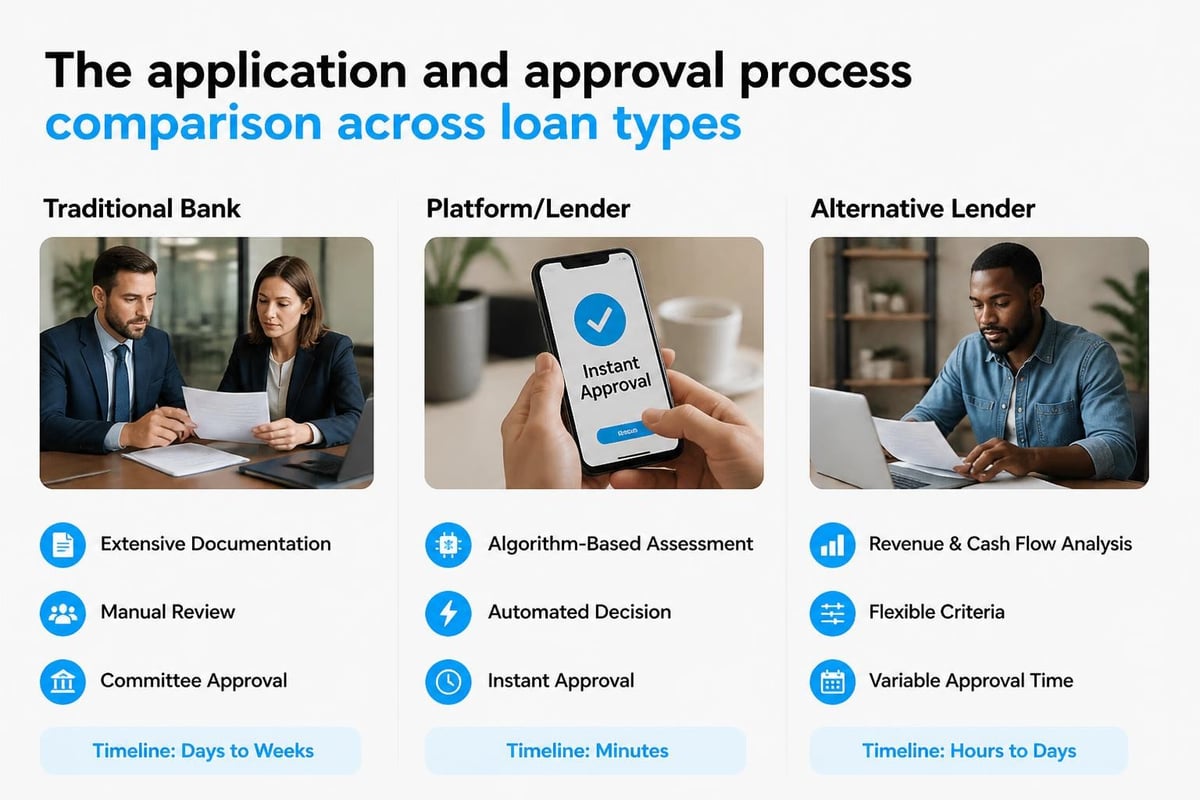
Many specialized ecommerce lenders integrate directly with your sales platforms and accounting software, pulling real-time data to accelerate approval decisions. This data-driven approach often enables faster funding than traditional bank applications, with some lenders providing capital within 24 to 48 hours of approval.

SBA Loan Programs for Ecommerce Businesses
The Small Business Administration offers multiple loan programs that ecommerce businesses can access, though application requirements and timelines differ from alternative financing. SBA 7(a) loans remain the most versatile option, supporting working capital, equipment purchases, inventory acquisition, and even online marketplace purchases or website development.
SBA 7(a) Standard and Express Options
SBA 7(a) loans offer amounts up to $5 million with repayment terms extending to 10 years for working capital and 25 years for real estate. Interest rates typically range from prime plus 2.25% to prime plus 4.75%, making these among the most affordable ecommerce business loans available. The SBA Express variant caps at $500,000 but provides faster processing, often delivering decisions within 36 hours.
Ecommerce businesses benefit particularly from the program's flexibility regarding collateral. While lenders require collateral for loans exceeding $50,000, the SBA does not decline applications solely due to insufficient assets-a significant advantage for inventory-light dropshipping or digital product businesses.
| SBA Loan Type | Maximum Amount | Term Length | Best For | Typical Timeline |
|---|---|---|---|---|
| 7(a) Standard | $5,000,000 | 10-25 years | Major expansion, acquisitions | 60-90 days |
| 7(a) Express | $500,000 | Up to 10 years | Working capital, inventory | 2-4 weeks |
| 504 Program | $5,500,000 | 10-20 years | Equipment, facilities | 90-120 days |
| Microloan | $50,000 | Up to 6 years | Startups, small inventory needs | 4-6 weeks |
Qualification Requirements and Documentation
Qualifying for SBA-backed ecommerce business loans requires meeting specific criteria. Your business must operate for profit within the United States, qualify as a small business by SBA size standards, and demonstrate reasonable owner equity investment. Most SBA lenders require at least two years of operating history, though exceptions exist for well-capitalized startups with experienced owners.
Documentation demands are substantial. Expect to provide three years of business tax returns, personal tax returns for all owners holding 20% or more equity, interim financial statements, business debt schedule, and detailed revenue projections. Ecommerce applicants should prepare additional platform-specific reports showing sales trends, customer retention, and marketplace performance metrics.
Revenue-Based Financing and Merchant Cash Advances
Revenue-based financing has emerged as one of the fastest-growing categories of ecommerce business loans, particularly suited to online retailers with consistent sales volume but limited traditional collateral. These products tie repayment directly to your daily or weekly revenue, creating a self-adjusting payment structure that scales with your cash flow.
How Revenue-Based Products Work
Rather than fixed monthly installments, revenue-based financing providers take a predetermined percentage of your daily credit card sales or total revenue until the advance plus fees is fully repaid. Typical retrieval rates range from 5% to 20% of daily receipts, with factor rates (the multiple of borrowed funds you repay) commonly between 1.15 and 1.45.
For example, if you receive $50,000 at a 1.30 factor rate, you'll repay $65,000 total. If your retrieval rate is 10% and you process $5,000 in daily card sales, the lender collects $500 per day until the full $65,000 is satisfied. During slower periods, payments decrease proportionally; during peak seasons, they accelerate.
This structure makes revenue-based ecommerce business loans particularly attractive for businesses with seasonal fluctuation. Unlike term loans with rigid monthly payments that strain cash flow during slow months, revenue-based products automatically adjust to your sales reality.
Inventory Financing Solutions
Inventory financing addresses one of the most capital-intensive aspects of ecommerce operations: purchasing stock before customer orders arrive. These specialized ecommerce business loans use your inventory itself as collateral, enabling you to secure larger amounts than unsecured options while maintaining lower costs than merchant cash advances.
Purchase Order and Inventory Lines of Credit
Purchase order (PO) financing provides capital specifically to fulfill confirmed customer orders, with the lender paying your supplier directly and receiving repayment once your customer pays. This works exceptionally well for ecommerce businesses that secure large orders but lack sufficient cash to manufacture or purchase the goods.
Inventory lines of credit function more like revolving facilities, providing ongoing access to capital for purchasing stock. As you sell inventory and repay the line, credit becomes available again for new purchases. Advance rates typically range from 50% to 80% of inventory value, depending on the product category, turnover rate, and obsolescence risk.
- Advance against eligible inventory valued through professional appraisal
- Revolving access that resets as inventory sells and loans repay
- Fast-moving consumer goods often qualify for higher advance rates
- Seasonal buildup supported through temporary limit increases
- Integration with inventory management systems for real-time monitoring
Inventory financing proves especially valuable for ecommerce businesses preparing for seasonal peaks like holiday shopping, back-to-school periods, or industry-specific surges. By securing products well in advance, you capture early-bird manufacturing slots, negotiate better supplier terms, and ensure stock availability during peak demand.

Platform-Integrated and Embedded Financing
A growing segment of ecommerce business loans originates directly from the platforms where merchants conduct business. Amazon Lending, Shopify Capital, PayPal Working Capital, and Square Loans exemplify this embedded finance trend, offering seamless application experiences and ultra-fast approval based on transaction data these platforms already possess.
Marketplace Lender Advantages and Limitations
Platform-integrated lenders evaluate your application using proprietary algorithms analyzing your full transaction history, customer reviews, seller metrics, and historical performance. This data richness enables instant pre-approvals and same-day funding in many cases. Shopify Capital, for instance, repays through automatic deductions from your daily sales, creating a frictionless experience where you never manually make a payment.
The convenience comes with tradeoffs. Platform loans typically cost more than bank financing, with factor rates often between 1.15 and 1.40. Amounts may be limited relative to your sales volume, with most platforms capping initial offers conservatively. Additionally, these products tie you more deeply to a single ecosystem-if you diversify sales channels, the lender may view your declining platform volume as increased risk.
Research from Harvard Kennedy School on embedded finance for small businesses highlights how platform integration reduces information asymmetry and enables credit access for businesses that traditional lenders might decline. For ecommerce merchants just establishing operating history, these embedded products often provide the first institutional capital access.
Traditional Bank Loans and Credit Lines
Despite the proliferation of alternative ecommerce business loans, traditional banks remain relevant for established online retailers with strong financials and longer operating history. Bank products offer the lowest interest rates and longest terms, making them ideal for larger capital needs, strategic acquisitions, or major infrastructure investments.
Requirements for Bank Ecommerce Financing
Banks evaluating ecommerce loan applications apply conventional underwriting standards: minimum two years of profitability, strong personal credit scores (typically 680+), substantial business and personal collateral, and detailed financial documentation. According to the FDIC's 2024 Small Business Lending Survey, banks approved approximately 65% of small business loan applications in 2024, with approval rates higher for established businesses with existing banking relationships.
Ecommerce businesses seeking bank financing should prepare for longer timelines-typically 45 to 90 days from application to funding. This extended period accommodates detailed financial review, collateral appraisal, legal documentation, and committee approval. For time-sensitive opportunities, bank loans may arrive too late.
| Financing Source | Typical Rate/Cost | Speed to Funding | Amount Range | Best Use Case |
|---|---|---|---|---|
| SBA 7(a) Loan | Prime + 2.25-4.75% | 4-12 weeks | $50K-$5M | Major expansion, acquisitions |
| Bank Term Loan | 6-12% APR | 4-8 weeks | $25K-$500K | Equipment, long-term growth |
| Revenue-Based | 1.2-1.5 factor | 1-5 days | $10K-$500K | Inventory, marketing, cash flow |
| Platform Lending | 1.15-1.40 factor | Same-day to 3 days | $5K-$250K | Quick working capital |
| Inventory Line | 8-18% APR | 2-4 weeks | $50K-$2M | Seasonal stock buildup |
Working Capital Options for Ecommerce Growth
Working capital financing addresses the ongoing operational expenses that ecommerce businesses face between purchasing inventory and collecting customer payments. These ecommerce business loans fill the cash-flow gap created by the time lag between paying suppliers and receiving marketplace payouts or customer payments.
The Federal Reserve's Small Business Credit Survey found that 43% of employer firms applied for financing in 2024, with working capital and cash-flow management cited as the primary reasons. For ecommerce businesses, this need intensifies due to platform hold periods, payment processing delays, and the capital demands of scaling customer acquisition.
Working capital financing can take several forms: term loans providing a lump sum for operational expenses, revolving lines of credit offering flexible draw-and-repay cycles, or merchant cash advances structured as revenue purchases. The optimal choice depends on whether you need one-time capital injection for a specific initiative or ongoing flexible access for variable expenses.
Calculating Your Working Capital Needs
Determining appropriate working capital amounts requires analyzing your cash conversion cycle: the time elapsed between paying suppliers and collecting customer payments. Ecommerce businesses with 30-day supplier terms, 7-day inventory turnover, and 3-day marketplace payout cycles need minimal working capital. Those with 60-day supplier terms, 45-day inventory cycles, and 14-day platform holds require substantially more.
Calculate your working capital gap by multiplying average daily operating expenses by the length of your cash conversion cycle. Add a buffer for unexpected expenses or growth opportunities. This figure represents your baseline working capital requirement-the amount needed simply to maintain operations without growth. Scale-up initiatives demand additional capital.
Equipment and Technology Financing
While many ecommerce businesses operate asset-light models, those in manufacturing, fulfillment, or content production often require significant equipment investments. Specialized equipment financing uses the purchased assets as collateral, enabling favorable terms even for businesses without extensive additional collateral.
Eligible Equipment and Typical Terms
Ecommerce-relevant equipment financing covers warehouse automation systems, packaging equipment, photography and videography gear, commercial-grade computers and servers, fulfillment center infrastructure, and transportation vehicles. Advance rates typically reach 80% to 100% of equipment cost, with terms matching the asset's useful life-often 3 to 7 years.
Interest rates on equipment financing generally fall between traditional bank loans and alternative products, ranging from 8% to 20% depending on credit profile, equipment type, and vendor relationships. Some manufacturers and distributors offer captive financing programs with promotional rates, occasionally including deferred payment periods or interest-free terms for qualified buyers.
Tax Implications and Deductibility
Understanding the tax treatment of ecommerce business loans helps optimize your borrowing strategy and maximize deductions. The IRS Publication 334, Tax Guide for Small Business, provides authoritative guidance on deducting business loan interest, fees, and related expenses.
Interest Deductibility and Fee Treatment
Interest paid on business loans is generally tax-deductible as an ordinary business expense, reducing your taxable income. This deduction applies whether you secure a traditional term loan, line of credit, or revenue-based product. However, the method for calculating deductible interest differs by product type.
For term loans and lines of credit with stated interest rates, deductibility is straightforward: deduct the interest paid during the tax year. Revenue-based financing and merchant cash advances present complexity because they're structured as purchased future receivables rather than loans. The IRS typically allows deducting the fee portion (the amount above principal) ratably over the repayment period, though specific treatment may vary based on the contract structure.
Origination fees, application fees, and other loan costs generally must be amortized over the loan term rather than deducted immediately. If you pay $3,000 in origination fees for a 5-year loan, you deduct $600 annually over five years. Points paid on real estate loans follow specific rules detailed in IRS guidance.
Regulatory Framework and Consumer Protections
The regulatory landscape governing ecommerce business loans has evolved significantly, with recent federal and state initiatives aimed at increasing transparency and protecting small business borrowers. The Consumer Financial Protection Bureau's Small Business Lending Rule implementation reflects this trend toward consumer-style protections.
Disclosure Requirements and Rate Transparency
Beginning in 2026, certain lenders must collect and report small business lending data, including application outcomes, pricing, and borrower demographics. This transparency initiative aims to identify potential discrimination and improve credit access for underserved communities. For ecommerce borrowers, these requirements should eventually enable better comparison shopping and market competition.
Several states have enacted small business borrower bills of rights requiring commercial financing providers to disclose key terms in standardized formats. California, New York, Utah, and Virginia mandate annual percentage rate (APR) disclosure even for products not traditionally structured as loans, helping ecommerce owners compare the true cost across different financing types.
The U.S. Treasury's analysis of small business financing highlights persistent gaps in transparency and the need for standardized disclosures. When evaluating ecommerce business loans, request clear documentation of total repayment amount, effective APR, all fees, prepayment terms, and the dollar cost of every $1,000 borrowed.
Choosing the Right Financing for Your Situation
Selecting appropriate ecommerce business loans requires matching product characteristics to your specific circumstances, goals, and constraints. No single financing type suits every situation-optimal choices depend on urgency, amount needed, qualification profile, and intended use.
Decision Framework for Ecommerce Financing
Start by defining your timeline. If you need capital within days to capture a limited-time supplier opportunity or prevent stockouts during peak season, revenue-based financing or platform-integrated products make sense despite higher costs. For planned expansion over several months, invest time in SBA or bank loan applications to secure better terms.
Next, evaluate qualification likelihood. Businesses operating less than two years with limited collateral rarely qualify for traditional bank loans but may easily access platform lending or revenue-based products. Those with strong credit, established profitability, and substantial assets should prioritize lower-cost options.
Consider these factors in your decision:
- Time sensitivity of the capital need
- Amount required and whether it's one-time or recurring
- Qualification profile including credit, time in business, and revenue
- Collateral availability and willingness to pledge assets
- Repayment structure preference (fixed vs. variable)
- Total cost tolerance and impact on unit economics
- Documentation capacity and administrative bandwidth
Match your situation to product strengths. SBA loans excel for major investments with patient timelines. Revenue-based financing works for growth capital when speed matters. Inventory lines suit businesses with predictable seasonal patterns. Platform lending serves newer businesses or those needing small, quick injections.
Alternative Funding Beyond Traditional Loans
Beyond conventional ecommerce business loans, alternative funding sources can supplement or replace debt financing depending on your situation and growth stage. Equity financing, crowdfunding, strategic partnerships, and supplier credit each offer distinct advantages and tradeoffs.
Equity Investment and Revenue-Share Agreements
Equity investors provide capital in exchange for ownership stakes, eliminating repayment obligations but diluting your ownership and control. For ecommerce businesses with exceptional growth potential, angel investors and venture capital firms offer not only funding but also strategic guidance, industry connections, and operational expertise.
Revenue-share agreements represent a hybrid between debt and equity: investors provide capital in exchange for a percentage of future revenue until reaching a predetermined return multiple (often 2x to 3x their investment). Unlike revenue-based financing with fixed retrieval rates, revenue-share percentages typically remain constant regardless of sales volume.
Supplier credit represents one of the most underutilized funding sources. Negotiating extended payment terms-moving from net-30 to net-60 or net-90-effectively provides free financing. This approach works particularly well for established ecommerce businesses with proven sales velocity and strong supplier relationships.
Building Creditworthiness for Future Financing
Accessing favorable ecommerce business loans in the future requires systematically building business creditworthiness today. Business credit profiles function separately from personal credit, though both influence lending decisions, particularly for small ecommerce operations.
Establishing Business Credit Infrastructure
Begin by structuring your business as a distinct legal entity-typically an LLC or corporation-and obtaining a federal Employer Identification Number (EIN). Open business bank accounts and credit cards in the company name, ensuring all business transactions flow through business accounts rather than personal ones.
Register with major business credit bureaus: Dun & Bradstreet, Experian Business, and Equifax Business. Establish vendor accounts with suppliers that report payment history to these bureaus. Consistent on-time payments to reporting vendors build your business credit file and improve scores over time.
Maintain clean separation between business and personal finances. Commingling funds, using personal cards for business expenses, or treating business accounts as personal piggy banks damages credibility with lenders and creates tax complications. Lenders view sloppy financial boundaries as management weakness and elevated risk.
Monitor your business credit reports regularly, disputing errors and addressing negative items promptly. Many lenders check business credit scores early in the application process; scores below threshold levels trigger automatic declines before human review. Building strong business credit creates access to better ecommerce business loans at lower costs.
Managing Multiple Funding Sources
Successful ecommerce businesses often maintain diverse funding relationships rather than relying on a single source. This portfolio approach provides flexibility, ensures backup options during market disruptions, and enables matching specific funding products to particular needs.
Coordinating Multiple Credit Facilities
Managing multiple ecommerce business loans simultaneously requires careful coordination to avoid over-leveraging and ensure covenant compliance. Track total debt service coverage ratio (DSCR)-the relationship between operating income and total debt payments-to ensure sustainable leverage levels. Most lenders prefer DSCR above 1.25, indicating cash flow covers debt service by at least 25%.
Be transparent with lenders about other financing relationships. Many loan agreements include provisions requiring disclosure of additional debt and restricting new borrowing without lender consent. Violating these covenants can trigger default, accelerate repayment, or damage valuable lender relationships.
Consider the cumulative impact on daily cash flow. If you maintain a revenue-based facility taking 10% of daily sales and a merchant cash advance retrieving 8%, that's 18% of revenue servicing debt before operating expenses. High debt service percentages squeeze margins and reduce flexibility during downturns.
Strategic coordination enables powerful combinations. Pair a low-cost SBA loan for equipment or facility improvements with a small, flexible line of credit for working capital fluctuations. Use seasonal inventory financing during peak buildup months while maintaining a modest year-round term loan for baseline operations.
Navigating the complex landscape of ecommerce business loans requires understanding how each product type aligns with your specific capital needs, qualification profile, and growth objectives. From SBA programs offering the lowest rates to revenue-based solutions providing same-day funding, the right financing choice depends on carefully matching product characteristics to your situation. Enterprise Finest Solutions helps ecommerce businesses explore the full spectrum of funding options through a network of specialized lenders and alternative financing providers, identifying solutions that align with your revenue patterns, business performance, and capital needs. Enterprise Finest Solutions connects you with financing partners who understand the unique dynamics of online retail and can deliver the flexible capital your ecommerce business needs to scale.
Written by
Enterprise Finest Solutions
Content creator and writer sharing insights and stories.