Commercial Hard Money Lenders: Fast Financing Guide 2026
Discover how commercial hard money lenders provide fast, asset-based financing for real estate deals and business properties in 2026.

Commercial real estate investors and business owners often face situations where traditional bank financing moves too slowly or imposes restrictions that don't align with their transaction timelines. Commercial hard money lenders fill this gap by offering asset-based financing that prioritizes the value of the underlying property over conventional underwriting criteria. These specialized lenders have become increasingly important in 2026 as businesses seek flexible capital solutions for acquisitions, renovations, bridge financing, and other time-sensitive commercial real estate needs.
Understanding Commercial Hard Money Lending
Commercial hard money lenders operate fundamentally differently than traditional financial institutions. While banks focus heavily on borrower creditworthiness, cash flow analysis, and extensive documentation requirements, hard money lenders emphasize collateral value as their primary underwriting criterion.
The term "hard money" refers to the asset-backed nature of these loans. The property itself serves as the hard asset securing the financing. This approach allows lenders to make faster decisions and accommodate borrowers who may not meet conventional lending standards but possess valuable commercial real estate.
Key Characteristics of Commercial Hard Money Loans
Commercial hard money financing typically features several distinguishing elements:
- Higher interest rates ranging from 8% to 15% or more annually
- Shorter terms usually between 6 months and 3 years
- Lower loan-to-value ratios commonly 60% to 75% of property value
- Faster approval often within days rather than weeks or months
- Flexible qualification criteria focusing on asset value over borrower credit
| Feature | Commercial Hard Money | Traditional Commercial Loan |
|---|---|---|
| Approval Time | 3-10 days | 30-90 days |
| Primary Criterion | Property value | Borrower financials |
| Interest Rate | 8-15%+ | 4-8% |
| Typical Term | 6-36 months | 5-25 years |
| Documentation | Minimal | Extensive |
The growth of private credit has expanded the commercial hard money landscape significantly. Institutional investors and private equity firms now participate alongside traditional hard money lenders, increasing available capital for commercial borrowers.

When Commercial Hard Money Makes Sense
Business owners and investors turn to commercial hard money lenders in specific scenarios where speed, flexibility, or unique property characteristics make conventional financing impractical.
Time-Sensitive Acquisitions
Commercial real estate opportunities often require quick action. When a business owner identifies an undervalued property or faces competition from other buyers, the ability to close within two weeks can make the difference between securing the deal and losing it. Commercial hard money lenders excel in these situations because their streamlined underwriting doesn't require the extensive financial analysis that banks demand.
Bridge Financing Needs
Properties requiring renovation or repositioning frequently need bridge financing. A business purchasing a distressed commercial building to renovate and lease may struggle to secure conventional financing until renovations are complete and tenants occupy the space. Commercial hard money lenders provide the capital needed during this transition period.
Credit or Documentation Challenges
Businesses with recent credit issues, irregular income documentation, or unconventional property types often find traditional lenders unwilling to extend financing. Commercial hard money lenders focus on the exit strategy and collateral value rather than perfect credit scores or standardized income verification.
Property Types Banks Avoid
Certain commercial property categories face difficulty securing bank financing:
- Mixed-use properties combining residential and commercial spaces
- Non-conforming buildings with unique characteristics
- Special-purpose properties like gas stations or churches
- Properties in secondary markets with limited comparable sales
- Value-add opportunities requiring significant improvements
For businesses seeking more conventional financing structures, working capital financing may provide an alternative solution depending on the specific use case and business qualifications.
The Commercial Hard Money Lending Process
Understanding how commercial hard money lenders evaluate and structure deals helps borrowers prepare effective applications and set realistic expectations.
Initial Property Assessment
The lending process begins with property evaluation. Commercial hard money lenders conduct preliminary assessments to determine whether the property provides sufficient collateral for the requested loan amount. This typically involves reviewing property details, location, condition, and comparable sales data.
Lenders apply conservative loan-to-value ratios to protect their capital. A property appraised at $1,000,000 might qualify for $650,000 to $750,000 in hard money financing, ensuring the lender maintains a substantial equity cushion.
Appraisal and Valuation
Professional appraisals form a critical component of commercial hard money underwriting. Lenders require current appraisals from licensed commercial appraisers to validate property values. Following appraisal quality standards helps ensure accurate valuations that protect both lender and borrower interests.
The appraisal considers multiple valuation approaches including income capitalization, cost approach, and sales comparison. For income-producing properties, current and projected rental income significantly influences valuation.
Borrower Exit Strategy
Commercial hard money lenders focus intensely on the borrower's exit strategy. How will the borrower repay the loan? Common exit strategies include:
- Refinancing into conventional permanent financing once renovations are complete
- Property sale after improvements increase market value
- Business cash flow from operations or other income sources
- Alternative financing through other capital sources
A clear, realistic exit strategy substantially improves approval odds and may influence loan terms.

Costs and Fee Structures
Commercial hard money lenders charge higher rates and fees than traditional lenders to compensate for increased risk and faster service delivery. Understanding the complete cost structure helps borrowers evaluate whether hard money financing makes financial sense for their specific situation.
Interest Rates and Points
Interest rates for commercial hard money typically range from 8% to 15% annually, with some lenders charging even higher rates for riskier transactions. Additionally, lenders charge origination fees called "points," with each point representing 1% of the loan amount.
A $500,000 commercial hard money loan at 12% annual interest with 3 points would incur:
- Origination fees: $15,000 (3% of $500,000)
- Monthly interest: $5,000 ($500,000 × 12% ÷ 12 months)
- 12-month total interest: $60,000
Additional Fees
Beyond interest and points, commercial hard money lenders may charge:
- Application fees covering initial review and processing
- Appraisal fees for professional property valuation
- Underwriting fees for loan analysis and approval
- Servicing fees for ongoing loan administration
- Extension fees if the loan term requires lengthening
- Early payoff penalties in some cases
| Fee Type | Typical Range | When Charged |
|---|---|---|
| Origination Points | 2-5% | At closing |
| Application Fee | $500-$2,500 | Upon application |
| Appraisal | $2,000-$10,000 | During underwriting |
| Monthly Servicing | $50-$200 | Monthly |
| Extension Fee | 1-2 points | If term extended |
Businesses should factor all fees into their financial analysis. While commercial hard money costs more upfront than conventional financing, the speed and flexibility often justify the expense for time-sensitive opportunities or situations where traditional financing isn't available.
Tax Considerations for Borrowers
Commercial borrowers should understand the tax implications of hard money financing. The IRS provides guidance on business interest deductions under Section 163(j), which limits the deductibility of business interest expense for certain entities.
For many businesses, interest paid on commercial hard money loans remains tax-deductible as a business expense, potentially offsetting some of the higher interest costs. However, businesses with average annual gross receipts exceeding certain thresholds may face limitations on interest deductibility.
Consulting with a qualified tax professional ensures businesses maximize legitimate deductions while remaining compliant with current tax regulations. The tax treatment can significantly impact the net cost of commercial hard money financing.
Regulatory Environment and Borrower Protections
Commercial hard money lenders operate in a different regulatory framework than consumer mortgage lenders. Understanding which protections apply helps borrowers set appropriate expectations.
Business Purpose Exemptions
Most commercial hard money loans qualify as business-purpose financing, which exempts them from many consumer protection regulations. The FDIC clarifies RESPA exemptions for business-purpose loans, noting that commercial transactions fall outside RESPA's scope.
This means commercial borrowers don't receive the same disclosure requirements, rescission rights, or settlement procedure protections that apply to residential consumer mortgages. Borrowers bear greater responsibility for understanding loan terms and conducting due diligence.
Due Diligence Responsibilities
Without extensive regulatory protections, commercial borrowers should:
- Carefully review all loan documents before signing
- Engage legal counsel familiar with commercial real estate financing
- Verify lender credentials and track record
- Understand all fees and cost components
- Confirm prepayment terms and conditions
The characteristics and risks of private credit highlight the importance of borrower awareness when working with non-bank lenders in less regulated spaces.
Finding Reputable Commercial Hard Money Lenders
The commercial hard money market includes established institutional lenders, regional private lenders, and individual investors. Selecting the right lending partner significantly impacts the borrowing experience and transaction success.
Evaluating Potential Lenders
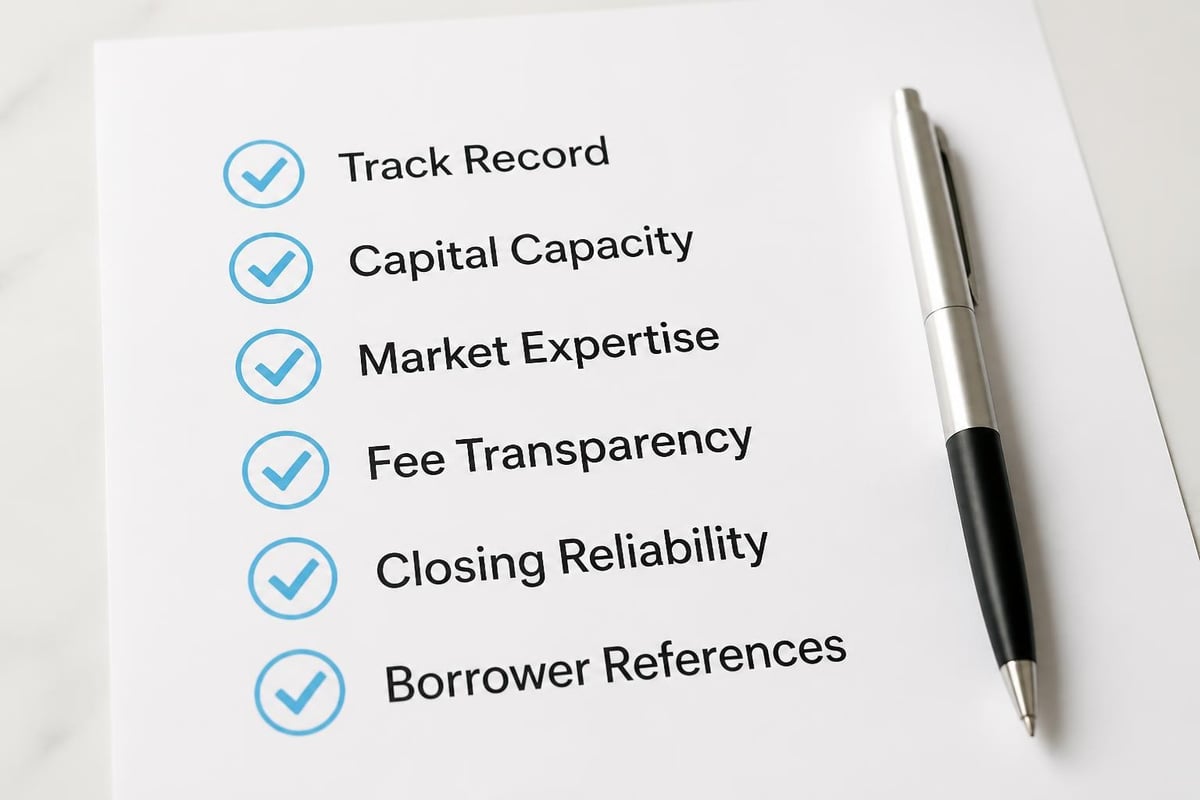
Business owners should assess commercial hard money lenders across multiple dimensions:
- Track record with similar property types and loan sizes
- Capital availability to fund the full requested amount
- Geographic expertise in the property's market
- Transparency regarding fees, rates, and terms
- Closing speed and reliability meeting deadlines
- References from previous borrowers
Working with Financing Brokers
Many businesses access commercial hard money lenders through financing brokers who maintain relationships with multiple lending sources. Brokers can match borrowers with appropriate lenders based on property type, loan amount, location, and borrower circumstances.
Enterprise Finest Solutions helps businesses evaluate various financing options, including situations where commercial hard money might provide the most practical solution for specific real estate-related capital needs. A qualified broker brings market knowledge and lender relationships that individual borrowers may lack.
Market Trends in Commercial Hard Money Lending
The commercial hard money landscape continues evolving as market conditions, technology, and capital sources change. Understanding current trends helps borrowers navigate the market effectively in 2026.
Institutional Capital Participation
Traditional hard money lending was dominated by individual investors and small private funds. Recent years have seen increased institutional participation, with private equity firms and credit funds allocating capital to commercial bridge lending. This institutional involvement has:
- Increased available capital for larger transactions
- Introduced more standardized underwriting processes
- Created downward pressure on interest rates in some segments
- Enhanced professionalism and transparency across the industry
Research on the evolution of residential transition lending provides insights into how private lending markets have matured and institutionalized, trends that parallel developments in commercial hard money.
Technology Integration
Commercial hard money lenders increasingly leverage technology to streamline operations:
Automated valuation models supplement traditional appraisals for preliminary assessments. Digital document management accelerates application processing and closing. Online portals provide borrowers with real-time visibility into loan status and servicing.
These technological improvements reduce transaction friction while maintaining the speed advantage that defines commercial hard money lending.
Market Segment Specialization
Many commercial hard money lenders now specialize in specific property types or transaction structures. This specialization creates expertise depth but requires borrowers to identify lenders aligned with their particular needs. Specialized lenders may focus on:
- Office and retail properties
- Multifamily and apartment buildings
- Industrial and warehouse facilities
- Hospitality and special-purpose properties
- Construction and ground-up development
Alternatives to Commercial Hard Money
While commercial hard money lenders serve important functions, businesses should evaluate alternative financing sources to ensure they're selecting the optimal capital solution.
Traditional Commercial Mortgages
For borrowers who can wait 30 to 90 days and meet conventional underwriting standards, traditional commercial mortgages offer significantly lower interest rates and longer terms. The time investment in the application process often pays dividends through reduced financing costs.
SBA Loans
Small Business Administration loan programs provide government-guaranteed financing for qualified businesses purchasing commercial real estate. SBA 504 loans specifically finance owner-occupied commercial properties with favorable terms, though approval timelines extend several months.
Revenue-Based Financing
Businesses needing working capital rather than property acquisition might find revenue-based financing more suitable. Merchant cash advance and revenue-based financing provides capital based on business revenue performance, with repayment tied to ongoing sales.
Equipment Financing for Business Assets
When a business needs to acquire physical assets rather than real estate, specialized equipment financing may offer more favorable terms than commercial hard money. Equipment lenders focus on the financed equipment's value and revenue-generating capacity.
| Financing Type | Best For | Typical Timeline | Interest Rate Range |
|---|---|---|---|
| Commercial Hard Money | Quick closings, credit challenges | 3-10 days | 8-15%+ |
| Traditional Commercial Mortgage | Strong credit, time available | 30-90 days | 4-8% |
| SBA 504 Loan | Owner-occupied property | 60-120 days | 5-7% |
| Revenue-Based Financing | Working capital needs | 1-5 days | 15-50% factor rate |
Structuring Successful Hard Money Transactions
Maximizing the value of commercial hard money financing requires strategic planning and execution. Borrowers who approach these transactions methodically achieve better outcomes.
Accurate Property Valuation
Conservative, realistic property valuations prevent disappointment during underwriting. Borrowers should research comparable sales, consider current market conditions, and account for any property deficiencies that might reduce value. Overestimating property value leads to lower loan-to-value ratios than anticipated or loan declines.
Clear Renovation Budgets
For value-add transactions requiring property improvements, detailed renovation budgets strengthen applications. Commercial hard money lenders want confidence that the budgeted improvements will actually increase property value sufficiently to support refinancing or sale.
Renovation budgets should include:
- Detailed scope of work
- Contractor estimates or bids
- Timeline for completion
- Contingency reserves for unexpected issues
- Projected post-renovation value with supporting data
Realistic Exit Strategy Timeline
Borrowers should build realistic timelines into their exit strategies, accounting for potential delays in renovation completion, market absorption, or refinancing processes. Commercial hard money lenders appreciate borrowers who demonstrate awareness of potential challenges and plan accordingly.
A borrower planning to renovate and refinance within 12 months might secure an 18-month hard money loan to provide buffer time. This approach reduces stress and minimizes the risk of expensive loan extensions.
Professional Team Assembly
Successful commercial hard money transactions typically involve professional advisors:
- Real estate attorney reviewing loan documents and transaction structure
- Commercial appraiser providing credible property valuations
- Accountant or tax advisor analyzing financial implications
- Contractor or project manager for renovation projects
- Commercial broker for eventual sale or leasing
The cost of professional guidance often proves minimal compared to the value of avoiding costly mistakes or unfavorable terms.
Managing Commercial Hard Money Loans
Once a commercial hard money loan closes, effective loan management protects the borrower's interests and ensures smooth execution of the exit strategy.
Communication with Lender
Maintaining open communication with commercial hard money lenders prevents misunderstandings and facilitates problem-solving if challenges arise. Borrowers should promptly notify lenders of any issues affecting the property or repayment timeline.
Lenders often show flexibility when borrowers communicate proactively rather than defaulting silently. A borrower facing a two-month renovation delay will receive a better reception discussing an extension early rather than defaulting when the loan matures.
Progress Monitoring
For renovation or development projects, borrowers should monitor progress against timelines and budgets continuously. Regular progress reviews help identify problems early when solutions remain manageable.
Many commercial hard money lenders require periodic updates for construction or renovation loans, including:
- Work completion photographs
- Updated budget versus actual spending reports
- Contractor payment documentation
- Revised completion timeline estimates
Exit Strategy Execution
Borrowers should begin executing their exit strategy well before loan maturity. Waiting until the final month to initiate refinancing or list the property for sale creates unnecessary pressure and reduces negotiating leverage.
For refinancing exits, contact conventional lenders 90 to 120 days before the hard money loan matures. For sale exits, engage commercial brokers and begin marketing 120 to 180 days in advance, depending on market conditions and property type.
Commercial hard money lenders provide essential financing solutions for businesses and investors needing fast, flexible capital for commercial real estate transactions. While costs exceed traditional financing, the speed and accessibility often make commercial hard money the practical choice for time-sensitive opportunities or unique situations. Enterprise Finest Solutions helps businesses explore appropriate financing options across multiple capital sources, connecting clients with solutions that align with their specific transaction requirements, timeline, and financial circumstances.
Written by
Enterprise Finest Solutions
Content creator and writer sharing insights and stories.