Commercial Bridge Loan Lenders: A 2026 Guide for Businesses
Learn how commercial bridge loan lenders work, what they offer, and when businesses use short-term financing to close deals and manage transitions.

Commercial bridge loan lenders provide short-term financing solutions designed to help businesses navigate transitional periods, close time-sensitive real estate transactions, and secure capital while arranging permanent financing. These specialized lenders fill a critical gap in the commercial lending market, offering speed and flexibility when traditional bank loans move too slowly or when borrowers need immediate capital to seize opportunities. Understanding how commercial bridge loan lenders operate, their underwriting criteria, and the costs associated with bridge financing enables business owners to make informed decisions during pivotal moments in their growth trajectory.
What Commercial Bridge Loan Lenders Offer
Commercial bridge loan lenders specialize in providing temporary financing that "bridges" the gap between an immediate capital need and a future financing event. Unlike conventional commercial mortgages that extend 10, 15, or 25 years, bridge loans typically last 6 to 36 months and are structured with the expectation of rapid repayment.
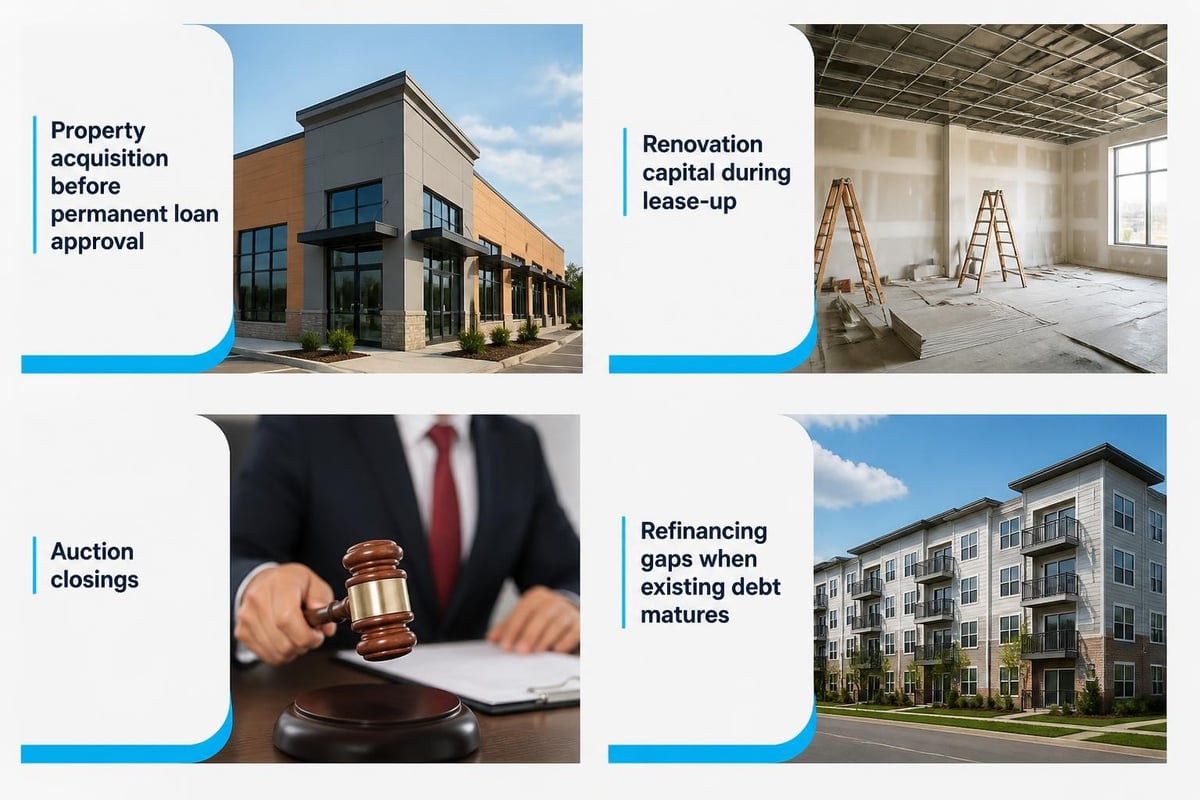
These lenders serve businesses across multiple scenarios:
- Property acquisition: Funding to purchase commercial real estate before permanent financing is in place
- Renovation and repositioning: Capital to improve properties and increase their value or occupancy before refinancing
- Auction purchases: Fast closings required at real estate auctions where traditional loans cannot close in time
- Lease-up periods: Financing during tenant recruitment when cash flow is limited but property value is expected to rise
- Refinancing gaps: Short-term loans when existing debt matures before new long-term financing can be arranged
Commercial bridge loan lenders evaluate deals differently than traditional banks. Speed, asset value, and exit strategy often carry more weight than the borrower's credit history or debt-service-coverage ratio (DSCR). This focus on the underlying real estate and the path to repayment allows bridge lenders to approve transactions that conventional lenders might decline or delay.
Types of Bridge Lenders in the Market
The landscape of commercial bridge loan lenders includes several distinct categories, each with unique structures, speed, and pricing.
Traditional banks and credit unions occasionally offer bridge products, particularly to existing customers with strong banking relationships. These institutions typically provide the lowest interest rates but impose stricter underwriting standards and slower approval timelines. Regulatory oversight from agencies such as the FDIC and the OCC means banks must carefully manage commercial real estate (CRE) exposure and adhere to loan-to-value (LTV) and DSCR guidelines.
Private bridge lenders and debt funds dominate the market today. These non-bank lenders operate outside traditional banking regulations and can move quickly, often closing loans in 7 to 21 days. Private credit providers have grown significantly as regulatory pressures and capital constraints have pushed banks to tighten CRE lending standards. Private lenders charge higher interest rates-often ranging from 8% to 15%-but provide flexibility on property condition, borrower credit, and deal structure.
Hard money lenders represent a subset of private lenders focused on asset-based lending with minimal underwriting. These lenders prioritize the property's current or projected value and offer extremely fast closings but command the highest rates and fees.
| Lender Type | Approval Speed | Interest Rate Range | LTV Range | Primary Focus |
|---|---|---|---|---|
| Traditional Banks | 30–60 days | 6%–9% | 60%–75% | Borrower strength, DSCR |
| Private Debt Funds | 7–21 days | 8%–12% | 65%–80% | Asset value, exit strategy |
| Hard Money Lenders | 3–10 days | 10%–15% | 50%–70% | Property value, collateral |
How Commercial Bridge Loan Lenders Underwrite Deals
Commercial bridge loan lenders employ underwriting standards that emphasize collateral, exit strategy, and speed. While traditional banks scrutinize cash flow, borrower financials, and long-term projections, bridge lenders prioritize the following:
Asset valuation and loan-to-value (LTV) ratio: The property securing the loan serves as the primary protection for the lender. Most commercial bridge loan lenders cap LTV at 65% to 80%, ensuring sufficient equity cushion in case of default. Appraisals and broker price opinions (BPOs) guide valuations, with lenders often discounting projected "as-stabilized" or "as-complete" values to mitigate risk.
Exit strategy clarity: Lenders require a credible plan for repayment. Common exit strategies include refinancing into permanent financing, selling the property, or leasing up the asset to achieve stabilization and qualifying cash flow. Bridge lenders assess the feasibility of the exit based on market conditions, property type, and borrower experience.
Borrower experience and track record: While less critical than in traditional lending, the borrower's history with similar projects informs the lender's confidence. Developers with proven success in repositioning properties or managing complex transactions receive better terms and higher leverage.
Loan structure and recourse: Many bridge loans are structured with full or partial recourse, meaning the borrower personally guarantees repayment. This shifts risk back to the borrower and strengthens the lender's position.
Interest Rates, Fees, and Costs
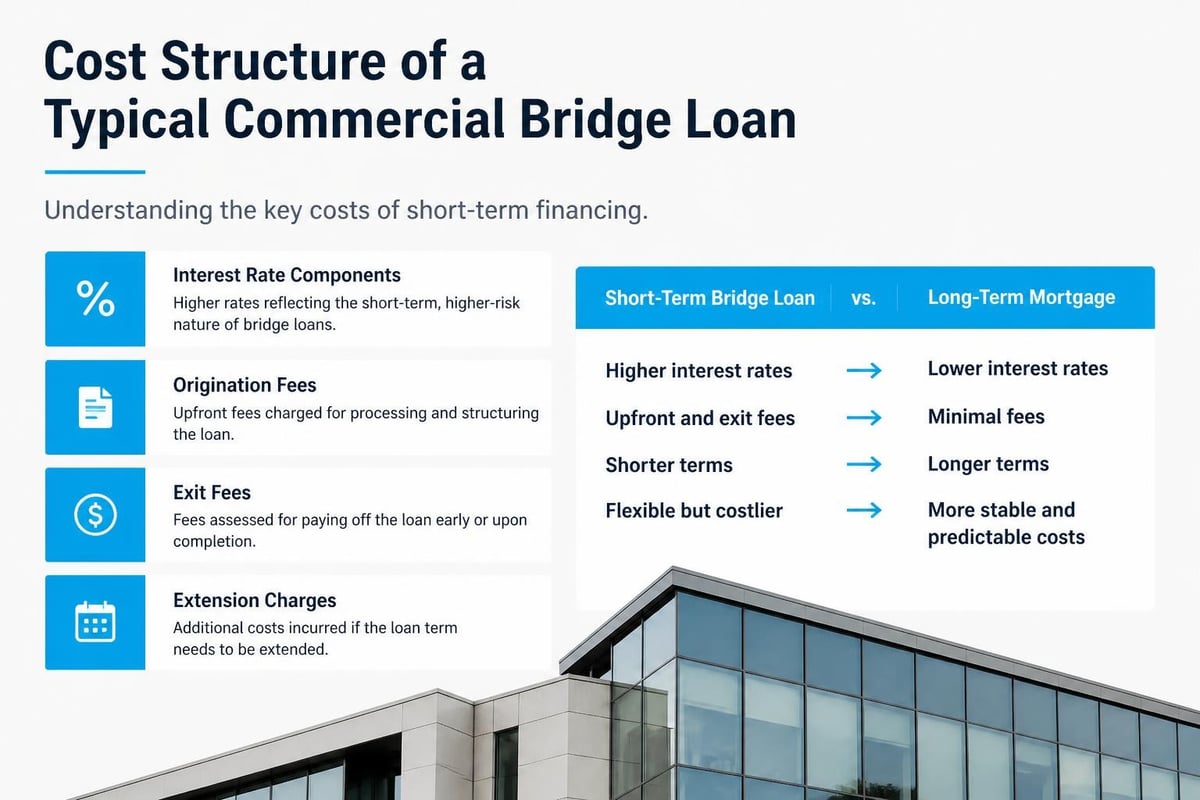
Commercial bridge loan lenders charge substantially higher rates than conventional lenders due to increased risk, short duration, and rapid deployment of capital. Borrowers should anticipate the following cost structure:
- Interest rates: Typically 7% to 15% annually, depending on lender type, property risk, and borrower profile
- Origination fees: 1% to 3% of the loan amount, paid at closing
- Exit fees: Some lenders charge 0.5% to 1% upon repayment
- Extension fees: If the borrower cannot repay within the original term, lenders may allow extensions for additional fees (often 0.25% to 0.5% per month)
Given the short duration, borrowers often pay interest-only monthly payments, with the principal due in a balloon payment at maturity. This structure keeps monthly obligations low but requires careful planning to ensure the exit event occurs on time.
The 2026 Risk Review from the FDIC highlights ongoing refinancing pressures in the commercial real estate market, driven by rising interest rates and tighter lending standards. These conditions have increased demand for bridge financing as borrowers seek time to stabilize assets or wait for more favorable permanent financing markets.
When Businesses Turn to Bridge Lenders
Commercial bridge loan lenders serve a vital function during moments of urgency, transition, or opportunity. Businesses across industries leverage bridge financing in specific situations where speed and flexibility outweigh the cost premium.
Time-sensitive acquisitions represent a leading use case. When a business identifies a valuable property but lacks the time to secure conventional financing-such as a competitor's asset coming to market or an off-market opportunity-commercial bridge loan lenders provide the capital to close quickly. Auction purchases, foreclosure sales, and short-sale transactions frequently require proof of funds and rapid closings that only bridge lenders can accommodate.
Renovation and value-add projects benefit from bridge capital when properties require improvements before they qualify for permanent loans. Lenders may advance funds in tranches tied to construction milestones, allowing borrowers to upgrade buildings, improve occupancy, or reposition assets. Once renovations are complete and the property generates stable income, the borrower refinances into a lower-cost, long-term mortgage.
Lease-up and stabilization periods create cash-flow challenges that conventional lenders avoid. A newly constructed office building or a recently acquired apartment complex may have low occupancy, rendering it ineligible for traditional financing. Bridge lenders fill this gap, providing capital during the lease-up phase and allowing borrowers to achieve stabilization before refinancing.
Refinancing maturity walls have intensified in recent years. As commercial mortgages originated during the low-rate environment of 2020–2021 come due, many borrowers face challenges refinancing at higher rates or meeting stricter underwriting standards. Data from the Federal Reserve's Senior Loan Officer Opinion Survey shows that banks have tightened CRE lending standards significantly, reducing availability of permanent loans and driving demand for bridge solutions that buy time for market conditions to improve.
Alternatives and Complementary Financing
While bridge loans address immediate capital needs, businesses should evaluate complementary or alternative funding structures depending on their situation.
Working capital financing and revenue-based solutions may serve businesses that need liquidity but do not require real estate collateral. For companies seeking flexible funding tied to operational performance rather than property transactions, working capital financing can provide fast access to capital for inventory, payroll, expansion, and other expenses without the complexity of real estate underwriting.
Business lines of credit offer revolving access to funds and can supplement bridge financing or serve as an alternative when capital needs are ongoing rather than tied to a single transaction. Lines of credit provide flexibility for businesses managing cash flow, seasonal fluctuations, or unexpected expenses alongside real estate activities.
Mezzanine debt and preferred equity allow borrowers to stack additional capital on top of senior bridge loans. These subordinated financing layers increase total leverage and reduce the equity required from the borrower, though they come with higher costs and additional complexity. Mezzanine lenders often participate in property upside through equity kickers or profit-sharing arrangements.
Selecting the Right Bridge Lender
Choosing among commercial bridge loan lenders requires careful evaluation of terms, reputation, and alignment with the borrower's timeline and strategy. Not all lenders operate with the same speed, flexibility, or transparency, and mismatches can derail transactions or lead to unfavorable outcomes.
Speed and certainty of execution stand as primary considerations. Borrowers should verify the lender's track record of closing deals on time and honoring term sheets. References from past clients, case studies, and online reviews provide insight into reliability. Lenders who require extensive documentation, multiple committee approvals, or frequent term changes may not deliver the speed bridge borrowers need.
Term flexibility and prepayment options vary widely. Some commercial bridge loan lenders impose steep prepayment penalties, while others allow early repayment without fees. Borrowers confident in a quick exit should negotiate favorable prepayment terms to avoid unnecessary costs. Extension options also matter-if the project takes longer than anticipated, built-in extension clauses at defined costs provide a safety net.
Transparency in fees and costs separates reputable lenders from predatory operators. Hidden fees, last-minute rate adjustments, and unclear documentation requirements signal potential problems. Borrowers should request a detailed fee schedule upfront and compare all-in costs across multiple lenders.
Lender expertise in the property type and market enhances deal success. A lender experienced in multifamily repositioning in urban markets brings valuable insights that a generalist lender may lack. Specialized knowledge translates into smoother underwriting, realistic valuations, and constructive problem-solving when challenges arise.
Regulatory and Market Influences
Broader financial trends and regulatory developments shape the commercial bridge lending landscape. The Federal Reserve's Financial Stability Report identifies commercial real estate vulnerabilities as a key risk area, noting that elevated vacancy rates in office and retail sectors, combined with higher interest rates, create refinancing pressures for property owners. These macroeconomic conditions drive borrowers toward bridge lenders as banks retreat from certain property types and markets.
Private credit's growth reflects structural shifts in lending. Research on loan guarantees and credit structures underscores how alternative lenders use guarantees, third-party credit enhancements, and flexible pricing to manage risk and compete with banks. This evolution has expanded access to bridge capital but also introduced variability in terms and structures that borrowers must navigate carefully.
Bank regulatory frameworks continue to influence supply. The OCC and FDIC impose concentration limits and risk-management expectations on commercial real estate lending, constraining banks' ability to originate short-term, higher-risk bridge loans. This regulatory environment has created space for non-bank lenders to dominate the bridge market, though it also means borrowers must conduct deeper due diligence on lender stability and capital sources.
Risks and Mitigation Strategies
Commercial bridge loan lenders and borrowers both face risks inherent in short-term, transitional financing. Understanding these risks and implementing mitigation strategies improves outcomes and reduces the likelihood of default or financial distress.
Refinancing risk tops the list. If the borrower cannot secure permanent financing or sell the property before the bridge loan matures, they face default, forced asset sales, or expensive extensions. Mitigation requires realistic exit planning, market analysis, and maintaining relationships with multiple permanent lenders. Borrowers should begin arranging takeout financing well before the bridge loan matures, not weeks before the deadline.
Interest rate volatility affects both the cost of the bridge loan and the availability of permanent financing. Rising rates can make refinancing unaffordable or push DSCR below acceptable thresholds. Locking interest rates on permanent loans early, when possible, or negotiating rate caps with bridge lenders can provide protection.
Construction and lease-up delays commonly occur in value-add and development scenarios. Budget overruns, contractor issues, permitting delays, or slow leasing velocity extend project timelines and jeopardize the exit. Borrowers should build contingency time and capital into their plans and choose lenders willing to grant extensions if needed.
Property value fluctuations impact the lender's collateral position and the borrower's equity. A market downturn during the bridge period can erode values, reducing refinancing proceeds or sale prices. Conservative LTV assumptions and maintaining equity buffers protect both parties.
| Risk Type | Borrower Impact | Mitigation Strategy |
|---|---|---|
| Refinancing failure | Default, asset loss | Early permanent loan applications, multiple lender relationships |
| Interest rate increases | Higher costs, DSCR issues | Rate locks, caps, conservative projections |
| Project delays | Timeline extension, added costs | Contingency budgets, experienced contractors |
| Market downturns | Value erosion, equity loss | Conservative LTV, asset quality focus |

Strategic Considerations for Borrowers
Business owners evaluating commercial bridge loan lenders must align financing with broader strategic goals and operational realities. Bridge loans are tools, not solutions in themselves, and their effectiveness depends on clear objectives and disciplined execution.
Matching loan structure to business strategy ensures the financing supports rather than constrains plans. A borrower planning a quick flip should prioritize low prepayment penalties and minimal fees, while a developer executing a multi-phase renovation may need flexible draw schedules and longer initial terms. Understanding the business plan in detail allows for precise lender selection and term negotiation.
Balancing cost and speed involves trade-offs. The fastest lenders often charge the highest rates, while more affordable options require longer approval processes. Borrowers must assess whether time sensitivity justifies premium pricing or if a slightly slower process with better terms makes more sense. Overpaying for speed on a non-urgent transaction wastes capital; waiting too long on a competitive acquisition loses the opportunity.
Building lender relationships pays dividends over time. Repeat borrowers who perform well earn better terms, faster approvals, and more flexible structures on subsequent deals. Establishing trust and demonstrating successful exits positions borrowers favorably when they need capital again.
Coordinating bridge and permanent financing from the outset streamlines the transition and reduces uncertainty. Some borrowers secure commitment letters from permanent lenders before closing the bridge loan, ensuring a clear path to refinancing. Others work with lenders who offer bridge-to-perm programs, where the same institution provides both short-term and long-term capital under a unified agreement.
Documentation and Closing Process
The mechanics of closing a loan with commercial bridge loan lenders differ from traditional mortgages in pace and documentation requirements. While banks may require extensive financial statements, tax returns, rent rolls, and environmental reports, bridge lenders streamline the process to match their faster timelines.
Core documentation typically includes:
- Property appraisal or broker price opinion (BPO)
- Purchase agreement or existing mortgage payoff statement
- Personal financial statement and credit report (for recourse loans)
- Project budget and timeline (for renovation or development loans)
- Exit strategy narrative and supporting evidence
Lenders often waive or reduce documentation for experienced borrowers, properties in strong markets, or deals with substantial equity. Due diligence focuses on verifying property value, confirming title, and assessing environmental concerns through Phase I environmental assessments when necessary.
Closing timelines range from as little as 3 days for hard money lenders to 21 days for private debt funds. Borrowers accelerate closings by organizing documents in advance, responding quickly to lender requests, and working with experienced attorneys and title companies familiar with bridge transactions.
Post-closing obligations often include periodic reporting, reserve account management, and compliance with renovation milestones or leasing targets. Borrowers should understand these requirements before closing to avoid surprises or covenant violations that trigger default provisions.
Market Outlook and Trends
The commercial bridge lending market continues to evolve in response to economic conditions, interest rates, and regulatory changes. Several trends shape the environment borrowers and lenders navigate in 2026.
Private credit expansion accelerates as traditional banks reduce CRE exposure. Private debt funds, insurance companies, and specialty finance firms have raised record capital to deploy into bridge and transitional lending. This influx of capital increases competition, improving terms and availability for borrowers.
Technology adoption enhances speed and efficiency. Lenders now use digital platforms for document submission, automated valuation models (AVMs) for property analysis, and data analytics for risk assessment. These tools reduce closing times and lower operational costs, benefits often passed to borrowers through reduced fees.
Specialization by property type creates niche expertise. Lenders increasingly focus on specific asset classes-multifamily, industrial, retail, or hospitality-developing deep knowledge that improves underwriting accuracy and borrower service. Borrowers benefit by accessing lenders who understand their property type's unique risks and opportunities.
Integration with permanent lending through bridge-to-perm programs simplifies the financing lifecycle. Lenders offering both short-term and long-term products reduce transaction friction, lower overall costs, and provide borrowers with certainty of execution.
Commercial bridge loan lenders provide essential short-term capital that enables businesses to navigate transitions, seize opportunities, and manage refinancing challenges in dynamic real estate markets. Choosing the right lender, structuring terms carefully, and planning realistic exit strategies determine success. Whether you need fast acquisition capital, renovation funding, or a solution to a refinancing gap, Enterprise Finest Solutions connects businesses with a network of flexible funding partners tailored to your revenue, performance, and capital needs. Reach out today to explore financing options that align with your growth objectives.
Written by
Enterprise Finest Solutions
Content creator and writer sharing insights and stories.