Commercial Bridge Loan Guide for Business Owners 2026
Learn how a commercial bridge loan works, when to use it, and what lenders require. Complete guide to short-term real estate financing for businesses.

A commercial bridge loan serves as a powerful short-term financing tool that helps businesses navigate time-sensitive real estate transactions and capital needs. Whether acquiring a property before permanent financing is in place, funding renovations to qualify for better terms, or capitalizing on an urgent opportunity, bridge financing provides the immediate capital required when traditional lending timelines don't align with business reality. Understanding how these specialized loans work, when they make strategic sense, and what lenders evaluate can help business owners leverage bridge financing effectively while managing costs and risks.
What Is a Commercial Bridge Loan
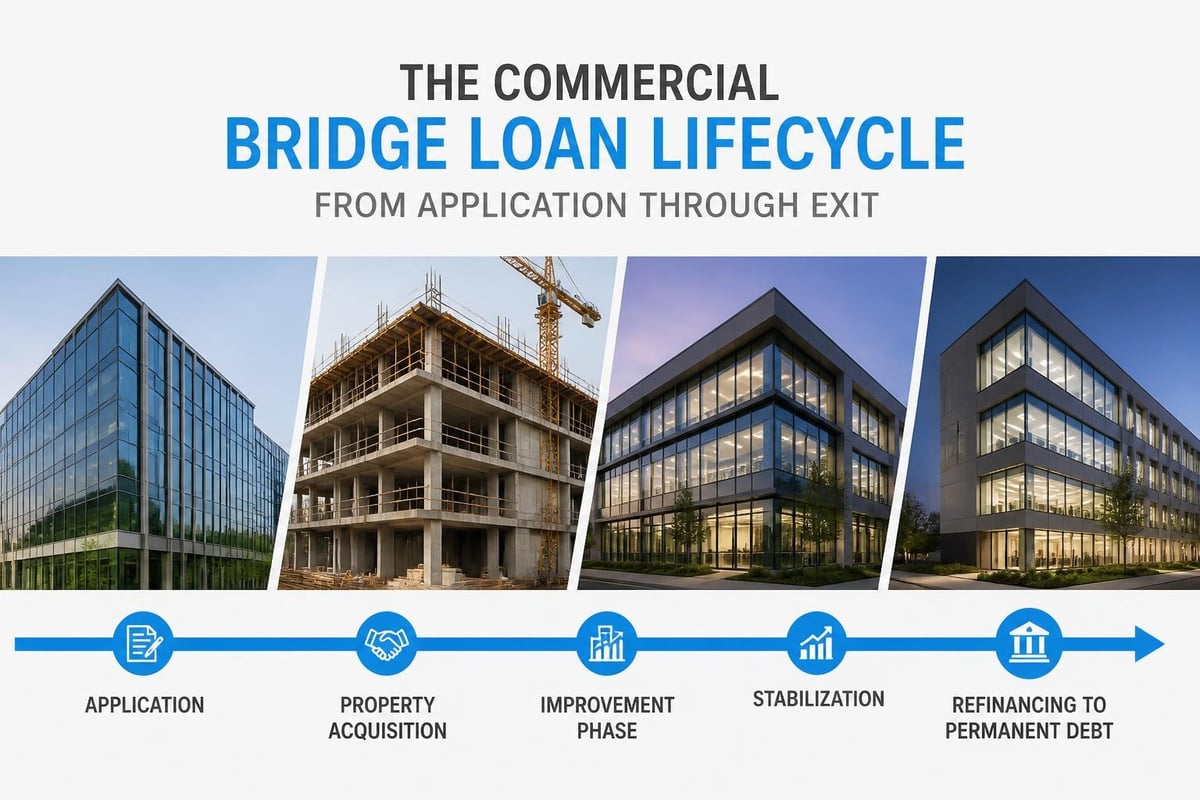
A commercial bridge loan is a short-term financing solution secured by real estate, typically lasting between 6 and 36 months. These loans "bridge" the gap between an immediate capital need and a future financing event-such as securing permanent financing, completing property improvements, or generating stabilized cash flow from a property.
Unlike traditional commercial mortgages that may take 60 to 90 days to close, bridge lenders can often fund within two to four weeks. This speed comes from streamlined underwriting that focuses heavily on the property's current or projected value and the borrower's exit strategy rather than extensive financial documentation.
Key characteristics that define commercial bridge financing include:
- Loan amounts typically ranging from $100,000 to $25 million or more
- Interest rates generally 2 to 6 percentage points above conventional commercial mortgages
- Loan-to-value (LTV) ratios commonly between 65% and 80%
- Interest-only payment structures in most cases
- Origination fees ranging from 1% to 3% of the loan amount
The Comptroller's Handbook on Commercial Real Estate Lending provides regulatory perspective on how lenders approach short-term commercial real estate financing and the risk controls they implement.
Speed and Flexibility as Primary Advantages
Bridge lenders prioritize transaction velocity and flexible underwriting. Many business owners turn to bridge financing specifically because conventional lenders cannot accommodate compressed timelines or properties that don't yet meet traditional lending criteria.
A mixed-use property requiring tenant improvements, for example, might not qualify for permanent financing until occupancy reaches 80%. A commercial bridge loan can fund the acquisition and renovations, allowing the owner to reach stabilization and then refinance into permanent debt at more favorable terms.
Common Scenarios for Using Bridge Financing
Business owners and real estate investors deploy commercial bridge loans across a diverse range of situations. Understanding these use cases helps clarify whether bridge financing aligns with your specific circumstances.
Acquisition Before Permanent Financing
Competitive commercial real estate markets often require all-cash offers or rapid closings. A bridge loan enables buyers to act quickly, secure the property, and then arrange permanent financing once ownership transfers. This approach is particularly valuable when acquiring properties at auction or in bidding wars where delayed closings reduce negotiating leverage.
Property Improvement and Repositioning
Many properties require physical improvements, tenant upgrades, or operational changes before they qualify for conventional financing. Bridge loans fund both acquisition and renovation costs, giving owners time to complete improvements and demonstrate improved performance metrics that permanent lenders require.
| Use Case | Typical Duration | Exit Strategy |
|---|---|---|
| Acquisition funding | 12–18 months | Permanent mortgage refinance |
| Renovation bridge | 18–24 months | Refinance after stabilization |
| Lease-up financing | 12–24 months | Refinance at higher occupancy |
| Cash-out refinance alternative | 6–12 months | Sale or permanent refi |
Business Expansion and Relocation
Companies relocating to larger facilities or opening new locations sometimes need bridge financing to acquire property before existing space sells or before business cash flow from the new location supports conventional debt service. This temporary financing maintains business momentum without waiting for all pieces to align.
For businesses facing immediate operational capital needs beyond real estate, working capital financing may offer complementary solutions that address inventory, payroll, and cash-flow requirements while managing real estate transitions.
Portfolio Restructuring
Real estate investors sometimes use commercial bridge loans to extract equity from one property to fund acquisitions or improvements elsewhere in their portfolio. This strategy accelerates growth without selling performing assets, though it increases leverage and requires careful attention to debt service coverage.
How Lenders Evaluate Bridge Loan Applications
Commercial bridge loan underwriting differs significantly from conventional commercial mortgage analysis. While permanent lenders emphasize borrower creditworthiness, business financials, and property cash flow, bridge lenders focus more heavily on asset value and exit feasibility.
Property Value and Loan-to-Value Ratio
The property securing the loan represents the lender's primary protection. Bridge lenders typically advance 65% to 80% of the property's current "as-is" value or projected "as-stabilized" value after improvements. Properties in strong markets with clear comparable sales receive more favorable LTV ratios.
Lenders order third-party appraisals that may include both current value and future value scenarios. For renovation projects, they often fund improvements in stages tied to completion milestones, similar to construction loan draws.
Exit Strategy Clarity
Every commercial bridge loan requires a documented exit strategy. Lenders need confidence that borrowers can repay the loan at maturity through one of several paths:
- Refinancing into permanent commercial mortgage debt
- Selling the property at stabilized value
- Generating sufficient property cash flow to support conventional financing
- Bringing in equity partners or additional capital
The interagency policy statement from the FDIC addresses how financial institutions handle commercial real estate loan accommodations, including considerations relevant to short-term bridge financing and workout situations.
Borrower Experience and Liquidity
While less emphasized than in conventional lending, borrower track record still matters. Lenders favor borrowers with demonstrated commercial real estate experience, particularly in similar property types or improvement projects. First-time commercial buyers may face higher rates or require larger down payments.
Personal liquidity and reserves also factor into approval. Most bridge lenders require borrowers to demonstrate liquid reserves equal to 6 to 12 months of interest payments, providing cushion if the exit timeline extends.
Cost Structure and Financial Considerations
Commercial bridge loans carry higher costs than conventional financing, reflecting their short duration, flexible underwriting, and elevated risk profile. Business owners must weigh these costs against the opportunity value and strategic benefits the financing enables.
Interest Rates and Payment Structures
Current commercial bridge loan rates in 2026 typically range from 8% to 14%, depending on property type, borrower strength, loan-to-value ratio, and market conditions. The KPMG credit markets update provides useful context on broader credit market conditions affecting commercial lending availability and pricing.
Most bridge loans feature interest-only monthly payments, reducing debt service during the loan term. Some lenders offer full interest reserves, meaning all interest accrues and is paid at loan maturity, eliminating monthly payments entirely but increasing total interest cost.
Origination Fees and Closing Costs
Expect origination fees between 1% and 3% of the loan amount, paid at closing. A $1 million bridge loan might carry $20,000 to $30,000 in origination fees alone. Additional closing costs-appraisal, environmental reports, title insurance, legal fees-can add another $10,000 to $25,000 depending on transaction complexity.
| Cost Component | Typical Range | Example on $1M Loan |
|---|---|---|
| Interest rate | 8%–14% annually | $80,000–$140,000/year |
| Origination fee | 1%–3% | $10,000–$30,000 |
| Closing costs | 1%–2.5% | $10,000–$25,000 |
| Extension fee (if needed) | 0.5%–1% | $5,000–$10,000 |
Prepayment and Extension Options
Many commercial bridge loans allow prepayment without penalty, a significant advantage when exit opportunities arise earlier than anticipated. However, some lenders impose minimum interest periods (often three to six months) or modest prepayment fees.
Extension options provide valuable flexibility if the original timeline proves insufficient. Lenders may offer one or two six-month extensions at fees of 0.5% to 1% of the loan amount per extension, plus potential rate adjustments.
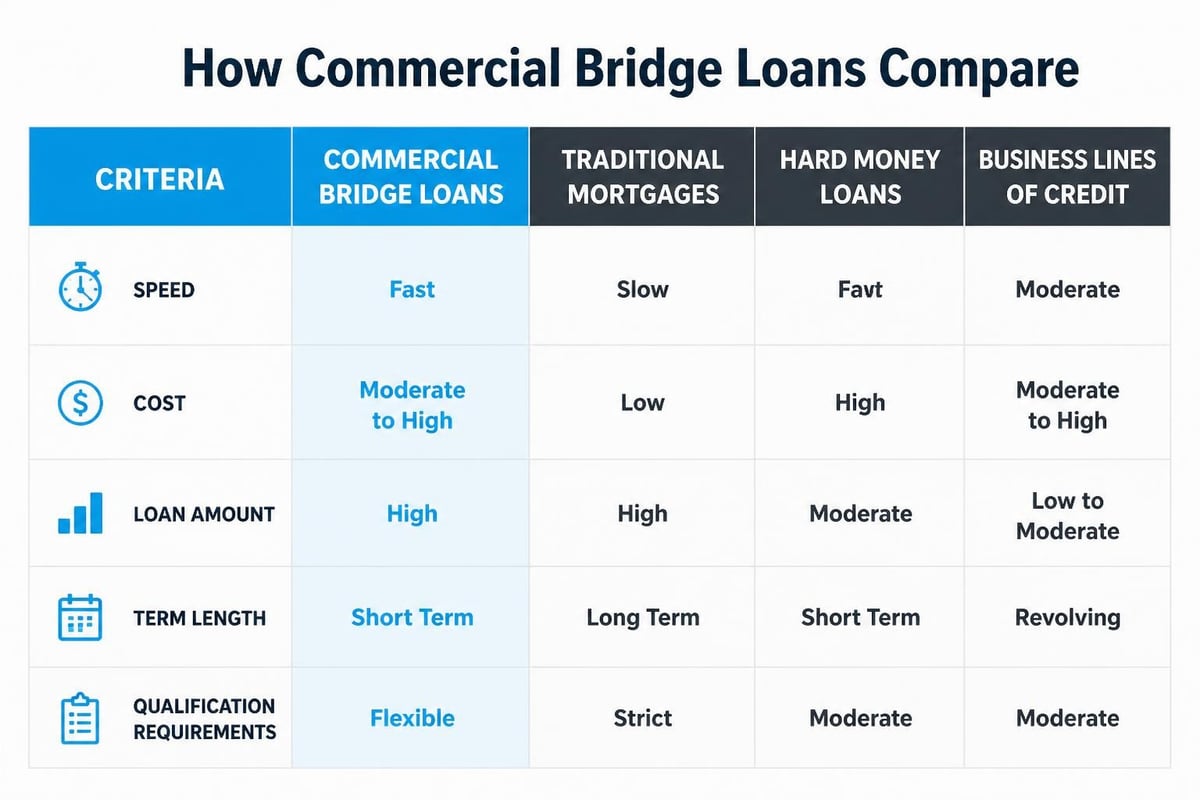
Comparing Bridge Loans to Alternative Financing
Understanding how commercial bridge loans compare to other financing options helps business owners select the most appropriate tool for their specific situation.
Commercial Bridge Loan vs. Traditional Mortgage
Traditional commercial mortgages offer lower rates (typically 6% to 9% in 2026) and longer terms (5 to 25 years), but require extensive documentation, longer closing timelines, and properties that already meet stabilization criteria. Bridge financing trades higher cost for speed and flexibility.
Choose traditional financing when time permits and the property already generates stable cash flow. Select bridge financing when speed is essential or the property requires improvements before qualifying for conventional debt.
Bridge Loan vs. Hard Money Loan
Hard money loans and commercial bridge loans share similarities-both provide short-term, asset-based financing with expedited underwriting. Hard money lenders typically focus on smaller loans (under $2 million) with even higher rates (10% to 18%) and shorter terms (6 to 18 months). Bridge lenders generally serve larger transactions with slightly more favorable terms and longer duration options.
Bridge Loan vs. Business Line of Credit
A business line of credit provides flexible access to capital but is typically unsecured or secured by business assets rather than real estate, resulting in lower advance rates and shorter repayment terms. Lines of credit work well for working capital and operational needs but rarely provide sufficient capital for commercial real estate acquisitions.
The Application and Closing Process
Securing a commercial bridge loan follows a streamlined but thorough process designed to balance speed with appropriate due diligence.
Initial Qualification and Documentation
Begin by assembling basic information about the property and transaction:
- Property details: Address, property type, square footage, current use, acquisition or appraised value
- Transaction structure: Purchase price, down payment, improvement budget (if applicable)
- Exit strategy: Detailed plan for loan repayment, including timeline and supporting assumptions
- Borrower information: Personal financial statement, credit authorization, real estate experience summary
Lenders typically provide initial qualification and term sheets within 48 to 72 hours based on this preliminary information.
Due Diligence and Underwriting
Once you accept a term sheet, the lender begins formal due diligence. This phase includes property appraisal, environmental Phase I assessment (for most property types), title review, and verification of borrower information. The lender's underwriting team analyzes the property's value, market position, and the feasibility of your exit strategy.
Unlike conventional mortgages that might require extensive business tax returns and financial statements, bridge lenders focus primarily on the property and exit plan. Personal credit still matters, but scores in the 600s often qualify whereas conventional lenders typically require 680 or higher.
Closing and Funding
Commercial bridge loan closings typically occur 15 to 30 days after application, depending on transaction complexity and due diligence findings. Closing involves signing loan documents, funding escrow (if applicable), and satisfying any closing conditions. Most lenders wire funds directly to the title company or closing attorney for same-day disbursement.
Risk Management and Exit Planning
While commercial bridge loans provide valuable flexibility, they also carry risks that require active management throughout the loan term.
Interest Rate and Market Risk
Bridge loans with floating rates expose borrowers to interest rate increases during the loan term. In a rising rate environment, monthly debt service can increase significantly, affecting cash flow and exit economics. Fixed-rate bridge loans eliminate this risk but typically carry slightly higher initial rates.
Market volatility also affects exit strategies. Property values or rental markets that deteriorate during the bridge period can complicate refinancing or sale plans. The Deloitte commercial real estate outlook offers valuable perspective on CRE market trends that influence bridge loan exit timing and risk.
Timeline and Execution Risk
The greatest risk in bridge financing is failing to execute your exit strategy within the loan term. Renovation delays, slower-than-projected lease-up, or permanent financing complications can leave borrowers scrambling as maturity approaches.
Mitigate this risk by building timeline cushion into your initial planning, securing extension options at closing, and beginning exit strategy execution early. For renovation projects, start the permanent financing application as soon as you achieve stabilization milestones rather than waiting until the bridge loan nears maturity.
Stress Testing Your Exit Plan
Before committing to a commercial bridge loan, stress test your exit assumptions. What happens if renovations take three months longer than planned? If vacancy rates increase by 10%? If interest rates rise another 100 basis points before you refinance?
Conservative underwriting assumes slower execution and less favorable exit conditions than your base case. If the transaction still works under these stressed scenarios, you likely have adequate risk cushion. If not, consider increasing your equity contribution, securing longer initial terms, or exploring alternative strategies.
Current Market Dynamics Affecting Bridge Lending
The commercial bridge loan market in 2026 reflects broader commercial real estate and credit market conditions that influence availability, pricing, and terms.
Lender Competition and Capital Availability
Private debt funds, specialty finance companies, and regional banks all actively compete in the commercial bridge lending space. This competition has generally maintained borrower-friendly conditions with reasonable pricing and flexible terms, though individual lender appetites vary by property type and market.
Moody's analysis of structured finance and CMBS markets provides insight into refinancing pressures and funding availability that affect both bridge lending demand and exit financing options.
Property Type Preferences
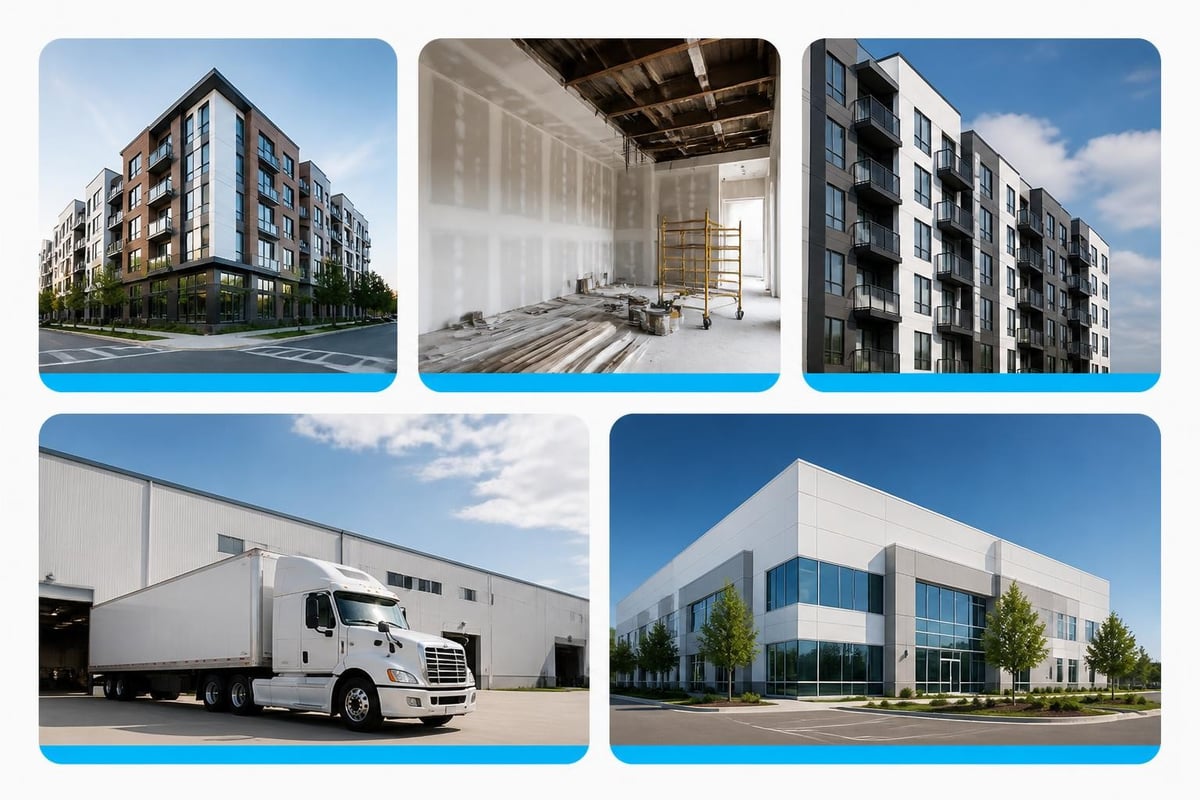
Not all property types receive equal treatment from bridge lenders. Multifamily properties, particularly in strong markets, typically secure the most favorable terms. Office properties, especially older suburban product, face more scrutiny and conservative lending terms given ongoing workplace evolution.
Property type lending preferences (most to least favorable):
- Stabilized multifamily in primary markets
- Retail (grocery-anchored, necessity-based)
- Industrial and warehouse
- Mixed-use with strong residential component
- Hospitality (select service, strong locations)
- Office (depends heavily on location, age, tenant quality)
Regulatory Environment
While bridge lenders operate with more flexibility than traditional banks, they still navigate a regulatory environment that influences lending standards and risk appetite. Fannie Mae's guidance on bridge/swing loans offers useful context on documentation and underwriting considerations, even though many commercial bridge loans fall outside agency parameters.
Making the Bridge Loan Decision
Determining whether a commercial bridge loan serves your business needs requires honest assessment of both the opportunity and your execution capabilities.
When Bridge Financing Makes Strategic Sense
Consider a commercial bridge loan when you face one or more of these circumstances:
- A time-sensitive acquisition opportunity that requires rapid closing
- A property that needs physical or operational improvements before qualifying for permanent financing
- A strategic real estate move (expansion, relocation) that demands immediate action
- Access to a compelling opportunity where the value creation potential clearly justifies bridge financing costs
The key question: Does the opportunity value exceed the incremental cost of bridge financing versus waiting for conventional financing or alternative approaches?
When to Explore Other Options
Bridge financing may not be appropriate when:
- Your timeline allows conventional mortgage processing (60 to 90 days)
- The property already meets stabilization criteria for permanent financing
- Your exit strategy depends on uncertain future events outside your control
- The total cost of bridge financing plus permanent refinancing exceeds alternative approaches
- You lack experience executing similar property improvements or lease-up plans
Working with Experienced Partners
Given the complexity and costs involved, most business owners benefit from working with experienced commercial real estate brokers or financing advisors who understand bridge lending markets and maintain relationships with multiple lenders. These professionals help structure transactions appropriately, compare competing offers, and navigate the closing process efficiently.
A commercial bridge loan delivers immediate capital and strategic flexibility for time-sensitive commercial real estate transactions, though success requires careful planning, realistic exit strategies, and active risk management throughout the loan term. When conventional financing timelines don't align with business opportunities, bridge financing provides a practical path forward. Enterprise Finest Solutions connects business owners with a network of lenders and funding partners, helping clients identify financing options-including specialized real estate and working capital solutions-that align with their business performance, revenue, and capital needs.
Written by
Enterprise Finest Solutions
Content creator and writer sharing insights and stories.