Chase Bank Small Business Loan: Guide & Alternatives
Explore Chase bank small business loan options, eligibility requirements, application steps, and alternative funding solutions for your business.

Chase Bank serves millions of small business customers across the United States, offering a range of financing products designed to support growth, manage cash flow, and fund operational needs. A chase bank small business loan can provide capital for inventory, equipment, expansion, payroll, and other essential expenses, but understanding the product suite, eligibility criteria, and application process is crucial before moving forward. For many business owners, the decision to pursue traditional bank financing versus alternative funding options depends on their qualifications, urgency, and operational flexibility.
Understanding Chase Bank Small Business Loan Products
Chase offers several distinct financing products under its commercial banking umbrella, each designed for different use cases and borrower profiles. The most common products include term loans, business lines of credit, and SBA-backed loans through the bank's participation in U.S. Small Business Administration programs.
Term loans provide a lump sum of capital repaid over a fixed schedule with predictable monthly payments. These loans typically range from $10,000 to several million dollars, depending on the borrower's qualifications and business needs. Term loans work well for one-time investments such as real estate purchases, major equipment acquisitions, or business acquisitions.
Business lines of credit offer revolving access to capital up to a pre-approved limit. Borrowers draw funds as needed and pay interest only on the outstanding balance. Chase's business line of credit options can range from $10,000 to $500,000 or more for qualified businesses, making them suitable for managing seasonal fluctuations, covering short-term cash gaps, or funding recurring operational expenses.

SBA loans facilitated by Chase include 7(a) loans, CDC/504 loans, and microloans. These government-backed products feature longer repayment terms, lower down payments, and more flexible eligibility criteria than conventional bank loans. However, they require extensive documentation and longer approval timelines. The SBA's funding programs outline the full range of guaranteed loan products available through participating lenders like Chase.
Eligibility Requirements for Chase Business Financing
Chase evaluates small business loan applications using a combination of business performance metrics, owner creditworthiness, and collateral availability. While specific requirements vary by product and loan amount, several common criteria apply across most chase bank small business loan applications.
Credit score minimums typically range from 680 to 700 for conventional products, though SBA loans may accept scores as low as 650 depending on compensating factors. Both business credit and personal credit histories receive scrutiny, particularly for newer businesses without established commercial credit profiles.
Time in business requirements generally call for at least two years of operation, though some products may consider businesses with 12 to 18 months of history. Startups and newer ventures often qualify only through SBA programs or with substantial owner investment and strong personal credit.
Revenue thresholds vary significantly by product. Lines of credit may require minimum annual revenues of $100,000 to $250,000, while larger term loans typically demand $500,000 or more in annual sales. Profitability matters-consistent positive cash flow strengthens applications significantly.
| Loan Product | Typical Credit Score | Minimum Time in Business | Typical Revenue Requirement |
|---|---|---|---|
| Term Loan | 700+ | 2+ years | $500,000+ annually |
| Line of Credit | 680+ | 2 years | $100,000–$250,000+ annually |
| SBA 7(a) Loan | 650+ | Varies | Varies by use case |
| Equipment Financing | 680+ | 1–2 years | Varies |
Collateral and personal guarantees are standard requirements for most chase bank small business loan products. Real estate, equipment, inventory, and accounts receivable commonly serve as collateral. Owners typically must provide unlimited personal guarantees, putting personal assets at risk if the business defaults.
Application Process and Documentation Requirements
Applying for a chase bank small business loan involves multiple steps, extensive documentation, and patience throughout underwriting. The process typically takes two to eight weeks for conventional products and significantly longer for SBA loans.
Chase provides a detailed business loan application checklist that outlines required documents and information. Applicants should gather these materials before starting:
- Business financial statements: Balance sheets, profit-and-loss statements, and cash-flow projections covering the past two to three years
- Tax returns: Business tax returns for two to three years, plus personal tax returns for all owners with 20% or greater ownership
- Business plan: Comprehensive plan outlining use of funds, market analysis, competitive positioning, and financial projections
- Legal documents: Articles of incorporation, operating agreements, franchise agreements, commercial leases, and licenses
- Personal financial statements: Detailed asset and liability documentation for all guarantors
- Bank statements: Three to twelve months of business bank statements demonstrating cash-flow patterns
Underwriting Timeline and Decision Factors
Chase's underwriting team analyzes multiple dimensions of creditworthiness before approving a chase bank small business loan. The evaluation process considers quantitative metrics, qualitative factors, and external market conditions.
Debt service coverage ratio (DSCR) measures whether business cash flow can comfortably cover loan payments. Chase typically requires a DSCR of 1.25 or higher, meaning the business generates at least $1.25 in cash flow for every $1.00 of debt service. Stronger ratios improve approval odds and may unlock better terms.
Loan-to-value (LTV) ratios determine how much financing Chase will extend against collateral. Real estate loans may reach 75% to 85% LTV, while equipment financing typically caps at 80% to 90% of the asset's appraised value. Higher down payments reduce lender risk and improve approval likelihood.
Industry and economic conditions also influence decisions. Recent Federal Reserve lending surveys show that banks tighten or loosen credit standards based on macroeconomic outlook, competition, and sector-specific risks. Industries experiencing volatility or decline face more scrutiny and potentially higher denial rates.

Regulatory Changes Affecting Small Business Lending
The small business lending landscape has evolved significantly due to new regulations aimed at increasing transparency and fairness. The CFPB's Small Business Lending Rule under Regulation B requires large lenders to collect and report detailed data on small business credit applications starting in 2024 and 2025.
These requirements affect how banks like Chase process applications and what information they request from borrowers. Lenders must now collect demographic data about business owners, including race, ethnicity, gender, and veteran status, to help regulators monitor fair lending practices and identify potential discrimination patterns.
Compliance obligations under the new rule include:
- Collecting applicant demographic information (with opt-out provisions)
- Reporting application outcomes, pricing, and terms to the CFPB
- Maintaining detailed records of credit decisions
- Implementing systems to track and report covered credit transactions
The CFPB's compliance guide provides technical details on implementation requirements and reporting timelines. While these regulations primarily impact lenders, borrowers may notice extended application forms and additional demographic questions during the application process for a chase bank small business loan.
Market Trends and Chase's Position
Chase ranks among the largest small business lenders in the United States, competing with other national banks, regional institutions, credit unions, and alternative lenders. Understanding broader market trends helps contextualize Chase's offerings and limitations.
According to the FDIC's 2024 Small Business Lending Survey, large banks like Chase face increasing competition from fintech platforms and alternative lenders that offer faster approvals, less documentation, and more flexible underwriting. However, traditional banks maintain advantages in pricing, loan size capacity, and integration with other commercial banking services.
The Federal Reserve's 2024 Small Business Credit Survey reveals important borrower behavior patterns. Many small businesses report seeking multiple financing sources simultaneously, comparing traditional bank loans with online lenders, merchant cash advances, and revenue-based financing. Speed and convenience increasingly influence decisions, particularly for smaller loan amounts under $250,000.
Key competitive factors include:
- Approval speed: Alternative lenders often approve and fund loans within days versus weeks for banks
- Documentation burden: Traditional banks require extensive paperwork compared to streamlined online applications
- Approval rates: Banks typically maintain stricter underwriting standards and lower approval rates
- Relationship banking: Chase offers integrated services (deposits, treasury, merchant services) that competitors cannot match
Alternatives to Chase Bank Small Business Loans
Businesses that don't qualify for traditional bank financing or need faster access to capital have numerous alternatives. Understanding these options helps business owners make informed decisions aligned with their specific circumstances and constraints.
For businesses with strong revenue but credit challenges, a business line of credit through alternative lenders may provide flexible working capital access without the stringent credit requirements of a chase bank small business loan. These products often emphasize cash flow and business performance over credit scores and time in business.
Alternative financing options include:
- Merchant cash advances: Repayment tied to daily credit card sales, ideal for businesses with high card transaction volumes
- Revenue-based financing: Funding repaid as a percentage of monthly revenue, scaling payments with business performance
- Invoice factoring: Advance against outstanding receivables, converting unpaid invoices to immediate cash
- Equipment financing: Asset-backed loans specifically for purchasing or leasing business equipment
- Online term loans: Faster approval and funding than banks, though typically at higher interest rates
When Alternative Funding Makes Sense
Certain business situations favor alternative funding over traditional bank products. Companies facing urgent capital needs, experiencing rapid growth, recovering from credit setbacks, or operating in higher-risk industries often find better fits outside conventional banking.
Time-sensitive opportunities such as bulk inventory purchases, emergency repairs, or seasonal hiring may require funding within days rather than weeks. Alternative lenders typically complete underwriting and fund loans within 24 to 72 hours, while a chase bank small business loan application may take four to eight weeks from submission to funding.
Credit recovery scenarios present another common use case. Businesses rebuilding after financial difficulties may not meet Chase's credit standards but can qualify for alternative products that emphasize current cash flow over historical credit events. Successfully managing alternative financing can help rebuild business credit and eventually qualify for traditional bank products.
Industry-specific challenges affect approval likelihood at traditional banks. Restaurants, retail businesses, contractors, and service companies with fluctuating revenue or thin margins may struggle to meet bank requirements but qualify for revenue-based products that account for seasonal patterns and industry-specific operating models.
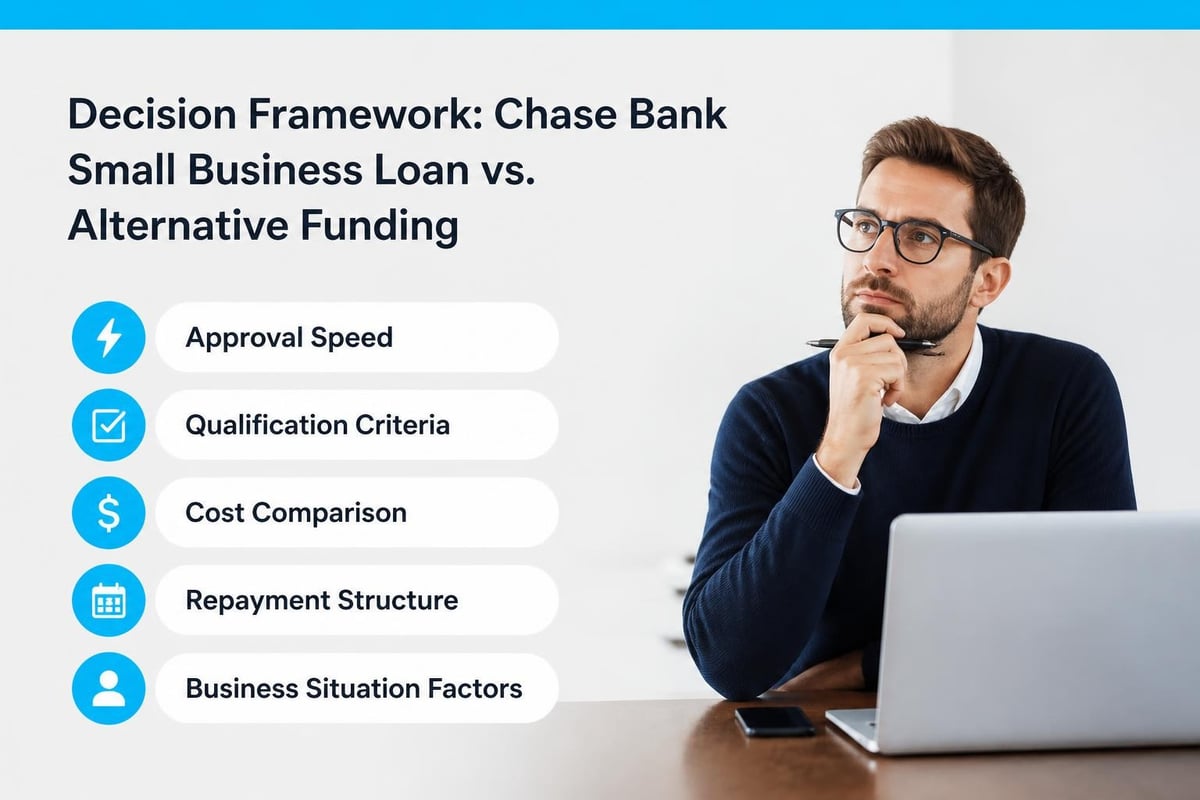
Preparing Your Business for Loan Success
Whether pursuing a chase bank small business loan or exploring alternatives, preparation significantly improves approval odds and unlocks better terms. Business owners should focus on strengthening financial fundamentals, organizing documentation, and understanding lender perspectives months before applying.
Credit optimization should begin well before submitting applications. Review personal and business credit reports for errors, dispute inaccuracies, pay down high-balance credit cards, and avoid new credit inquiries. Establishing trade credit accounts with suppliers and maintaining timely payment histories builds positive business credit over time.
Financial statement accuracy is critical. Work with a qualified bookkeeper or accountant to ensure financial records accurately reflect business performance. Clean, professional financial statements instill lender confidence and streamline underwriting. Address any discrepancies between tax returns and internal statements before lenders discover them.
Cash flow management demonstrates operational discipline. Maintain consistent deposit patterns, avoid frequent overdrafts, minimize NSF fees, and separate personal and business finances completely. Lenders scrutinize bank statements closely-irregular patterns or commingled funds raise red flags.
Strategic Planning and Use-of-Funds Clarity
Lenders evaluate not just whether a business can repay a loan, but whether the funded initiative makes sound business sense. A compelling business plan with clear use-of-funds documentation strengthens applications significantly.
Specific use cases resonate better than vague references to "working capital" or "business expenses." Detail exactly how borrowed funds will be deployed:
- Equipment purchases with vendor quotes and ROI projections
- Inventory acquisitions with supplier contracts and turnover analyses
- Expansion plans with market research, location details, and revenue forecasts
- Marketing campaigns with channel strategies, budget allocations, and customer acquisition costs
Return-on-investment calculations demonstrate financial sophistication. Show how the borrowed capital will generate revenue, reduce costs, or create competitive advantages that exceed the cost of financing. Lenders want to fund growth, not subsidize operational inefficiencies.
Comparing Costs and Terms Across Lenders
The true cost of a chase bank small business loan or any financing product extends beyond the stated interest rate. Comparing offers requires evaluating the total cost of capital, including fees, repayment structure, and prepayment penalties.
Annual Percentage Rate (APR) provides the most accurate cost comparison by incorporating interest and fees into a single annualized figure. A term loan with a 7% interest rate but significant origination fees may carry a higher APR than a stated 8% rate with minimal fees. Always compare APRs rather than interest rates alone.
Origination fees typically range from 1% to 5% of the loan amount at banks and can reach 5% to 10% with alternative lenders. These fees may be paid upfront or rolled into the loan balance. Calculate the effective APR impact of any fees before committing.
| Cost Factor | Chase Bank (Typical) | Alternative Lenders (Typical) |
|---|---|---|
| Interest Rate | 6%–10% | 10%–40%+ |
| Origination Fee | 1%–3% | 2%–10% |
| Prepayment Penalty | Sometimes | Often |
| Monthly vs. Daily Payments | Monthly | Often daily/weekly |
| Effective APR | 7%–12% | 15%–60%+ |
Repayment frequency affects cash flow management. Traditional banks typically require monthly payments, while alternative lenders may demand daily or weekly payments tied to business revenue or credit card sales. More frequent payments create tighter cash flow constraints but may result in faster payoff and lower total interest costs.
Prepayment penalties restrict early repayment and can lock businesses into unfavorable terms. Some chase bank small business loan products include prepayment penalties or minimum interest guarantees. Read term sheets carefully and negotiate penalty waivers when possible.
Working with Financing Brokers and Advisors
Navigating the small business financing landscape requires expertise many business owners lack. Financing brokers and advisors help businesses identify appropriate products, strengthen applications, and access lenders that might otherwise be unavailable.
Broker advantages include market knowledge, lender relationships, application expertise, and negotiation leverage. Experienced brokers understand which lenders serve specific industries, business profiles, and funding needs. They can match businesses to appropriate products more efficiently than owners researching independently.
Application support from brokers includes document preparation, financial statement presentation, business plan development, and strategic positioning. Brokers help businesses present their strongest case, addressing potential concerns proactively and highlighting strengths that resonate with specific lenders.
Access to multiple options allows businesses to compare offers across traditional banks, alternative lenders, and specialty finance companies simultaneously. Rather than applying sequentially and risking multiple credit inquiries, brokers can present pre-qualified options from multiple sources, enabling informed decision-making.
Evaluating Broker Relationships
Not all financing brokers provide equal value or operate with client interests first. Business owners should evaluate broker qualifications, transparency, and compensation structures before engaging.
Transparent fee structures are essential. Reputable brokers clearly disclose how they're compensated-whether through lender-paid commissions, client fees, or a combination. Avoid brokers who are evasive about compensation or who pressure specific products without explaining alternatives.
Lender network breadth indicates broker capability. Strong brokers maintain relationships with dozens of lenders across the spectrum from traditional banks offering products like a chase bank small business loan to specialized alternative finance companies. Limited networks suggest the broker may not access the full range of appropriate solutions.
Track record and references provide insight into broker performance. Request references from businesses in similar industries or situations and verify the broker's experience with businesses of your size and complexity.
Securing the right financing requires understanding your options, preparing thoroughly, and choosing products aligned with your business model and growth trajectory. While a chase bank small business loan offers competitive rates and robust banking relationships for qualifying businesses, alternative funding solutions provide viable paths for companies that need faster access, more flexible underwriting, or specialized products. Enterprise Finest Solutions connects business owners with a diverse network of lenders and alternative funding providers, helping you identify financing options that match your revenue, performance, and capital needs.
Written by
Enterprise Finest Solutions
Content creator and writer sharing insights and stories.