Business Require: Defining Needs for Funding & Growth
Learn what business require for success in 2026: funding, planning, and operational clarity. Align capital needs with strategic goals.

Every successful enterprise starts with a clear understanding of what they need to thrive. The term "business require" captures the essential question that drives strategic planning, resource allocation, and capital decisions across organizations of all sizes. Whether preparing for expansion, managing cash flow, or planning major investments, identifying and documenting what your business require forms the foundation for sustainable growth and operational excellence. For small and medium-sized businesses in 2026, this clarity has never been more critical as competition intensifies and funding options diversify.
Understanding What Business Requirements Mean
Business requirements represent the documented needs, goals, and constraints that an organization must address to achieve its strategic objectives. When we examine what business require, we're looking at everything from immediate operational needs to long-term strategic initiatives. These requirements serve as the roadmap that guides decision-making, resource investment, and performance measurement.
The business requirements specification process follows established frameworks that help organizations identify, document, and validate their true needs. Unlike simple wish lists, properly defined business requirements connect directly to measurable outcomes and strategic priorities.
The Core Categories of Business Requirements
When assessing what business require for success, leaders typically encounter several distinct categories:
- Operational requirements: Daily functions, processes, systems, and resources needed to deliver products or services
- Financial requirements: Capital, cash flow, working capital, and funding needed to sustain and grow operations
- Regulatory requirements: Compliance obligations, industry standards, and legal mandates
- Strategic requirements: Long-term goals, market positioning, competitive advantages, and growth targets
- Stakeholder requirements: Customer expectations, employee needs, investor demands, and partner obligations
Each category demands its own analysis and documentation approach. The challenge many businesses face is that these requirement types often overlap and compete for limited resources.

Why Clear Requirements Drive Better Funding Decisions
Understanding what your business require has direct implications for how you approach financing. Vague or poorly defined needs lead to mismatched funding solutions, unnecessary costs, and missed opportunities. Conversely, precise requirement documentation enables business owners to communicate clearly with lenders, compare financing options effectively, and select capital solutions that truly fit their situation.
Consider a retail business experiencing seasonal fluctuations. The owner knows they need "more money," but that's not a requirement, that's a symptom. The actual business requirement might be: "Maintain inventory levels 30% above baseline from October through December to meet holiday demand without stockouts, requiring approximately $150,000 in additional working capital for 90 days."
From Symptoms to Requirements
Many businesses struggle to distinguish between problems, symptoms, and actual requirements. This distinction matters enormously when seeking funding:
| What You Notice | The Symptom | The Actual Requirement |
|---|---|---|
| "We're always short on cash" | Cash flow volatility | Establish revolving credit access for $50K to bridge 15-day payment cycles |
| "We can't grow" | Resource constraints | Acquire $200K in capital equipment to increase production capacity 40% |
| "Payroll is stressful" | Timing mismatches | Secure flexible financing to smooth revenue-to-expense timing gaps |
This analytical process, explained in practical business requirements guidance, helps translate business challenges into actionable, fundable requirements. When you can articulate exactly what your business require in specific, measurable terms, you position yourself to find financing that solves real problems rather than creating new ones.
Documenting Requirements for Operational Excellence
The act of writing down what business require serves multiple purposes beyond funding applications. Documentation creates shared understanding across teams, establishes accountability, enables measurement, and provides a baseline for future planning. In 2026, organizations increasingly use collaborative tools and living documentation to keep requirements current as conditions change.
Essential elements of effective requirement documentation include:
- Clear, specific statements of what is needed, not how to achieve it
- Measurable criteria for determining when the requirement has been met
- Priority rankings that indicate which requirements are critical versus nice-to-have
- Traceability links connecting each requirement to strategic goals and stakeholder needs
- Validation evidence demonstrating the requirement addresses a real business need
Modern businesses benefit from collaborative work management approaches that keep requirements visible and actionable across departments. Rather than static documents that quickly become outdated, requirements should live in systems that teams actively use for planning and execution.
Avoiding Common Documentation Pitfalls
Even experienced business leaders make predictable mistakes when defining what their business require:
- Solution bias: Stating "we need new software" instead of "we need to reduce order processing time by 50%"
- Vagueness: Writing "improve customer service" rather than "respond to all customer inquiries within 4 hours"
- Scope creep: Including nice-to-have features that dilute focus from critical needs
- Missing stakeholders: Failing to gather input from all affected parties
- No success criteria: Defining needs without explaining how to measure fulfillment
These errors waste time, money, and credibility. They also make it harder to secure appropriate funding because lenders and investors need concrete information to assess risk and structure deals appropriately.
Aligning Requirements with Available Capital Solutions
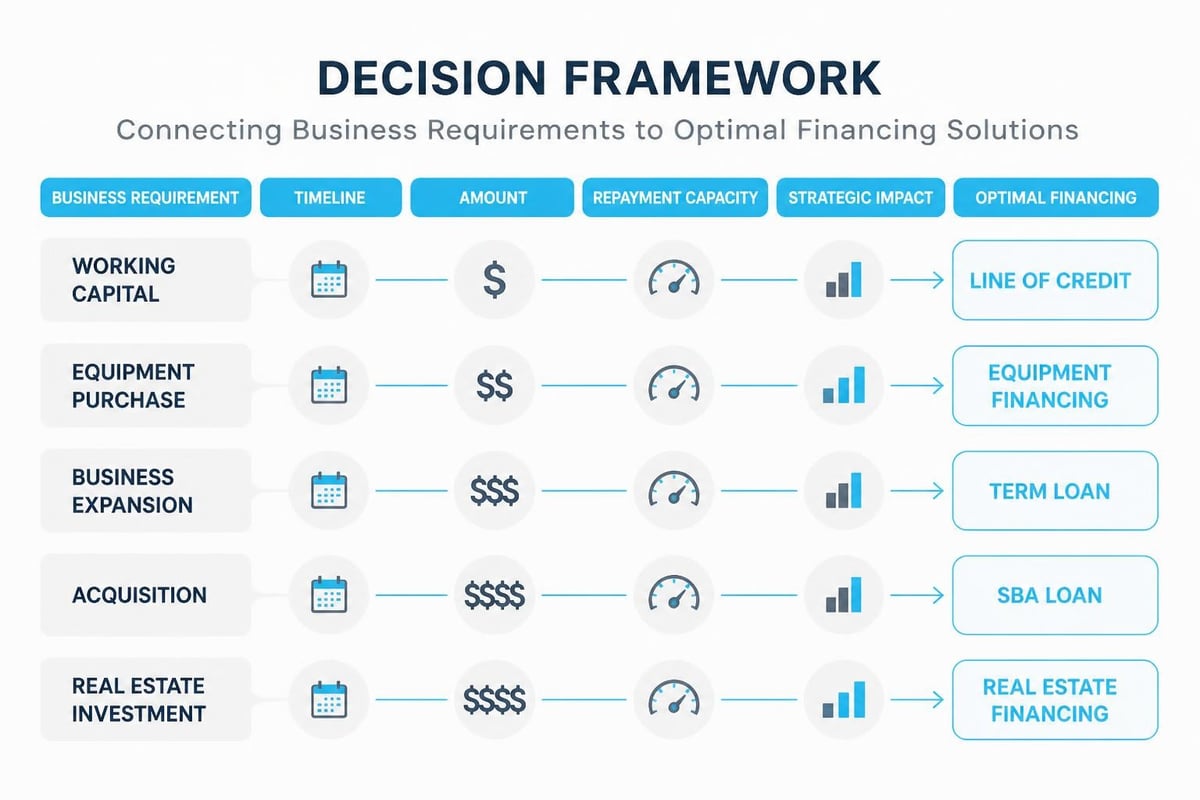
Once you've documented what your business require, the next challenge is matching those needs to appropriate funding mechanisms. Not every business requirement demands the same capital solution, and understanding these alignments prevents costly mismatches.
For businesses with clearly defined working capital needs tied to revenue cycles, exploring Working Capital Financing through experienced brokers can help identify flexible options that match cash flow patterns and business performance metrics rather than relying solely on traditional credit criteria.
Matching Requirements to Funding Types
Different business requirements align naturally with specific financing structures:
| Business Requirement Type | Appropriate Funding Solutions | Key Considerations |
|---|---|---|
| Equipment acquisition | Equipment financing, equipment loans | Asset-based terms, depreciation schedules |
| Short-term cash flow gaps | Lines of credit, revenue-based financing | Flexibility, access speed, repayment structure |
| Inventory for seasonal demand | Working capital loans, inventory financing | Seasonal revenue patterns, turnover rates |
| Major expansion projects | Term loans, SBA loans, equity investment | Long-term projections, collateral, dilution |
| Emergency needs | Merchant cash advances, bridge loans | Speed vs. cost trade-offs, repayment capacity |
Understanding these alignments helps business owners avoid common mistakes like using expensive short-term financing for long-term needs or pursuing lengthy application processes when immediate capital is required.
Requirements Management Throughout the Business Lifecycle
What business require evolves as companies mature. A startup's requirements differ dramatically from those of an established enterprise, and even within a single organization, requirements shift as markets change, opportunities emerge, and challenges arise. Effective requirement management isn't a one-time exercise but an ongoing discipline.
Startup Phase Requirements
Early-stage businesses typically require:
- Proof of concept funding
- Minimal viable product development resources
- Initial market validation capacity
- Core team compensation
- Basic infrastructure and tools
These needs often prioritize speed and flexibility over cost optimization. Startups must define requirements that allow rapid testing and iteration while conserving limited capital.
Growth Phase Requirements
As businesses gain traction, what they require shifts toward:
- Scaling infrastructure and systems
- Expanded inventory and working capital
- Additional team members and expertise
- Marketing and customer acquisition investment
- Process standardization and automation
Growth-phase requirements often involve balancing immediate opportunities against long-term sustainability. The temptation to pursue every possible revenue stream must be weighed against operational capacity and capital availability.
Maturity Phase Requirements
Established businesses face different requirement priorities:
- Market share defense and competitive positioning
- Operational efficiency improvements
- Innovation to prevent disruption
- Talent retention and development
- Strategic diversification or consolidation
Mature organizations generally have better access to traditional financing but may also have more complex requirement trade-offs involving multiple stakeholders with competing priorities.
Technology and Tools for Requirements Management
In 2026, businesses have access to sophisticated tools for capturing, tracking, and managing what they require. The requirements management capabilities built into platforms like Jira enable teams to maintain living requirement documentation that stays synchronized with actual work.
Key capabilities modern requirement management tools provide:
- Centralized requirement repositories accessible to all stakeholders
- Version control and change tracking for requirement evolution
- Traceability matrices linking requirements to deliverables and tests
- Collaboration features for stakeholder input and approval workflows
- Integration with financial planning and project management systems
- Reporting and analytics on requirement coverage and completion
These tools transform requirements from static documents into dynamic management assets. When everyone can see what the business require and how current initiatives address those needs, alignment improves and wasted effort decreases.
Balancing Technology with Human Judgment
Despite powerful tools, technology alone cannot determine what your business require. The most sophisticated requirement management system still depends on human insight, strategic thinking, and stakeholder engagement. Tools enable better documentation and tracking, but business leaders must still make the fundamental decisions about priorities, trade-offs, and acceptable risks.
The most effective approach combines structured processes with collaborative dialogue. Regular requirement review sessions, stakeholder interviews, and market analysis should feed into your requirement management system rather than replace it.
Regulatory and Compliance Requirements
For many industries, a significant portion of what business require stems from regulatory mandates and compliance obligations. These requirements are non-negotiable, yet they often compete with growth initiatives for limited resources. Understanding and properly documenting compliance requirements helps businesses plan appropriately and avoid costly violations.
The security and privacy control frameworks published by NIST provide detailed guidance on translating regulatory needs into system-level requirements, particularly for businesses handling sensitive data or operating in regulated industries.
Common Compliance Requirement Categories
- Data protection and privacy: GDPR, CCPA, PIPEDA, industry-specific data handling mandates
- Financial reporting: Tax compliance, audit requirements, financial disclosure obligations
- Industry licensing: Professional certifications, operational permits, regulatory registrations
- Workplace safety: OSHA requirements, industry-specific safety standards, insurance mandates
- Environmental standards: Waste management, emissions controls, sustainability reporting
Compliance requirements often have strict timelines and penalties for non-compliance, making them high-priority even when they don't directly generate revenue. Smart businesses incorporate compliance costs into their requirement planning from the start rather than treating them as unexpected expenses.

Validating and Prioritizing Requirements
Not everything your business require can be addressed simultaneously. Effective requirement management demands rigorous prioritization based on strategic impact, urgency, dependencies, and available resources. The prioritization process itself reveals important insights about your business model and competitive positioning.
Common Prioritization Frameworks
MoSCoW Method:
- Must have: Critical requirements without which the business cannot function
- Should have: Important requirements that significantly impact success
- Could have: Valuable requirements that provide incremental benefits
- Won't have (this time): Recognized needs deferred to future planning cycles
Value vs. Effort Matrix:
| High Value, Low Effort | High Value, High Effort |
|---|---|
| Quick wins - do first | Strategic investments - plan carefully |
| Low Value, Low Effort | Low Value, High Effort |
| Consider if capacity exists | Avoid or defer indefinitely |
Risk-Based Prioritization: Evaluate requirements based on the risk of not addressing them, considering both probability and impact of failure. Requirements that prevent existential threats take precedence over those that enable incremental improvements.
Stakeholder Input in Prioritization
What your business require looks different depending on whose perspective you consider. Customers, employees, investors, and partners each have legitimate but often competing requirement priorities. Effective prioritization requires gathering diverse stakeholder input while maintaining clear decision authority.
Regular stakeholder requirement reviews should address:
- Have circumstances changed that affect requirement priorities?
- Are current initiatives delivering expected value?
- What new requirements have emerged?
- Which requirements can be deferred or eliminated?
This ongoing dialogue ensures your requirement portfolio remains relevant and achievable rather than becoming an ever-expanding wish list that paralyzes decision-making.
Connecting Requirements to Financial Planning
The ultimate test of requirement clarity is whether you can translate needs into accurate financial projections. When you understand precisely what your business require, you can build budgets, forecast cash needs, and plan capital raises with confidence. Conversely, vague requirements produce unreliable financial plans that leave you constantly surprised by unforeseen expenses.
Steps to connect requirements to financial planning:
- Estimate the cost to fulfill each documented requirement
- Map requirements to budget periods based on priority and dependencies
- Identify which requirements can be funded from operating cash flow versus those requiring external capital
- Determine the optimal funding structure for capital-intensive requirements
- Build scenario models showing different requirement prioritization approaches
- Monitor actual costs against estimates and refine future requirement costing
This disciplined approach transforms requirement management from an academic exercise into a practical business tool that directly improves financial decision-making.
Requirement-Based Funding Requests
When approaching lenders or investors, the ability to articulate exactly what your business require and why creates credibility and confidence. A funding request built on documented, validated requirements is fundamentally more compelling than one based on general aspirations or vague growth targets.
Your funding request should explicitly connect requested capital to specific requirements:
- "We require $175,000 to purchase three additional delivery vehicles and hire four drivers, enabling us to expand our service radius by 40 miles and capture an estimated $450,000 in annual revenue from underserved suburbs."
- "The business requires a $50,000 revolving line of credit to bridge the 21-day gap between customer payment terms and supplier payment obligations during our peak season from March through June."
This specificity helps lenders assess risk accurately, structure appropriate terms, and approve requests faster because they understand exactly how capital will be deployed and how it will generate returns.
Adaptive Requirement Management in Uncertain Markets
The business environment in 2026 demands flexibility. What your business require today may shift dramatically as technology evolves, consumer preferences change, supply chains adapt, and competitive landscapes transform. Static requirement plans that assume stable conditions inevitably become obsolete.
Adaptive requirement management embraces uncertainty through:
- Rolling requirement cycles that review and refresh needs quarterly rather than annually
- Scenario planning that documents requirements under different market conditions
- Modular requirement design that allows incremental implementation and course correction
- Built-in flexibility within financing structures to accommodate changing needs
- Regular validation testing whether previously defined requirements remain relevant
This approach doesn't mean abandoning planning discipline. Rather, it recognizes that the value of requirement management lies in creating shared understanding and enabling better decisions, not in predicting the future with false precision.
Learning from Requirement Failures
When initiatives fail to deliver expected value, the root cause often traces to requirement problems: misunderstood needs, missing stakeholder input, unrealistic assumptions, or inadequate validation. Rather than viewing these as wasted efforts, successful businesses treat them as learning opportunities.
Post-implementation reviews should ask:
- Did we accurately identify what the business require?
- Were requirements validated with appropriate rigor?
- Did priorities shift during implementation?
- Were success criteria clear and measurable?
- What would we do differently next time?
These lessons improve future requirement definition, making your organization progressively better at identifying and addressing true business needs.
Understanding what your business require is the foundation for every strategic decision, from daily operations to major capital investments. By documenting needs clearly, prioritizing ruthlessly, and connecting requirements to appropriate funding solutions, you position your organization for sustainable growth and competitive success. When you're ready to transform well-defined capital requirements into actionable funding solutions, Enterprise Finest Solutions helps small and medium-sized businesses explore flexible financing options matched to their specific revenue patterns, business performance, and growth objectives.
Written by
Enterprise Finest Solutions
Content creator and writer sharing insights and stories.