Business Funding No Credit Check: What You Need to Know
Business funding no credit check options offer fast access to capital but come with tradeoffs. Learn how these alternatives work and what to consider.

Small-business owners facing credit challenges often search for capital solutions that bypass traditional underwriting hurdles. Business funding no credit check has emerged as a category that promises faster access to working capital without the lengthy credit reviews that characterize bank loans. While these funding alternatives can provide essential liquidity during critical growth phases or cash-flow gaps, understanding how they work, what they cost, and when they make strategic sense is essential for making informed financing decisions. This article explores the landscape of no-credit-check business funding, the products that fall into this category, the real tradeoffs involved, and smarter approaches to securing capital when traditional credit presents a barrier.
Understanding Business Funding Without Traditional Credit Checks
Business funding no credit check refers to financing products where the lender or funding provider places minimal or no emphasis on the business owner's personal credit score during the approval process. Instead, these providers evaluate alternative data points such as monthly revenue, bank account activity, payment processing history, and overall business performance.
How Revenue-Based Underwriting Works
Rather than pulling credit reports from Equifax, Experian, or TransUnion, alternative funders typically request:
- Bank statements showing consistent deposits and cash-flow patterns
- Sales records or merchant processor statements demonstrating revenue volume
- Business documentation including tax returns, invoices, or profit-and-loss statements
- Time in business as a proxy for stability and operational track record
This shift from creditworthiness to cash-flow analysis allows businesses with limited credit history or past credit issues to qualify based on their actual business performance. The Federal Reserve's research on small-business financing has documented how credit-constrained entrepreneurs increasingly turn to revenue-based products when conventional bank financing remains out of reach.

Common Types of No-Credit-Check Business Funding
Several financing products operate primarily on revenue-based underwriting models:
| Funding Type | Typical Structure | Primary Evaluation Criteria |
|---|---|---|
| Merchant Cash Advance | Lump sum repaid via % of daily card sales | Credit/debit card processing volume |
| Revenue-Based Financing | Lump sum repaid via % of total revenue | Bank deposits and revenue consistency |
| Invoice Factoring | Advance on outstanding invoices | Quality and payment history of invoices |
| Equipment Financing | Asset-backed loan or lease | Equipment value and business revenue |
Businesses exploring merchant cash advance and revenue-based financing should understand that while these products may not require a pristine credit score, they are not truly "no review" transactions. Funders conduct their own risk assessment using operational and financial data, and approval is never guaranteed.
The True Cost of Skipping Credit Reviews
One of the most critical aspects of business funding no credit check is understanding the cost structure. Products marketed as accessible to all credit profiles typically carry significantly higher effective rates than traditional bank loans.
Factor Rates vs. Interest Rates
Many no-credit-check products use factor rates rather than annual percentage rates (APR). A factor rate might be expressed as 1.15 to 1.40, meaning you repay $1.15 to $1.40 for every dollar borrowed.
Example calculation:
- Loan amount: $50,000
- Factor rate: 1.25
- Total repayment: $62,500
- Cost of capital: $12,500
If this $12,500 cost is paid over six months, the effective APR can exceed 50%, far higher than traditional term loans. The Consumer Financial Protection Bureau has documented concerns about how factor-rate products can obscure the true cost of borrowing.
Daily or Weekly Repayment Structures
Business funding no credit check products frequently require daily or weekly repayments, which can strain cash flow:
- Merchant cash advances deduct a fixed percentage of daily credit card sales
- Revenue-based financing may withdraw a percentage of daily bank deposits
- Short-term business loans often require daily ACH debits
This aggressive repayment cadence means businesses must generate sufficient daily revenue to cover both operating expenses and funding repayments. During slow periods, these fixed withdrawals can create additional financial stress.
Regulatory Landscape and Consumer Protections
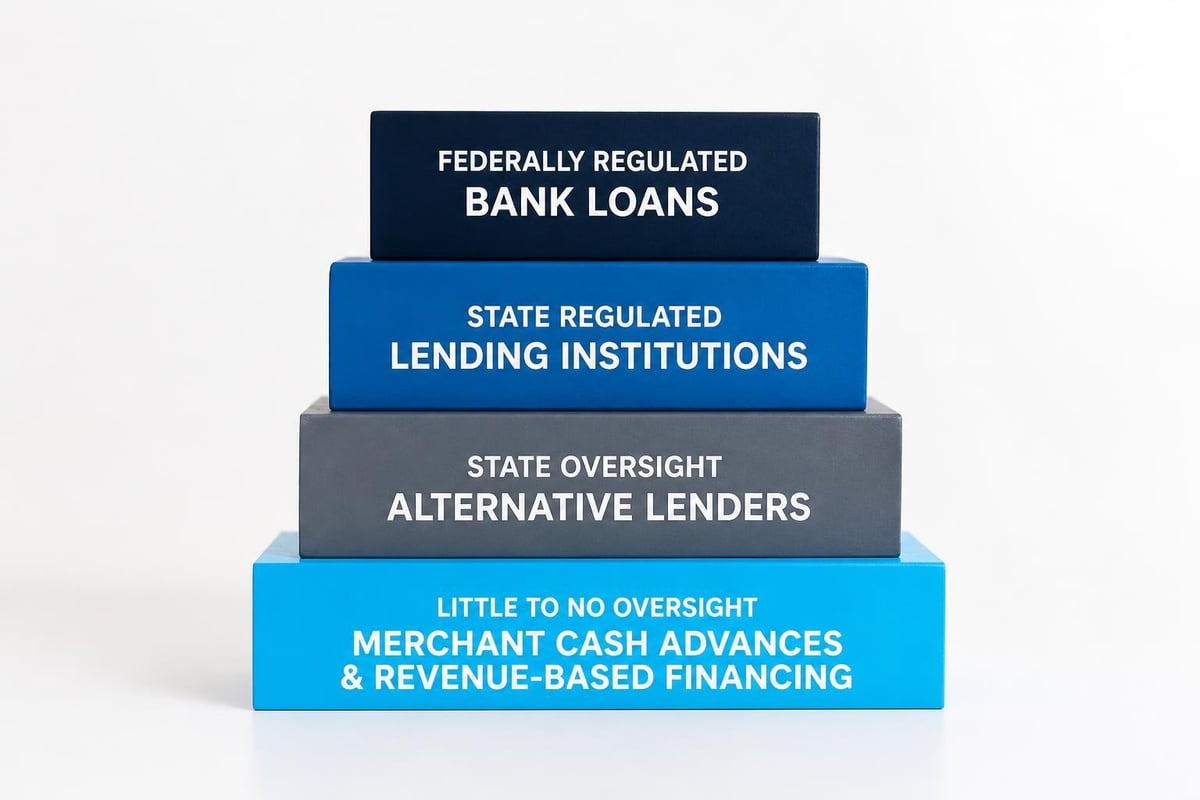
The business funding market operates under a different regulatory framework than consumer lending, with fewer disclosure requirements and protections.
Limited Federal Oversight
Unlike consumer credit products regulated under the Truth in Lending Act, most commercial financing falls outside TILA's scope. The CFPB's work on small-business lending data collection has highlighted this gap, noting that businesses often receive funding offers without standardized APR disclosures or comparison shopping tools.
Some products marketed as business funding no credit check are structured as purchases of future receivables rather than loans, which exempts them from certain lending regulations entirely. This legal distinction has allowed some providers to charge rates that would be considered usurious in consumer lending contexts.
State Enforcement Actions
State attorneys general have begun scrutinizing aggressive merchant cash advance practices. The New York Attorney General filed a major lawsuit in 2024 against providers allegedly using deceptive practices and charging effective rates exceeding 300% APR.
The Federal Trade Commission has also taken action, banning certain operators from the merchant cash advance industry for deceiving small businesses and illegally seizing funds from business bank accounts.
When No-Credit-Check Funding Makes Strategic Sense
Despite higher costs, business funding no credit check can serve legitimate business purposes in specific scenarios.
Time-Sensitive Opportunities
When a business has an immediate opportunity that will generate returns exceeding the cost of capital, fast funding may be justified:
- Inventory purchases for confirmed seasonal demand
- Contract deposits required to secure large projects
- Equipment repairs necessary to maintain operations
- Marketing campaigns with proven ROI potential
The key is ensuring the funded activity generates sufficient revenue to cover both the repayment and a meaningful profit margin.
Bridge Financing During Credit Rebuilding
Businesses actively improving their credit profile may use short-term, no-credit-check products strategically while working toward traditional financing:
- Make payments on time to demonstrate reliability
- Use capital to address issues affecting creditworthiness
- Keep loan amounts small relative to revenue
- Plan a clear exit strategy to lower-cost financing
This approach requires discipline and a realistic timeline for credit improvement.
Limited Alternatives for Newer Businesses
Startups and businesses with less than two years of operating history often lack access to conventional bank products. While business funding no credit check options carry higher costs, they may provide the only available pathway to growth capital during the early stages.
Smarter Alternatives to Explore First
Before committing to high-cost, no-credit-check products, businesses should exhaust more affordable alternatives.
SBA Microloan Program
The U.S. Small Business Administration's Microloan program provides loans up to $50,000 through nonprofit intermediary lenders. While these lenders do review credit, they often accept borrowers with imperfect credit histories and provide technical assistance alongside capital. Interest rates typically range from 8% to 13%, substantially below alternative funding costs.
Community Development Financial Institutions
CDFIs focus on underserved markets and may offer more flexible underwriting than traditional banks:
- Mission-driven lending criteria
- Technical assistance and business coaching
- Relationship-based decision-making
- Competitive rates relative to alternative products
Organizations like Kiva offer zero-interest microloans that can help business owners build credit while accessing modest amounts of capital.
Business Lines of Credit
For businesses with acceptable (though not perfect) credit, a business line of credit offers flexible access to capital with lower costs than merchant cash advances. Lines of credit allow businesses to draw funds as needed and pay interest only on the amount used, making them more economical for managing irregular cash-flow needs.
Revenue-Based Lenders with Transparent Pricing
Not all revenue-focused lenders charge predatory rates. Some newer fintech lenders offer transparent pricing with APRs disclosed upfront, more reasonable repayment terms, and customer-friendly practices that differentiate them from aggressive merchant cash advance providers.
Due Diligence: Questions to Ask Before Signing
Businesses considering business funding no credit check products should conduct thorough due diligence to avoid predatory terms.
Essential Questions for Funders
- What is the total repayment amount? Get the dollar figure, not just the factor rate.
- What is the APR? Request an annualized rate for comparison purposes.
- How frequent are payments? Daily, weekly, or monthly affects cash-flow impact.
- Are there prepayment penalties? Some products charge fees for early repayment.
- What happens if sales decline? Understand flexibility during slow periods.
- Are there additional fees? Origination, underwriting, or servicing charges add to costs.
Red Flags to Watch For
Be particularly cautious of providers who:
- Refuse to disclose total costs or APR
- Pressure you to sign immediately without time to review
- Require access to your business bank account before approval
- Offer to "stack" multiple advances simultaneously
- Make unrealistic promises about approval regardless of business condition
The Federal Reserve's Small Business Credit Survey documents how businesses seeking emergency capital are most vulnerable to predatory lending practices.

Building Business Credit for Future Financing
The most sustainable approach to accessing affordable capital is building strong business credit over time.
Establishing Separate Business Credit
Steps to develop a business credit profile independent of personal credit:
- Obtain an EIN (Employer Identification Number) from the IRS
- Register your business entity as an LLC, corporation, or other formal structure
- Open a business bank account in the company's legal name
- Apply for a business credit card and use it for regular expenses
- Work with vendors who report payments to business credit bureaus
Monitoring and Improving Your Business Credit Score
Business credit bureaus (Dun & Bradstreet, Experian Business, Equifax Business) maintain separate files from personal credit:
| Bureau | Score Range | Key Factors |
|---|---|---|
| Dun & Bradstreet PAYDEX | 1-100 | Payment history on trade accounts |
| Experian Intelliscore Plus | 1-100 | Credit utilization, payment trends, public records |
| Equifax Business Credit Risk Score | 101-992 | Payment history, credit usage, company size |
Regular monitoring allows you to identify and address issues before they affect financing access.
Graduating to Traditional Financing
As business credit strengthens, owners gain access to progressively better financing options:
- Business credit cards with rewards and lower rates
- Term loans from community banks and credit unions
- SBA 7(a) loans for expansion and working capital
- Commercial real estate financing
- Vendor credit lines and trade credit
This progression reduces reliance on business funding no credit check products and their associated costs.
Strategic Use of Alternative Funding Brokers
Navigating the alternative funding landscape can be complex, particularly for business owners unfamiliar with the various product structures, qualification criteria, and cost comparisons.
How Funding Brokers Add Value
Professional brokers who specialize in business financing can:
- Match businesses with appropriate funders based on industry, revenue, and needs
- Negotiate terms using relationships with multiple funding sources
- Explain complex pricing and translate factor rates into comparable metrics
- Streamline applications by preparing documentation that meets funder requirements
- Provide ongoing support throughout the funding relationship
Working with a reputable broker can save time and potentially secure better terms than direct applications to individual funders.
Evaluating Broker Transparency
Quality brokers are transparent about:
- How they are compensated (commission structures)
- The range of funders in their network
- Realistic qualification criteria for each product
- Total costs including all fees
- Alternative options that may better fit your situation
Businesses should avoid brokers who guarantee approval, pressure immediate decisions, or are evasive about costs and terms.
Industry-Specific Considerations
Different industries face unique challenges and opportunities with business funding no credit check products.
Restaurants and Food Service
Restaurants often have strong credit card sales volumes but thin profit margins:
- Merchant cash advances can be easier to qualify for due to daily card processing
- Daily percentage deductions must be carefully calibrated to avoid cash-flow crises
- Seasonal businesses should account for slow periods when setting repayment percentages
Retail and E-Commerce
Retailers may benefit from inventory financing structured on revenue-based terms:
- Funding timed to seasonal inventory needs can generate strong returns
- Omnichannel businesses with both card and ACH revenue may access larger amounts
- Rapid inventory turns can justify higher costs if margins support it
Service-Based Businesses
Professional services firms often have lower card processing volumes:
- Invoice factoring may be more appropriate than merchant cash advances
- Revenue-based financing tied to bank deposits can work for B2B service providers
- Longer sales cycles require careful matching of repayment terms to cash collection
Construction and Contracting
Project-based businesses face irregular cash flow:
- Equipment financing for tools and vehicles often has more favorable terms
- Revenue-based products can create problems during project gaps
- Project-specific financing or contractor lines of credit may be better matches
Making the Decision: A Framework
When evaluating whether business funding no credit check is right for your situation, use this decision framework:
Calculate the True ROI
Determine whether the funded activity will generate returns exceeding the total cost:
- Project total repayment amount including all fees
- Estimate realistic revenue or profit from the funded activity
- Calculate net benefit after all costs
- Compare to alternative funding sources or delaying the activity
Assess Cash-Flow Impact
Model how daily or weekly repayments will affect operations:
- Review historical revenue patterns including seasonal variations
- Ensure sufficient cushion for operating expenses after funding payments
- Identify potential cash-flow stress points
- Plan contingencies for slower-than-expected periods
Explore All Alternatives
Confirm you've exhausted more affordable options:
- Traditional bank products (even with credit challenges)
- SBA programs and community lenders
- Personal savings or owner investment
- Strategic partnerships or revenue acceleration strategies
Plan Your Exit Strategy
Treat high-cost business funding no credit check as a short-term bridge, not a permanent solution:
- Set specific milestones for transitioning to lower-cost financing
- Use the capital to address underlying issues affecting creditworthiness
- Avoid renewals or "stacking" additional advances
- Work toward building business credit and financial strength
Business funding no credit check products serve a legitimate role for businesses facing time-sensitive opportunities or credit challenges, but they require careful evaluation of costs, terms, and strategic fit. By understanding how these products work, exploring more affordable alternatives, and using them judiciously when they make business sense, companies can access needed capital without falling into cycles of expensive debt. Enterprise Finest Solutions helps business owners navigate these decisions by connecting them with a network of funding partners and identifying financing options aligned with their revenue, business performance, and capital needs, ensuring clients make informed choices that support sustainable growth.
Written by
Enterprise Finest Solutions
Content creator and writer sharing insights and stories.