Business and Account Management for Growing Companies
Master business and account management strategies to fuel growth. Learn how to align accounting, funding, and operations for SMB success in 2026.

Managing the relationship between your business and account systems forms the foundation of sustainable growth for small and medium-sized enterprises. Whether you're tracking daily transactions, evaluating funding needs, or planning for expansion, the way you structure your business and account processes directly impacts your ability to access capital, maintain compliance, and make informed strategic decisions. In 2026, business owners face increasing complexity as digital tools, regulatory requirements, and funding options continue to evolve, making it essential to understand how proper account management supports every aspect of business operations.
Understanding the Business and Account Relationship
The connection between your business operations and account management extends far beyond simple bookkeeping. Every transaction, revenue stream, and expense creates a data point that tells the story of your company's financial health. This relationship becomes particularly critical when seeking financing, as lenders and funding partners evaluate your business and account history to assess risk and determine appropriate capital solutions.
Modern business and account management encompasses several key dimensions:
- Revenue tracking and recognition across multiple channels
- Expense categorization and cost control measures
- Cash flow forecasting and liquidity management
- Tax compliance and regulatory reporting
- Financial statement preparation for internal and external stakeholders
Small businesses that maintain clean separation between personal and business finances while implementing robust account systems position themselves more favorably when pursuing growth opportunities. The IRS official tax guide for small businesses emphasizes proper accounting methods and recordkeeping as fundamental requirements for tax compliance and business legitimacy.
Structuring Your Business and Account Framework
Establishing the right business structure influences how you manage accounts, report income, and access funding. Sole proprietorships, partnerships, LLCs, S-corporations, and C-corporations each carry distinct accounting requirements, tax implications, and credibility factors that funding providers consider.
Your choice of accounting method-cash basis versus accrual-affects how revenue and expenses appear in your financial statements. Cash-basis accounting records transactions when money changes hands, offering simplicity for smaller operations. Accrual accounting recognizes revenue when earned and expenses when incurred, providing a more accurate picture of business performance over time.
| Accounting Method | Best For | Funding Implications | Complexity Level |
|---|---|---|---|
| Cash Basis | Service businesses, early-stage companies | May understate revenue consistency | Low |
| Accrual | Product businesses, inventory management | Shows true business performance | Medium to High |
| Modified Accrual | Hybrid operations with mixed revenue | Balanced view for specific needs | Medium |

Account Management for Funding Readiness
Access to capital depends heavily on the quality and organization of your business and account records. Funding partners evaluate businesses through multiple lenses, examining revenue consistency, expense management, cash flow patterns, and overall financial discipline. Companies that maintain well-organized accounts can move through the funding process more quickly and often qualify for better terms.
Essential Account Records for Funding Applications
Comprehensive documentation demonstrates business stability and revenue potential. Most funding providers request specific financial records spanning six to twenty-four months, depending on the financing type and amount requested.
Core documentation typically includes:
- Bank statements showing deposit patterns and account balances
- Profit and loss statements reflecting revenue and expense trends
- Balance sheets detailing assets, liabilities, and equity
- Tax returns validating reported income
- Accounts receivable aging for B2B operations
- Accounts payable showing vendor relationships and payment history
Businesses seeking revenue-based financing or merchant cash advances benefit from particularly strong revenue documentation. For example, merchant cash advance and revenue-based financing options evaluate business performance through consistent revenue patterns rather than traditional credit metrics, making accurate account records essential for qualification.
Separation of Business and Account Functions
Maintaining clear boundaries between business operations and personal finances strengthens your position with funding partners and simplifies tax compliance. Commingling funds creates confusion in financial statements, raises red flags during underwriting, and complicates recordkeeping.
Dedicated business banking accounts, credit cards, and payment processing systems create clean transaction trails. This separation also protects personal assets in liability situations and establishes professional credibility with vendors, partners, and financial institutions.
Strategic Cash Flow and Account Optimization
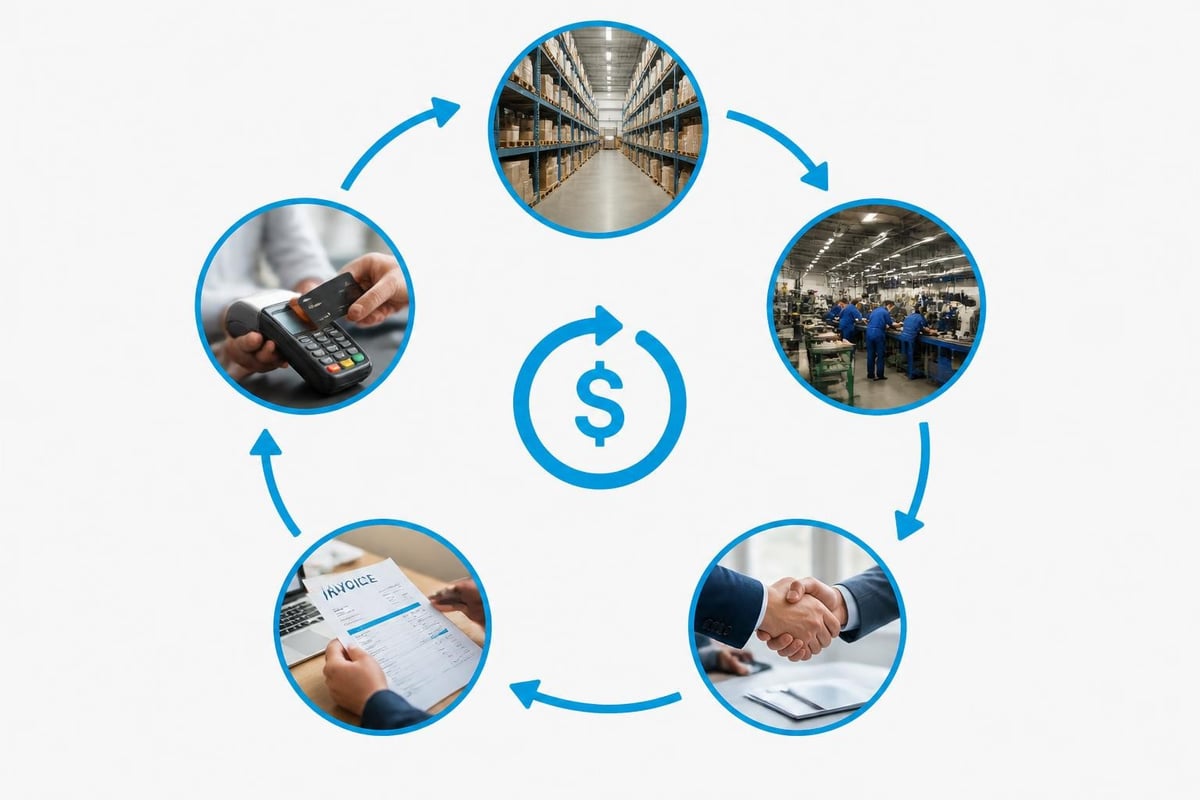
Managing the timing between revenue collection and expense obligations represents one of the most challenging aspects of business and account management. Even profitable companies can face cash flow gaps when customer payments arrive after bills come due, creating stress that affects operations and growth potential.
Understanding your cash conversion cycle-the time between paying suppliers and collecting from customers-helps identify opportunities for improvement. Businesses with long collection periods or significant inventory holding times often require working capital solutions to bridge these gaps.
Improving Business and Account Liquidity
Several strategies can strengthen your liquidity position and reduce dependence on external financing. Each approach requires balancing customer relationships, operational needs, and cash flow optimization.
- Accelerate receivables through early payment discounts, electronic invoicing, and proactive collection processes
- Negotiate extended payables with vendors while maintaining good relationships
- Optimize inventory levels to reduce capital tied up in stock
- Implement subscription or retainer models for predictable revenue
- Build cash reserves during strong periods to buffer seasonal fluctuations
Research from Harvard Business Review on cash management highlights that disciplined cash-flow management practices distinguish sustainable businesses from those that struggle despite apparent profitability. The connection between operational decisions and account performance becomes clear when examining how inventory purchases, credit terms, and payment schedules impact daily cash positions.
Technology Integration in Business and Account Systems
Digital transformation has revolutionized how small businesses manage financial operations. Cloud-based accounting platforms, automated payment processing, and integrated business management systems provide real-time visibility into business and account performance that was once available only to large enterprises.
Selecting Account Management Technology
Modern business and account software solutions range from basic bookkeeping tools to comprehensive enterprise resource planning (ERP) systems. The right choice depends on your industry, transaction volume, complexity, and growth trajectory.
| Software Category | Features | Ideal Business Size | Integration Capability |
|---|---|---|---|
| Basic Accounting | Income/expense tracking, invoicing, reports | Startups, sole proprietors | Limited |
| Mid-Market Solutions | Multi-user, inventory, project tracking | 5-50 employees | Moderate |
| ERP Systems | Full integration, automation, analytics | 50+ employees, complex operations | Extensive |
| Industry-Specific | Specialized features for niche needs | Varies by vertical | Varies |
According to Deloitte Insights on digital transformation in finance, automation in accounting and financial management reduces errors, accelerates reporting, and frees business owners to focus on strategic decisions rather than manual data entry. Businesses implementing modern account systems report improved accuracy in financial forecasting and faster access to capital when funding needs arise.
Data-Driven Business and Account Decisions
Real-time account visibility enables proactive management rather than reactive problem-solving. Dashboard analytics showing key performance indicators-gross profit margins, customer acquisition costs, lifetime value, and working capital ratios-transform raw transaction data into actionable insights.
Integration between point-of-sale systems, inventory management, and accounting software creates a unified view of business and account activity. This connectivity helps identify trends, flag anomalies, and support data-backed decisions about pricing, purchasing, hiring, and expansion.
Regulatory Compliance and Account Accuracy
Maintaining accurate business and account records serves legal and regulatory purposes beyond internal management. Tax authorities, regulatory agencies, and potential business partners or acquirers expect documentation that withstands scrutiny and demonstrates compliance with applicable rules.
Tax Planning and Account Management
Strategic tax planning requires year-round attention to business and account details rather than last-minute scrambling before filing deadlines. Proper categorization of expenses, documentation of deductions, and timing of major purchases can significantly impact tax liability.
Key tax considerations for business and account management:
- Quarterly estimated tax payments to avoid penalties
- Depreciation schedules for equipment and assets
- Section 179 deductions for qualifying business property
- Research and development credits for eligible activities
- State and local tax obligations varying by jurisdiction
Businesses operating across multiple states or provinces face additional complexity in managing business and account compliance. Sales tax collection, income tax apportionment, and varying regulatory requirements demand careful attention to ensure full compliance without overpayment.
Audit Readiness Through Strong Account Practices
While many small businesses never face formal audits, maintaining audit-ready business and account records provides peace of mind and demonstrates professionalism. Organizations seeking significant funding, pursuing acquisitions, or entering regulated industries often undergo financial due diligence that examines account accuracy in detail.
Documentation supporting every transaction, clear audit trails linking source documents to financial statements, and consistent application of accounting policies create defensible positions during reviews. This preparation also accelerates responses to funding requests, as providers can quickly verify the information presented.
Industry-Specific Business and Account Considerations
Different industries face unique challenges in managing the relationship between business operations and account systems. Understanding these nuances helps optimize processes and avoid common pitfalls specific to your sector.
Service-Based Business and Account Management
Professional services, consulting, creative agencies, and similar businesses manage accounts differently than product companies. Revenue recognition based on project completion or milestone achievement requires careful tracking of work-in-progress and unbilled services. Time tracking systems feeding into billing and accounting software ensure accurate revenue capture.
Service businesses often maintain lower inventory and equipment costs but face challenges in standardizing pricing and managing capacity utilization. Account systems must track billable versus non-billable time, project profitability, and resource allocation to support informed pricing and staffing decisions.
Product and Inventory-Intensive Operations
Retail, wholesale, distribution, and manufacturing businesses navigate complex business and account relationships involving inventory valuation, cost of goods sold calculations, and working capital tied up in stock. First-in-first-out (FIFO), last-in-first-out (LIFO), and weighted average inventory methods each impact reported profitability and tax obligations.
These operations benefit from integrated inventory management systems that automatically update account balances as products move through receiving, storage, and sales processes. Real-time visibility into stock levels, reorder points, and turnover rates supports both operational efficiency and accurate financial reporting.

Building Relationships with Financial Partners
Strong business and account management extends beyond internal processes to include relationships with banks, funding providers, accountants, and financial advisors. These partnerships become particularly valuable during growth phases, challenging periods, or strategic transitions.
Communicating Business and Account Performance
Regular communication with financial partners builds trust and often results in better terms, faster approvals, and proactive solutions during difficulties. Quarterly business reviews sharing financial performance, market conditions, and strategic plans demonstrate transparency and professional management.
When pursuing financing, the ability to clearly explain business and account trends, address concerns, and provide context for unusual patterns differentiates sophisticated operators from those who simply submit documents and hope for approval. Understanding what funding providers seek in financial statements and being prepared to discuss ratios, trends, and projections strengthens your position.
Leveraging Account Data for Strategic Planning
Financial statements represent historical performance, but forward-looking businesses use account data to model scenarios, evaluate opportunities, and assess risks. Sensitivity analysis showing how changes in pricing, volume, or costs impact profitability informs strategic decisions about product lines, markets, and investments.
The World Bank's research on SME finance demonstrates that businesses with sophisticated financial management practices access capital more easily and at lower costs than those with weak account systems. This advantage compounds over time as stronger finances enable growth investments that further improve competitive position.
Account Organization for Multi-Location Operations
Businesses expanding to multiple locations face increased complexity in business and account management. Centralized versus decentralized accounting, inter-company transactions, and consolidated reporting require careful planning to maintain accuracy while supporting operational autonomy.
Standardizing Business and Account Processes
Consistent chart of accounts, approval workflows, and reporting formats across locations enable meaningful comparisons and consolidated views of business performance. This standardization also simplifies training, reduces errors, and facilitates faster onboarding as new locations open.
Technology platforms supporting multi-entity accounting automatically handle eliminations, inter-company transfers, and location-specific reporting while maintaining unified records. Businesses operating across provincial or state lines must also navigate varying tax rules, licensing requirements, and compliance obligations affecting account management.
Risk Management Through Account Controls
Internal controls protecting business assets and ensuring account accuracy become increasingly important as companies grow. Segregation of duties, approval hierarchies, reconciliation procedures, and fraud prevention measures safeguard against both honest mistakes and intentional misconduct.
Essential controls for business and account protection include:
- Separation between authorization, recording, and custody functions
- Regular bank reconciliations by someone independent from transaction processing
- Dual signatures or approvals for significant expenditures
- Periodic inventory counts matching physical stock to account records
- Access controls limiting who can modify account data or approve transactions
Implementing appropriate controls demonstrates maturity to funding partners and reduces the risk of material misstatements in financial reporting. While small businesses may lack resources for complete segregation of all duties, compensating controls like owner review and third-party audits can mitigate risks.
Account Metrics That Drive Business Decisions
Beyond basic profit and loss statements, sophisticated business and account management tracks metrics revealing operational efficiency, financial health, and growth sustainability. These key performance indicators guide daily decisions and strategic planning.
| Metric Category | Key Indicators | Business Implications |
|---|---|---|
| Profitability | Gross margin, net margin, EBITDA | Pricing power, operational efficiency |
| Liquidity | Current ratio, quick ratio, working capital | Ability to meet obligations, funding needs |
| Efficiency | Inventory turnover, DSO, asset turnover | How effectively resources generate revenue |
| Leverage | Debt-to-equity, interest coverage | Financial risk, capacity for additional borrowing |
| Growth | Revenue growth rate, customer retention | Market position, sustainability trajectory |
Monitoring these metrics through integrated business and account dashboards enables proactive management. Declining margins signal pricing pressure or cost inflation requiring attention. Rising days sales outstanding (DSO) indicates collection issues affecting cash flow. Improving inventory turnover demonstrates better demand forecasting and purchasing decisions.
Preparing for Growth Through Account Infrastructure
Businesses planning significant expansion must ensure their business and account systems can scale without requiring complete overhauls during critical growth phases. Infrastructure capable of handling increased transaction volume, additional complexity, and enhanced reporting needs prevents operational disruptions.
Investing in scalable account systems, training staff on proper procedures, and establishing clear documentation of processes creates foundation for sustainable growth. Companies that outgrow their accounting infrastructure often face delayed reporting, accuracy issues, and difficulties accessing capital when opportunities arise.
Effective business and account management creates the foundation for sustainable growth, easier access to capital, and informed decision-making at every level of your organization. By implementing robust systems, maintaining clean records, and understanding the strategic implications of financial data, you position your business for long-term success. When you need flexible funding solutions aligned with your business performance and capital requirements, Enterprise Finest Solutions connects you with financing partners who understand the unique needs of growing companies.
Written by
Enterprise Finest Solutions
Content creator and writer sharing insights and stories.