Business Acquisition Financing: Complete 2026 Guide
Explore business acquisition financing options, structures, and strategies for 2026. Learn how SMEs secure capital to buy businesses.

Acquiring an existing business represents one of the fastest paths to ownership and growth, but the capital required often exceeds what most buyers can self-fund. Business acquisition financing bridges this gap, enabling entrepreneurs and investors to purchase companies by leveraging a combination of debt, equity, and creative deal structures. Understanding the available funding mechanisms, qualification criteria, and structuring strategies is essential for any buyer pursuing an acquisition in 2026's evolving credit markets.
Understanding Business Acquisition Financing Fundamentals
Business acquisition financing encompasses the various funding sources and structures used to purchase an existing company. Unlike traditional working capital or equipment loans, acquisition financing addresses the unique challenges of buying a business: verifying seller claims, allocating purchase price across assets, managing transition risk, and servicing debt from the acquired company's cash flows.
The core principle underlying most acquisition financing is that the target business itself generates sufficient cash flow to support debt service. Lenders evaluate the historical and projected performance of the acquired entity, not just the buyer's personal or existing business financials. This fundamental shift in underwriting means that even buyers with limited track records can secure financing if the target demonstrates stable, predictable cash flows.
Key Financing Components
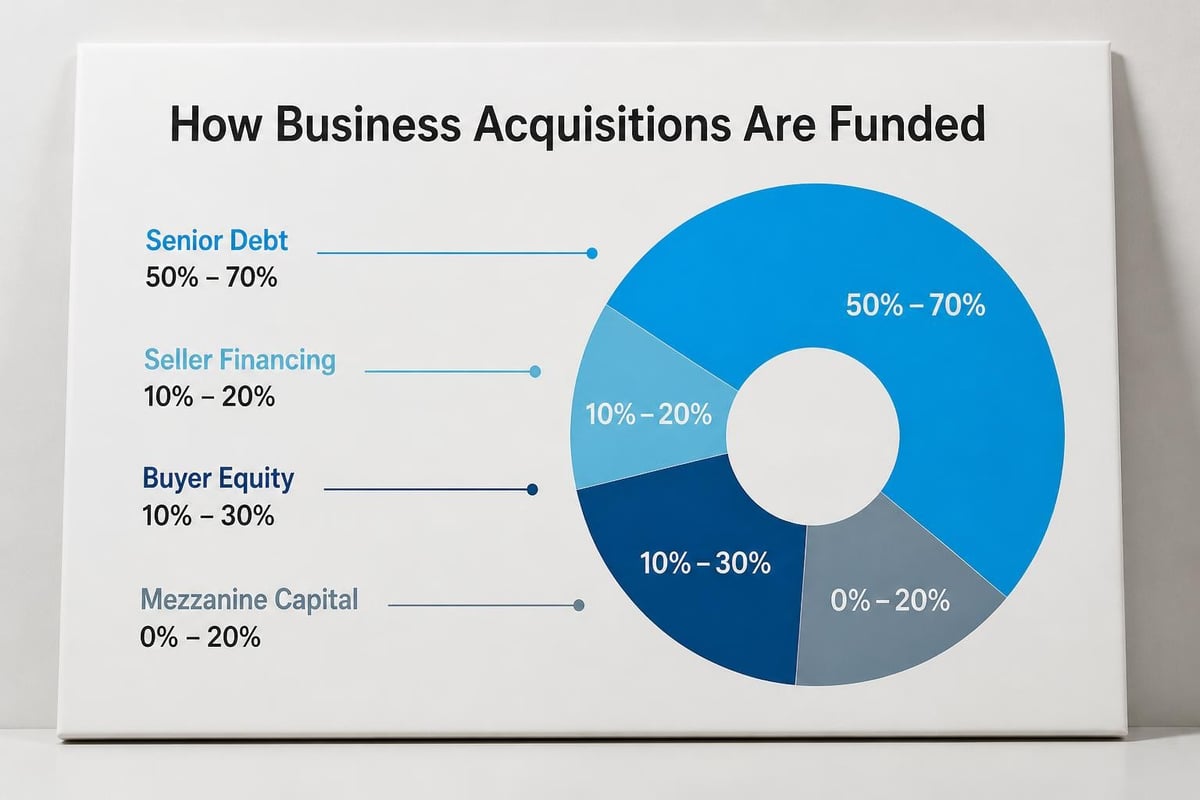
Most acquisitions involve multiple funding sources working together:
- Senior debt from banks or commercial lenders covering 50-70% of purchase price
- Seller financing providing 10-30% through deferred payment terms
- Buyer equity injection contributing 10-30% as down payment
- Mezzanine debt or subordinated notes filling gaps between senior debt and equity
- Earnouts tying a portion of consideration to future performance
The exact mix depends on deal size, industry, buyer qualifications, and target company characteristics. Smaller transactions under $5 million often rely more heavily on seller financing and SBA programs, while larger deals access institutional debt markets and private credit.
SBA Loan Programs for Business Acquisitions
The Small Business Administration offers several programs specifically designed to facilitate business acquisitions. The SBA 7(a) loan program remains the most popular choice for small and mid-sized acquisitions, providing up to $5 million in government-guaranteed financing with favorable terms.
SBA 7(a) Acquisition Loans
SBA 7(a) loans typically finance 75-90% of the purchase price, requiring buyers to inject just 10-25% equity. Interest rates in 2026 range from prime plus 2.25% to prime plus 4.75%, depending on loan size and term. Repayment periods extend up to 10 years for working capital and goodwill, or up to 25 years when substantial real estate is included.
Qualification focuses on the buyer's management experience, creditworthiness, and the target company's ability to service debt. Lenders examine:
- Personal credit scores above 680 (preferably 700+)
- Industry experience demonstrating capability to operate the business
- Cash flow coverage with debt service coverage ratio of 1.25x or higher
- Collateral including business assets and often personal guarantees
The application process requires extensive documentation: three years of tax returns for both buyer and target, detailed financial projections, purchase agreement, business plan, and personal financial statements.
SBA 504 for Real Estate and Equipment
When acquisitions include significant real estate or fixed assets, the SBA 504 program offers attractive long-term financing. This structure combines a bank loan covering 50% of the project cost, a Certified Development Company (CDC) loan covering 40%, and buyer equity of 10%.
The CDC portion carries a fixed interest rate based on the current 5-year or 10-year Treasury rate plus approximately 2.5%, providing payment certainty. Terms extend up to 25 years for real estate and 10 years for equipment, making monthly payments more manageable for buyers.
Conventional Bank Acquisition Financing
Banks and credit unions provide business acquisition financing outside SBA programs, particularly for larger transactions or buyers with strong financial profiles. Conventional acquisition loans typically require more equity (25-40%) but offer flexibility in structure and often faster closing timelines.
Commercial Loan Structures
Banks structure acquisition loans as term loans, often with initial interest-only periods to ease transition cash flow pressure. Pricing in 2026 ranges from prime plus 1% to prime plus 3%, depending on borrower strength and collateral quality. According to Moody's October 2024 analysis, commercial banks have tightened underwriting standards, placing greater emphasis on demonstrated cash flow stability and industry fundamentals.
Covenants typically include:
- Minimum debt service coverage ratios (1.20x to 1.50x)
- Maximum leverage ratios (total debt / EBITDA below 3.0x to 4.0x)
- Restrictions on additional debt or distributions
- Required maintenance of working capital levels
Banks also commonly require personal guarantees from acquiring principals and may take security interests in both the acquired business assets and buyer's other holdings.
| Financing Source | Typical LTV | Equity Required | Interest Rate Range | Term Length |
|---|---|---|---|---|
| SBA 7(a) | 75-90% | 10-25% | Prime + 2.25-4.75% | 10-25 years |
| SBA 504 | 90% | 10% | Treasury + ~2.5% | 10-25 years |
| Conventional Bank | 60-75% | 25-40% | Prime + 1-3% | 5-10 years |
| Private Credit | 50-70% | 30-50% | 8-15% | 3-7 years |
Seller Financing as Strategic Capital
Seller financing serves dual purposes in acquisition transactions: it bridges funding gaps and signals seller confidence in the business's future performance. When a seller agrees to defer 10-30% of the purchase price, lenders view it as validation of the business quality and financial projections.
Structuring Seller Notes
Seller notes typically subordinate to senior bank debt, meaning they receive payment only after bank obligations are satisfied. This subordination is essential for bank approval but creates risk for sellers. To balance interests, seller notes often include:
Higher interest rates (6-10%) reflecting subordinated position and unsecured status
Medium-term maturities of 3-7 years, positioned between senior debt and earnouts
Balloon payments with interest-only periods followed by principal payment at maturity
Security interests in specific assets or membership interests (junior to bank liens)
The amount of seller financing directly impacts the buyer's ability to secure bank debt. Most lenders prefer seeing 10-20% seller financing as it demonstrates alignment of interests and reduces the bank's exposure.
Earnouts and Contingent Consideration
Earnouts tie a portion of the purchase price to future performance metrics, bridging valuation gaps between buyer and seller expectations. Baker Tilly's 2024 analysis shows that earnouts appear in roughly 30% of middle-market transactions, typically representing 10-40% of total consideration.
Common earnout metrics include revenue targets, EBITDA thresholds, customer retention rates, or product development milestones. Structuring effective earnouts requires careful attention to:
- Measurement periods typically spanning 1-3 years post-closing
- Baseline adjustments accounting for buyer operational decisions
- Dispute resolution mechanisms when performance calculation disagreements arise
- Integration constraints limiting buyer's ability to make changes affecting earnout metrics
From a financing perspective, earnouts improve deal feasibility by reducing upfront cash requirements, but they create complexity in cash flow management since buyers must reserve capital for potential earnout payments.

Alternative and Private Credit Solutions
The growth of alternative lenders and private credit funds has expanded business acquisition financing options beyond traditional banks. EY's H2 2024 Private Credit Report documents the sector's continued expansion, with private credit assets under management exceeding $1.6 trillion globally.
Private Credit for Acquisitions
Private credit lenders fill the gap between bank financing limits and total deal value, particularly for transactions in the $2-20 million range. These lenders emphasize cash flow and business quality over rigid covenant packages, making them attractive for deals involving:
- Companies with lumpy or seasonal revenue patterns
- Businesses undergoing transition or repositioning
- Industries facing headwinds where banks reduce exposure
- Buyers with limited operating history in the sector
Pricing reflects the higher risk profile and flexible terms, with all-in rates ranging from 10-18% including base interest, unused commitment fees, and success fees. Terms typically span 3-5 years with flexible amortization schedules.
Revenue-Based Financing for Acquisitions
For businesses with strong, predictable revenue streams, revenue-based financing offers an alternative structure. Rather than fixed monthly payments, these arrangements tie repayment to a percentage of monthly sales, providing automatic payment flexibility during slower periods. For buyers exploring working capital solutions that align with business performance, revenue-based structures can complement traditional acquisition debt, particularly during the critical transition period.
This approach works especially well for acquiring businesses in retail, e-commerce, SaaS, and service industries where revenue visibility is high but traditional asset collateral may be limited.
Purchase Price Allocation and Tax Considerations
How buyers and sellers allocate the purchase price across different asset categories significantly impacts both tax treatment and lender evaluation. IRS Publication 544 provides guidance on proper allocation methods, while Mercer Capital's 2024 primer offers practical implementation strategies.
Asset Class Allocation
Purchase price must be allocated among seven asset classes in order:
- Cash and cash equivalents
- Actively traded securities
- Accounts receivable and other current assets
- Inventory
- Fixed assets (equipment, real estate)
- Intangible assets (customer lists, non-compete agreements, licenses)
- Goodwill and going concern value
The allocation directly affects buyer's tax deductions through depreciation and amortization schedules. Buyers prefer allocating more value to classes 1-6, which can be depreciated over shorter periods (3-15 years), while goodwill (class 7) amortizes over 15 years.
Lender Perspectives on Allocation
Lenders scrutinize purchase price allocation because it determines the collateral value supporting their loan. Stout's Q4 2024 Purchase Price Allocation study reveals that tangible assets receive higher collateral advance rates than intangibles:
| Asset Type | Typical Collateral Advance Rate |
|---|---|
| Cash & Marketable Securities | 90-100% |
| Accounts Receivable | 70-85% |
| Inventory | 50-70% |
| Equipment | 60-80% |
| Real Estate | 75-85% |
| Intangibles (Customer Lists) | 0-40% |
| Goodwill | 0% |
When goodwill and intangibles represent 60% or more of purchase price (common in service businesses), buyers face greater challenges securing high loan-to-value financing from traditional lenders. This scenario often necessitates higher equity contributions, more seller financing, or private credit participation.
Asset vs. Stock Purchases
Most small and mid-sized business acquisitions structure as asset purchases rather than stock purchases. Asset deals allow buyers to:
- Avoid inheriting unknown liabilities
- Obtain stepped-up tax basis for depreciation benefits
- Cherry-pick specific assets and contracts
- Exclude unwanted liabilities or obligations
However, asset purchases create additional complexity in business acquisition financing because lenders must perfect security interests in each transferred asset class individually, rather than taking a simple pledge of stock. This requires more extensive documentation but provides cleaner liability separation.

Due Diligence and Underwriting Requirements
Lenders conduct extensive due diligence before approving business acquisition financing, examining both the target company and the acquiring party. The depth and formality of this process scales with transaction size, but even small deals require substantial documentation.
Target Company Analysis
Financial due diligence focuses on verifying historical performance and assessing sustainability:
- Quality of earnings analysis identifying non-recurring items and normalizing adjustments
- Working capital requirements and typical fluctuation patterns
- Customer concentration risks when top customers represent >20% of revenue
- Revenue composition examining recurring vs. one-time sales
- Margin trends and competitive positioning within the industry
Lenders also examine operational factors: customer contracts, supplier relationships, employee key-person dependencies, regulatory compliance, and pending litigation. Any material findings trigger additional equity requirements or deal structure modifications.
Buyer Qualification Standards
Even when the target business shows strong cash flows, lenders evaluate the buyer's capability to successfully operate and potentially improve the business:
- Relevant industry experience (direct or transferable skills)
- Management team composition and depth
- Business plan demonstrating understanding of operations and growth strategy
- Financial capacity to fund working capital needs during transition
- Personal credit history and track record of debt repayment
First-time business buyers face greater scrutiny and often require larger equity contributions or more extensive seller transition support.
Structuring for Success
Successful business acquisition financing requires careful attention to structure, balancing competing interests of buyers, sellers, and lenders. Optimal structures accomplish several objectives simultaneously: minimizing buyer's upfront capital requirement, providing seller with acceptable risk-adjusted returns, and giving lenders adequate collateral and cash flow coverage.
Optimal Capital Stacks
For a typical $3 million acquisition of a profitable small business, an efficient capital stack might include:
- SBA 7(a) loan: $2,100,000 (70% of purchase price)
- Seller note: $450,000 (15% subordinated, 5-year term)
- Buyer equity: $450,000 (15% cash at closing)
This structure minimizes buyer's cash outlay while satisfying lender requirements for borrower equity and seller participation. The seller note provides the seller with ongoing interest income while the SBA loan offers favorable long-term fixed rates.
For larger transactions or situations requiring more creativity, layered structures might add mezzanine debt, earnouts, or equity participation components. Each additional layer adds complexity but can make otherwise unfeasible deals work.
Transition Planning and Financing Covenants
Lenders recognize that business transitions carry inherent risk. Many acquisition loans include specific transition-related provisions:
Seller employment or consulting agreements ensuring knowledge transfer over 6-24 months
Non-compete covenants preventing seller from starting competing businesses
Customer notification requirements and communication protocols
Performance monitoring with monthly or quarterly reporting during the first year
Restricted distributions preventing excessive owner compensation or dividend payments until the business stabilizes under new ownership
These provisions protect lender interests while creating framework for successful transition. Buyers should view them as risk management tools rather than burdensome restrictions.
Industry-Specific Considerations
Different industries present unique challenges and opportunities in business acquisition financing. Lenders develop specialized expertise and adjust underwriting criteria based on industry characteristics.
Service-Based Businesses
Professional services firms, agencies, and B2B service companies often carry significant goodwill and intangible value relative to tangible assets. This creates financing challenges since lender advance rates on intangibles remain low. However, high margins and recurring revenue models can support acquisition debt through strong cash flow coverage.
Key success factors include:
- Demonstrated client retention and contract renewal rates above 80%
- Diversified client base with no single client exceeding 15% of revenue
- Seller transition involvement to facilitate client relationship transfers
- Non-compete agreements preventing seller from soliciting clients
Asset-Heavy Businesses
Manufacturing, distribution, construction, and transportation businesses typically hold substantial equipment, inventory, and receivables. These tangible assets support higher leverage ratios, sometimes reaching 80-85% of purchase price when combined with SBA guarantees.
Lenders examine:
- Asset age, condition, and replacement schedules
- Specialized vs. general-purpose equipment (affects resale value)
- Inventory turnover rates and obsolescence risk
- Accounts receivable aging and collection history
Recurring Revenue Models
SaaS businesses, subscription services, and membership-based companies with predictable recurring revenue command premium valuations but present unique financing considerations. Lenders value the revenue predictability but scrutinize:
- Churn rates and customer lifetime value metrics
- Monthly recurring revenue trends and growth trajectories
- Cash vs. accrual revenue recognition (prepaid annual contracts)
- Technology dependencies and integration requirements
These businesses often secure acquisition financing through specialized tech-focused lenders who understand SaaS metrics and valuation multiples.
Securing the right business acquisition financing requires navigating multiple funding sources, understanding complex deal structures, and presenting compelling cases to lenders based on target company performance and buyer capabilities. Whether you're pursuing your first acquisition or expanding through strategic purchases, working with experienced advisors who understand the full spectrum of funding options can make the difference between successful transactions and missed opportunities. Enterprise Finest Solutions helps business buyers explore flexible financing alternatives through a network of lending partners, connecting you with capital sources that align with your acquisition goals, financial profile, and the unique characteristics of your target business.
Written by
Enterprise Finest Solutions
Content creator and writer sharing insights and stories.