Biz Loan Guide: Types, Terms & How to Qualify in 2026
Learn how biz loan options work, what lenders look for, and how to choose the right financing for your business in 2026.

Securing adequate funding remains one of the most critical challenges facing small and medium-sized businesses today. Whether you're looking to expand operations, purchase equipment, manage cash flow, or invest in inventory, understanding your financing options is essential. A biz loan can provide the capital you need to grow, but navigating the landscape of traditional bank loans, alternative financing, and government-backed programs requires careful consideration of your business's unique circumstances, revenue profile, and repayment capacity.
Understanding the Biz Loan Landscape in 2026
The business lending environment has evolved significantly over the past few years. According to the Federal Reserve's Senior Loan Officer Opinion Survey, lending standards for commercial and industrial loans have tightened in certain segments while remaining competitive in others. This means that securing a biz loan requires business owners to understand not only what they need but also what lenders are currently seeking in qualified borrowers.

Current Market Conditions
Business borrowing costs and availability reflect broader economic trends. The FDIC's 2026 Risk Review highlights how rising operational costs and economic pressures affect small business loan performance, including delinquency rates and credit risk assessments. These factors directly influence:
- Interest rates charged on various financing products
- Approval requirements and documentation standards
- Loan-to-value ratios for asset-based financing
- Revenue thresholds for qualification
- Industry-specific lending appetite
Understanding these dynamics helps business owners approach the biz loan application process with realistic expectations and proper preparation.
Types of Business Financing Solutions
Not all business financing is created equal. The right biz loan for your company depends on several factors including your capital needs, repayment ability, collateral availability, and how quickly you need funds.
Traditional Bank Loans
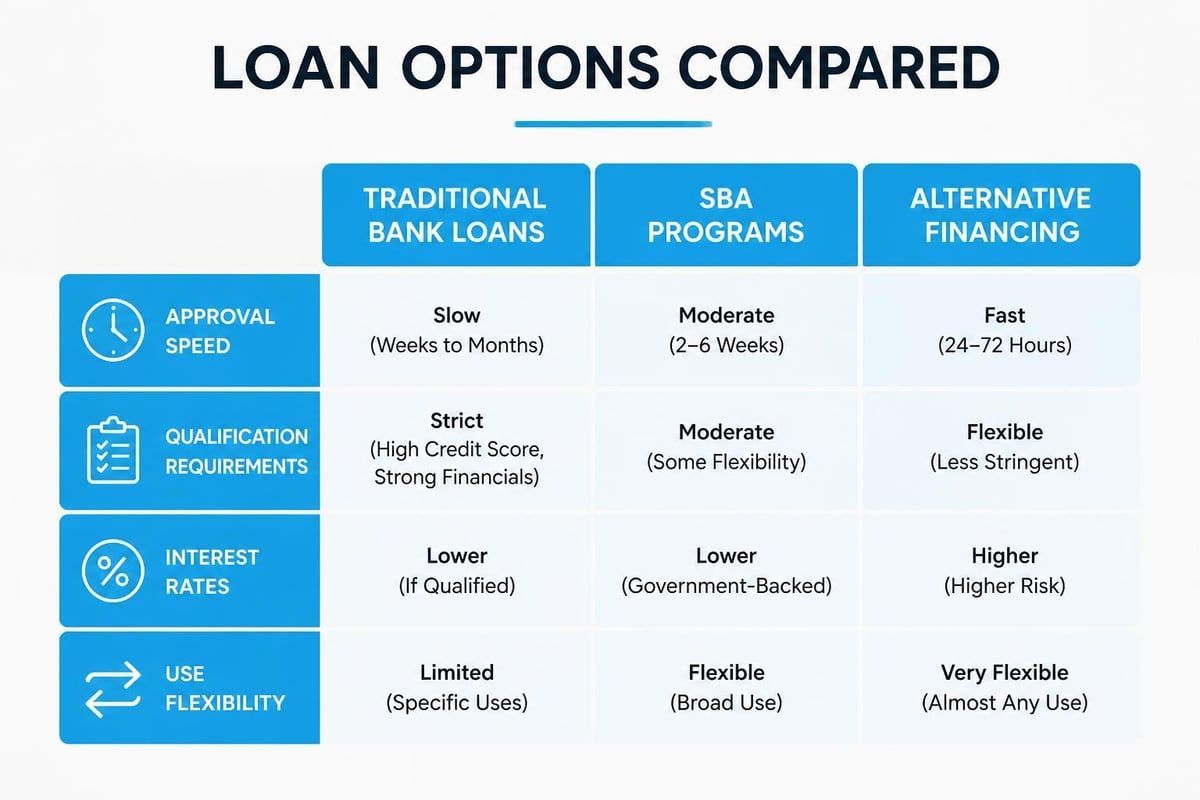
Conventional bank loans typically offer the lowest interest rates but require strong credit profiles, extensive documentation, and longer approval timelines. These loans generally feature:
- Fixed or variable interest rates
- Structured repayment schedules (monthly installments)
- Collateral requirements in many cases
- Personal guarantees from business owners
- Extensive financial documentation
The FDIC's Small Business Lending Survey reveals that banks define and underwrite small business loans differently based on their size and technology capabilities, which affects approval rates and processing times.
SBA-Backed Financing
The U.S. Small Business Administration offers several loan programs that provide government guarantees to reduce lender risk. The most popular programs include:
| Program | Maximum Amount | Use Cases | Key Feature |
|---|---|---|---|
| 7(a) Loan | $5 million | Working capital, expansion, equipment, real estate | Most flexible SBA program |
| 504 Loan | $5.5 million | Real estate, large equipment purchases | Fixed-rate, long-term financing |
| Microloan | $50,000 | Startup costs, inventory, supplies, equipment | Smaller amounts, faster process |
Recent policy changes have modified SBA loan programs, including updated underwriting standards and eligibility requirements, as detailed in this Congressional Research Service analysis. Business owners should verify current requirements before applying for any SBA-backed biz loan.
Alternative Financing Options
Beyond traditional banks and SBA loans, alternative lenders offer various products designed for businesses that need faster approvals or have non-traditional credit profiles. Enterprise Finest Solutions helps businesses explore working capital financing through its network of funding partners, connecting business owners with options that align with their revenue performance and capital requirements.
Alternative financing includes:
- Revenue-based financing that ties repayment to daily or weekly sales
- Merchant cash advances for businesses with consistent credit card transactions
- Invoice factoring to convert outstanding receivables into immediate cash
- Equipment financing specifically for purchasing business assets
- Business lines of credit for flexible, revolving access to capital
These options often prioritize business revenue and performance over traditional credit metrics, making them accessible to companies that might not qualify for conventional bank financing.
What Lenders Evaluate in Biz Loan Applications
Successfully securing a biz loan requires understanding what lenders examine during the underwriting process. While specific criteria vary by lender type and product, most evaluate a core set of business and personal factors.
Credit Profile Assessment
Personal credit scores remain important even for established businesses. Most lenders consider:
- FICO scores (typically 650+ for traditional loans, lower thresholds for alternative financing)
- Credit history length and payment patterns
- Outstanding debt obligations
- Recent credit inquiries
- Public records (bankruptcies, liens, judgments)
Business credit also factors into many decisions, especially for companies with established trade lines and vendor relationships.
Revenue and Cash Flow Analysis
According to the 2026 Report on Employer Firms, lenders increasingly focus on revenue consistency and cash flow strength. Documentation typically includes:
- Bank statements (3-6 months for most alternative lenders, up to 24 months for banks)
- Tax returns (personal and business, usually 2 years)
- Profit and loss statements
- Balance sheets
- Accounts receivable/payable aging reports
Demonstrating strong, consistent revenue gives lenders confidence in your ability to repay the biz loan according to agreed terms.
Business Fundamentals
Beyond numbers, lenders evaluate:
- Time in business (many require 6-12 months minimum, some 2+ years)
- Industry type (some sectors face tighter restrictions)
- Business structure (LLC, S-corp, sole proprietorship, etc.)
- Collateral availability for secured financing
- Use of funds and how capital will generate returns
The Application Process
Successful biz loan applications follow a structured approach:
Preparation phase:
- Gather required financial documentation
- Review and correct credit reports for errors
- Develop a clear capital use plan
- Calculate realistic repayment capacity
- Identify potential collateral if needed
Application phase:
- Complete lender applications accurately and completely
- Provide supporting documentation promptly
- Respond quickly to underwriter questions
- Maintain transparent communication throughout
Approval and funding:
- Review all terms, rates, and fees carefully
- Understand repayment structure and schedule
- Clarify any prepayment penalties or restrictions
- Confirm funding timeline and disbursement method
Choosing the Right Biz Loan for Your Situation
The optimal financing solution depends on your specific business circumstances, capital needs, and repayment capacity. Here's how different scenarios typically align with financing types:
Scenario-Based Financing Selection
| Business Need | Time Sensitivity | Recommended Options | Typical Timeline |
|---|---|---|---|
| Equipment purchase | Moderate | Equipment financing, SBA 504 | 2-6 weeks |
| Real estate acquisition | Low | SBA 504, traditional commercial mortgage | 4-12 weeks |
| Working capital | High | Revenue-based financing, business line of credit | 1-5 days |
| Inventory buildup | Moderate | Working capital loan, inventory financing | 1-3 weeks |
| Emergency cash needs | Very high | Merchant cash advance, short-term loans | 24-72 hours |
| Long-term expansion | Low | SBA 7(a), traditional term loan | 4-10 weeks |
Cost Considerations
When evaluating any biz loan, look beyond the stated interest rate to understand total borrowing costs:
- APR (Annual Percentage Rate) includes interest plus fees
- Factor rates (common in merchant cash advances) represent total repayment multiple
- Origination fees (typically 1-5% of loan amount)
- Processing and underwriting fees
- Early repayment penalties or prepayment restrictions
- Late payment fees and default charges
Total cost of capital provides the most accurate comparison between different financing options.
Industry-Specific Considerations
Certain industries face unique challenges when seeking business financing. The biz loan landscape varies significantly across sectors:
Higher-Risk Industries
Lenders may impose stricter requirements or charge higher rates for:
- Restaurants and food service
- Construction and contractors
- Transportation and logistics
- Cannabis-related businesses (even in legal states)
- Adult entertainment
- Gambling and gaming
These industries often benefit from specialized lenders who understand sector-specific revenue patterns and risk profiles.
Favorable Industries
Conversely, certain sectors typically enjoy easier access to financing:
- Professional services (legal, accounting, consulting)
- Healthcare and medical practices
- Technology and software companies
- Established retail with strong sales history
- Manufacturing with diversified customer bases

Transparency and Regulatory Developments
The business lending industry continues to evolve with increased transparency requirements. The Consumer Financial Protection Bureau's Small Business Lending Database initiative, mandated under Section 1071, will provide unprecedented visibility into loan applications, approvals, pricing, and demographic patterns in business lending.
These developments aim to:
- Reduce discriminatory lending practices
- Increase competition among lenders
- Help business owners compare options more effectively
- Identify and address access gaps in underserved communities
For business owners seeking a biz loan, this increased transparency will make it easier to understand whether they're receiving competitive terms and fair treatment.
Common Biz Loan Mistakes to Avoid
Many business owners undermine their financing prospects through preventable errors:
Application and documentation mistakes:
- Incomplete or inaccurate applications
- Inconsistent information across documents
- Missing supporting documentation
- Poorly explained credit issues
- Unrealistic revenue projections
Strategic errors:
- Applying for the wrong type of financing
- Borrowing more than necessary (increasing costs)
- Borrowing less than needed (requiring multiple applications)
- Failing to shop multiple lenders
- Accepting the first offer without comparison
Timing problems:
- Waiting until crisis mode to seek funding
- Applying during tax season delays
- Not accounting for approval timelines
- Missing industry-specific seasonality impacts
Building a Stronger Loan Application
Whether you're seeking your first biz loan or your fifth, strengthening your application improves approval odds and secures better terms:
Short-Term Improvements (1-3 Months)
- Clean up business and personal credit reports
- Organize financial documentation systematically
- Build business bank account balances
- Establish vendor trade references
- Document all revenue sources clearly
Medium-Term Strategies (3-12 Months)
- Increase business revenue and profitability
- Reduce outstanding debt obligations
- Build business credit through trade lines
- Improve personal credit scores
- Establish or strengthen business banking relationships
Long-Term Foundation (12+ Months)
- Maintain clean, audited financial records
- Develop diversified revenue streams
- Build tangible business assets
- Create documented business processes and systems
- Establish multi-year profitability track record
Working with Financing Partners
Many business owners benefit from working with financing brokers who maintain relationships across multiple lender networks. These partners can:
- Assess your qualification profile objectively
- Match your needs to appropriate products
- Submit applications to multiple lenders efficiently
- Negotiate terms on your behalf
- Expedite approval and funding timelines
The SBA's 2025 Annual Report notes changes to lending programs and performance metrics that affect how businesses access government-backed financing, emphasizing the value of experienced guidance through evolving requirements.
When evaluating any biz loan opportunity, business owners should understand all terms, compare multiple options when possible, and select financing that aligns with their repayment capacity and business objectives.
Documentation Requirements by Lender Type
Different lender categories require varying levels of documentation for biz loan applications:
Traditional Banks
- 2+ years business and personal tax returns
- Complete financial statements (balance sheet, P&L, cash flow)
- 12-24 months business bank statements
- Business plan with financial projections
- Collateral appraisals and documentation
- Business licenses and registrations
- Articles of incorporation or organization
Alternative Lenders
- 3-6 months business bank statements
- Driver's license or government ID
- Business voided check
- Recent revenue documentation (varies by product)
- Tax returns (sometimes optional)
- Minimal supporting documentation
SBA Lenders
- All traditional bank requirements
- Personal financial statements from all 20%+ owners
- Detailed business plan
- Environmental questionnaires (for real estate)
- Franchise documents (if applicable)
- Additional SBA-specific forms and certifications
The documentation burden generally correlates with approval timeline and interest rates: more extensive documentation typically means longer processing but potentially better terms.
Securing the right business financing requires understanding the diverse biz loan landscape, preparing thorough applications, and selecting products that match your revenue profile and repayment capacity. Whether you pursue traditional bank financing, SBA-backed programs, or alternative solutions, success depends on presenting your business's strengths clearly and choosing terms that support sustainable growth. Enterprise Finest Solutions helps small and medium-sized businesses navigate these options by connecting them with appropriate funding partners across its lender network, ensuring you find financing solutions aligned with your specific business needs and qualifications.
Written by
Enterprise Finest Solutions
Content creator and writer sharing insights and stories.