Amazon Small Business Grants: Guide for 2026
Discover how amazon small business grants work in 2026, eligibility criteria, application tips, and alternative funding options for your business.

Small business owners searching for non-dilutive capital often explore corporate grant programs as a funding alternative. Amazon has emerged as one of the most recognized corporations offering financial support to small businesses through its amazon small business grants initiative. Understanding how these grants work, who qualifies, and how they fit into your overall financing strategy can help you make informed decisions about pursuing this opportunity alongside other funding sources that may better match your immediate capital needs.
Understanding Amazon Small Business Grants
Amazon small business grants represent the e-commerce giant's commitment to supporting entrepreneurship and economic development within its ecosystem. The company launched its formal grant program in recent years, focusing primarily on businesses that sell through Amazon Business or align with specific corporate initiatives. Amazon Business celebrated its third annual Small Business Month with educational resources and over $250,000 in grant awards distributed to qualifying small businesses.
These grants differ fundamentally from loans or equity investment. Recipients receive capital that does not require repayment, carries no interest charges, and involves no ownership dilution. The funds come with specific usage guidelines and reporting requirements, but they provide genuine financial relief for qualifying businesses.
The competitive nature of amazon small business grants means thousands of applicants vie for limited awards. Winners typically demonstrate strong business fundamentals, compelling growth stories, and alignment with Amazon's strategic priorities. Grant amounts vary by program year and category, with individual awards ranging from $5,000 to $25,000 in recent cycles.

Eligibility Requirements and Qualifying Criteria
Amazon structures its grant programs with specific eligibility parameters designed to target businesses that benefit most from the support. Typical requirements include:
- Active Amazon Business Account: Applicants must maintain an active seller or buyer account in good standing
- Revenue Thresholds: Many programs cap annual revenue at $10 million or less
- Geographic Requirements: U.S.-based businesses with valid tax identification numbers
- Operational History: Minimum business age requirements, often one to two years of verified operation
- Industry Focus: Certain grant cycles prioritize specific sectors or underrepresented business owners
The application process requires detailed documentation. Business owners must prepare financial statements, tax returns, business licenses, and narrative responses explaining how grant funds would support specific growth objectives. Amazon evaluates applications using both quantitative metrics and qualitative assessment of business potential.
Diversity and inclusion factors often influence selection decisions. Programs may reserve portions of funding for women-owned, minority-owned, veteran-owned, or businesses operating in underserved communities. Understanding these priorities helps applicants position their submissions effectively.
Documentation Checklist
Successful applicants typically submit comprehensive application packages including:
- Business formation documents (articles of incorporation, partnership agreements, LLC operating agreements)
- Federal tax returns for the most recent two fiscal years
- Profit and loss statements and balance sheets
- Bank statements demonstrating financial health and cash flow patterns
- Narrative statements outlining growth plans, capital deployment strategy, and anticipated impact
- Supporting materials such as customer testimonials, product photos, or market research
The thoroughness of your documentation directly impacts evaluation outcomes. Incomplete applications rarely advance past initial screening rounds.
Application Strategy and Success Factors
Winning amazon small business grants requires strategic preparation that extends beyond basic eligibility. The most successful applicants understand evaluation criteria and craft compelling narratives that resonate with selection committees.
Clear Financial Projections: Reviewers favor applications demonstrating how grant capital will generate measurable results. Vague plans to "grow the business" carry less weight than specific projections showing how $15,000 in marketing spend will acquire 200 new customers at a $75 cost per acquisition, generating $180,000 in first-year revenue.
Alignment with Amazon's Mission: Applications that connect business growth to Amazon's strategic priorities receive favorable consideration. If Amazon emphasizes sustainability in a given program year, highlighting how your eco-friendly product line or green operations align with those values strengthens your position.
Community Impact: Grant programs often prioritize businesses creating local employment, supporting underserved markets, or contributing to economic development. Quantifying your community impact through job creation numbers, local supplier relationships, or charitable initiatives adds persuasive weight.
| Success Factor | Impact Level | Implementation Timeline |
|---|---|---|
| Complete documentation | High | 2-3 weeks |
| Compelling narrative | High | 1-2 weeks |
| Financial projections | Medium-High | 1 week |
| Letters of support | Medium | 2-4 weeks |
| Video submission | Medium | 1-2 weeks |
| Community testimonials | Low-Medium | 1-3 weeks |
The competitive landscape means that meeting minimum requirements does not guarantee selection. Differentiating your application through exceptional presentation, unique value propositions, or demonstrated traction separates finalists from the broader applicant pool.
Alternative Funding Pathways Beyond Grants
While amazon small business grants offer attractive non-dilutive capital, the competitive selection process and limited award amounts mean most applicants will need to pursue additional funding sources. Understanding the full spectrum of business financing options ensures you can access capital when your business needs it, regardless of grant outcomes.
For businesses requiring faster access to working capital or larger funding amounts, revenue-based financing solutions provide flexible alternatives. A business line of credit can deliver ongoing access to funds for inventory, payroll, marketing, and operational expenses, with businesses drawing only what they need and paying interest solely on utilized amounts.
Traditional small business loans offer another pathway, though approval timelines and documentation requirements often extend beyond what growing businesses can accommodate. Merchant cash advances and revenue-based financing structures evaluate businesses primarily on revenue performance rather than credit history alone, making them accessible to businesses that may not qualify for conventional bank products.
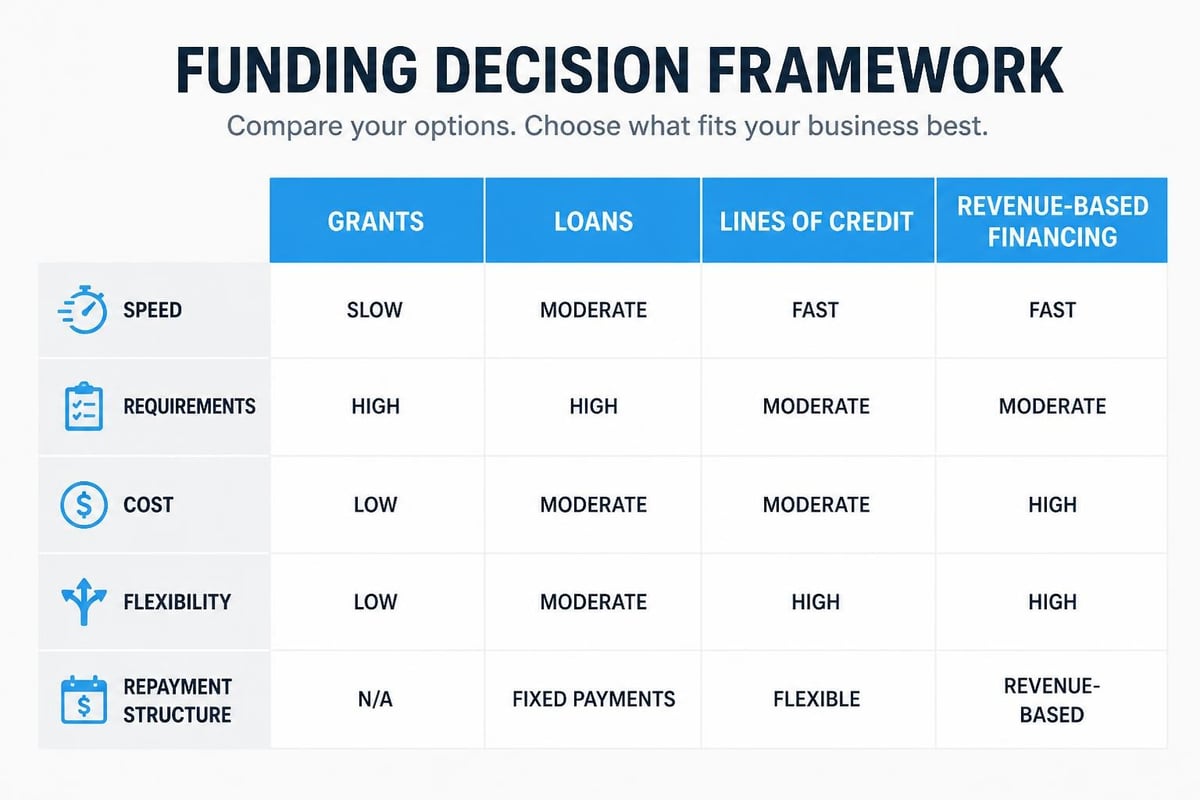
Comparing Funding Mechanisms
Different capital sources serve different business needs and circumstances:
Grants provide free capital but involve lengthy application processes, competitive selection, and limited availability. They work best for businesses with strong fundamentals that can afford extended waiting periods and may not receive funding.
Bank Loans deliver larger capital amounts at lower interest rates but require strong credit, collateral, and extensive documentation. Approval can take weeks or months, making them unsuitable for urgent capital needs.
Lines of Credit offer flexibility for recurring expenses and cash flow management. Businesses access funds as needed, pay interest only on drawn amounts, and can reuse the line as they repay balances.
Revenue-Based Financing considers business performance over credit scores, providing faster approvals and funding. Repayment structures align with revenue, offering built-in flexibility during seasonal variations.
The U.S. Small Business Administration provides comprehensive resources on grant opportunities beyond corporate programs, including federal grants that support specific industries, research initiatives, and economic development priorities.
Tax Implications and Financial Planning
Receiving amazon small business grants creates tax obligations that require careful planning. Unlike loans, which are not taxable because they must be repaid, grants typically constitute taxable income in the year received. IRS Publication 525 provides detailed guidance on the tax treatment of grants, prizes, and awards for businesses.
Business owners should consult tax professionals to understand how grant income affects their overall tax position. Strategic planning might involve:
- Timing expenses to offset grant income within the same tax year
- Accelerating planned purchases to maximize deductions
- Adjusting estimated tax payments to avoid underpayment penalties
- Documenting expenditures meticulously to support deductions and demonstrate proper use of funds
Grant programs often impose restrictions on how recipients can use funds. Common limitations include prohibitions on using grant money for debt repayment, owner distributions, or activities unrelated to business operations. Understanding these restrictions before applying prevents complications after receiving awards.
Some grants require regular reporting on fund usage, impact metrics, and business outcomes. These obligations can extend for months or years after receiving the grant, demanding administrative attention and documentation systems.
The Broader Grant Landscape
Amazon small business grants represent just one component of a much larger ecosystem of corporate and government grant programs. The Library of Congress maintains research guides on small business financing that catalog hundreds of grant opportunities across federal, state, and private sources.
Corporate grant programs have proliferated as companies recognize the value of supporting small business ecosystems. FedEx, Chase, Visa, Shopify, and dozens of other corporations now offer competitive grant programs with varying eligibility criteria, award amounts, and application timelines.
Federal grant opportunities often target specific industries, research areas, or policy priorities. Agricultural businesses might pursue USDA grants, technology startups can explore SBIR/STTR programs, and businesses in designated communities may qualify for economic development grants.
Industry-Specific Grant Opportunities
Different sectors enjoy access to specialized funding:
- Technology and Innovation: SBIR, STTR, and NSF grants supporting research and development
- Agriculture: USDA grants for sustainable farming, rural development, and specialty crops
- Healthcare: NIH grants for medical research and healthcare innovation
- Energy: DOE grants for renewable energy, efficiency, and clean technology
- Manufacturing: MEP grants supporting modernization and workforce development
- Retail: Corporate programs from major brands supporting retail entrepreneurs
Strategic business owners maintain awareness of multiple grant opportunities, submitting applications to several programs annually. This portfolio approach increases the likelihood of securing at least one award while diversifying funding sources.
Maximizing Your Grant Application Success
Research shows that winning applicants share common characteristics that go beyond meeting basic eligibility. Coverage of Amazon Business Small Business Grants recipients reveals patterns among successful applicants that other businesses can emulate.
Professional Presentation: Applications featuring clear organization, professional language, error-free writing, and compelling visual elements score higher than those with typos, unclear narratives, or incomplete sections.
Quantified Impact: Generic statements about "growing the business" or "hiring more employees" pale in comparison to specific commitments: "This grant will enable us to hire two full-time customer service representatives, reducing response times from 24 hours to 4 hours and improving customer retention by 15%."
Third-Party Validation: Letters of support from customers, community leaders, industry associations, or other credible sources add legitimacy to your application. Awards, certifications, media coverage, or partnerships with recognized organizations strengthen credibility.
Applicants should also consider:
- Starting the application process early to allow time for revisions
- Requesting feedback from mentors, advisors, or SCORE volunteers
- Tailoring narratives to each grant program's specific priorities
- Following instructions precisely, including word counts and formatting requirements
- Proofreading multiple times before submission

Non-Cash Support and Alternative Amazon Programs
Beyond direct grant funding, Amazon offers several programs providing value to small businesses. AWS Activate provides cloud computing credits to startups and growing businesses, offering thousands of dollars in Amazon Web Services resources that reduce technology costs and enable sophisticated cloud infrastructure.
Amazon Business Accelerator programs provide training, mentorship, and resources to sellers looking to scale their operations. While these programs don't offer direct cash grants, the education and support can prove equally valuable for businesses navigating growth challenges.
The Amazon Small Business Academy delivers free online courses covering topics from inventory management to digital marketing, helping entrepreneurs build capabilities that drive sustainable growth. These educational resources complement funding by strengthening business fundamentals.
Marketplace opportunities through Amazon Business, Amazon Handmade, and other specialized platforms give small businesses access to massive customer bases without requiring equivalent marketing investments. Strategic sellers leverage these platforms to generate revenue that funds growth, reducing dependence on external capital.
Preparing for Future Grant Cycles
Amazon small business grants typically operate on annual cycles, with applications opening during specific windows. Businesses that miss current deadlines or don't receive awards can strengthen their position for future opportunities.
Build Your Track Record: Use the intervening months to achieve measurable milestones-revenue growth, new product launches, market expansion, customer acquisition, or operational improvements. Future applications become more compelling when demonstrating documented progress.
Strengthen Financial Reporting: Implement robust accounting systems, clean up bookkeeping, and establish clear financial reporting processes. Professional financial statements signal organizational maturity and reduce perceived risk.
Expand Your Amazon Presence: For Amazon-specific grants, deepening your engagement with Amazon platforms strengthens your candidacy. Increase seller ratings, expand product offerings, improve fulfillment metrics, or participate in Amazon programs that demonstrate commitment.
Document Social Impact: Begin tracking community impact metrics-jobs created, local suppliers engaged, charitable contributions, sustainability initiatives, or diversity achievements. These data points strengthen future applications focused on social outcomes.
| Preparation Activity | Timeline | Priority Level |
|---|---|---|
| Financial cleanup | 3-6 months | High |
| Impact tracking systems | 2-4 months | Medium |
| Product line expansion | 6-12 months | Medium |
| Customer testimonial collection | 1-3 months | Medium |
| Professional photography | 1-2 months | Low |
| Website enhancement | 2-4 months | Low-Medium |
Understanding that federal grant applications often require extensive preparation helps contextualize corporate grant timelines. While Amazon's process is typically more streamlined than government grants, treating it with similar seriousness improves outcomes.
Strategic Integration with Overall Funding Plans
Sophisticated business owners view amazon small business grants as one element within comprehensive funding strategies rather than standalone solutions. Research from the Congressional Research Service on small business financing emphasizes the importance of diversified capital sources matched to specific business needs and growth stages.
Effective capital strategies typically combine:
- Owner Investment: Retained earnings and personal capital demonstrating commitment
- Revenue-Based Financing: Flexible working capital aligned with business performance
- Equipment Financing: Specialized loans for machinery, vehicles, or technology purchases
- Lines of Credit: Revolving access for ongoing operational needs
- Grants: Non-dilutive capital for specific projects or initiatives
- Strategic Partnerships: Joint ventures or collaborations providing resources beyond capital
Each funding mechanism serves distinct purposes within the business lifecycle. Grants excel for pilot programs, research initiatives, or community projects where traditional financing may not align with immediate revenue generation. Revenue-based financing works well for inventory purchases, marketing campaigns, or expansion initiatives with clear ROI timelines.
Business owners should assess their capital needs across multiple dimensions:
- Amount required: Total capital needed for specific objectives
- Timeline urgency: How quickly funds must be available
- Use restrictions: Any limitations on how capital can be deployed
- Repayment capacity: Ability to service debt from projected cash flows
- Risk tolerance: Comfort with various financing structures and obligations
Building Resilience Beyond Single Funding Sources
The competitive nature of amazon small business grants means prudent business owners cannot rely exclusively on winning these awards. Building financial resilience requires multiple strategies:
Cash Flow Optimization: Improving collections, negotiating better payment terms with suppliers, and managing inventory more efficiently strengthen financial position independent of external funding.
Relationship Development: Cultivating relationships with multiple lenders, funding partners, and financial institutions creates options when capital needs arise. Businesses with established banking relationships access financing faster and on better terms.
Credit Building: Maintaining strong business credit through timely payments, appropriate credit utilization, and regular credit monitoring expands future financing options. Many business owners neglect credit building until they need financing, discovering too late that poor credit limits their choices.
Financial Reserves: Establishing emergency funds covering 3-6 months of operating expenses provides buffers during unexpected challenges or opportunities. Grants can help build these reserves when used strategically.
Strong businesses combine multiple funding approaches rather than depending on any single source. This diversity creates flexibility, reduces vulnerability to changes in any one market or program, and enables faster response to opportunities or challenges.
Amazon small business grants offer valuable opportunities for qualifying businesses, but the competitive selection process and limited award amounts mean they should complement rather than replace comprehensive funding strategies. Whether you're pursuing grants or need more immediate access to working capital for inventory, expansion, or operational needs, Enterprise Finest Solutions connects small and medium-sized businesses with flexible financing options matched to your revenue, performance, and capital requirements-helping you access the funding your business needs to grow.
Written by
Enterprise Finest Solutions
Content creator and writer sharing insights and stories.