Acquisition Funding: A Complete Guide for 2026
Learn how acquisition funding works in 2026, from traditional loans to creative financing structures that help businesses complete strategic mergers.

Strategic acquisitions remain one of the fastest paths to business growth, market expansion, and competitive advantage. Yet the success of any acquisition hinges not just on finding the right target company but on securing the capital required to close the deal. Acquisition funding represents the specialized financing that enables business owners, private equity sponsors, and corporate buyers to purchase another company or its assets. Understanding how lenders evaluate acquisition deals, which financing structures align with different transaction types, and how to position your deal for approval can mean the difference between closing a transformational acquisition and watching an opportunity slip away.
Understanding the Fundamentals of Acquisition Funding
Acquisition funding encompasses any capital used to purchase an existing business, its assets, or a controlling equity stake. Unlike traditional working capital or equipment financing, lenders evaluate these deals through a distinct lens that weighs both the buyer's financial strength and the target company's performance history.
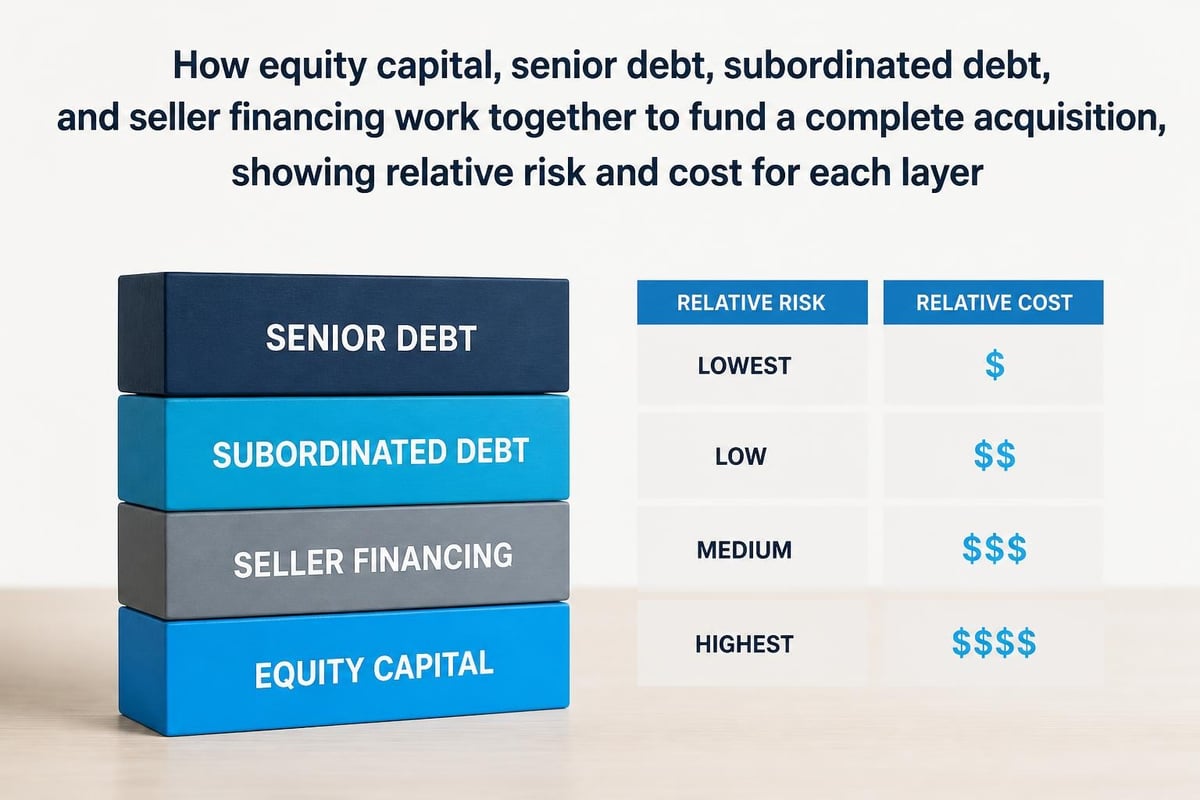
The financing structure typically combines multiple capital sources into a coordinated "stack" that covers the total purchase price. Equity from the buyer forms the foundation, while debt instruments fill the remaining gap. The proportion of debt to equity directly impacts both the deal's risk profile and the buyer's potential returns.
Debt vs. Equity in the Capital Structure
Most acquisition transactions involve a blend of debt and equity financing. Buyers contribute equity capital, which demonstrates commitment and absorbs first losses if the combined entity underperforms. Lenders provide senior debt secured by company assets, subordinated debt that accepts higher risk for better returns, or specialized acquisition facilities.
The optimal capital structure balances:
- Cost of capital: Debt typically costs less than equity but requires scheduled payments
- Risk allocation: Lenders protect their position through covenants and collateral
- Control considerations: Equity investors often demand board seats or governance rights
- Tax efficiency: Interest expense on acquisition debt generally receives favorable tax treatment
Understanding these trade-offs helps buyers construct financing packages that minimize capital costs while maintaining operational flexibility. The Internal Revenue Service guidance on asset allocation becomes critical when structuring deals, as purchase price allocation affects both tax deductions and lender security positions.
Traditional Bank Financing for Acquisitions
Commercial banks remain the primary source of acquisition funding for small and medium-sized business purchases. Banks offer term loans, revolving credit facilities, and commercial real estate mortgages that collectively finance the deal while securing repayment through company assets and cash flow.
Senior bank debt typically covers 50-70% of the total purchase price for well-qualified buyers and strong target companies. Lenders evaluate creditworthiness by examining both the buyer's balance sheet and the target's historical financial performance. Recent regulatory shifts, including the OCC's December 2025 rescission of interagency leveraged lending guidance, have provided banks greater flexibility in underwriting acquisition loans.
Key Bank Underwriting Criteria
Commercial lenders assess acquisition funding requests using strict analytical frameworks. Approval hinges on demonstrating that the combined entity can service debt while maintaining healthy operating margins.
Banks typically require:
- Debt service coverage ratio (DSCR) of at least 1.25x, meaning earnings before interest, taxes, depreciation, and amortization (EBITDA) must exceed debt payments by 25% or more
- Personal guarantees from business owners, especially for transactions under $5 million
- Equity injection of 20-30% of purchase price from buyer sources
- Detailed quality of earnings analysis verifying target company financial statements
- Industry experience demonstrating buyer capability to operate the acquired business
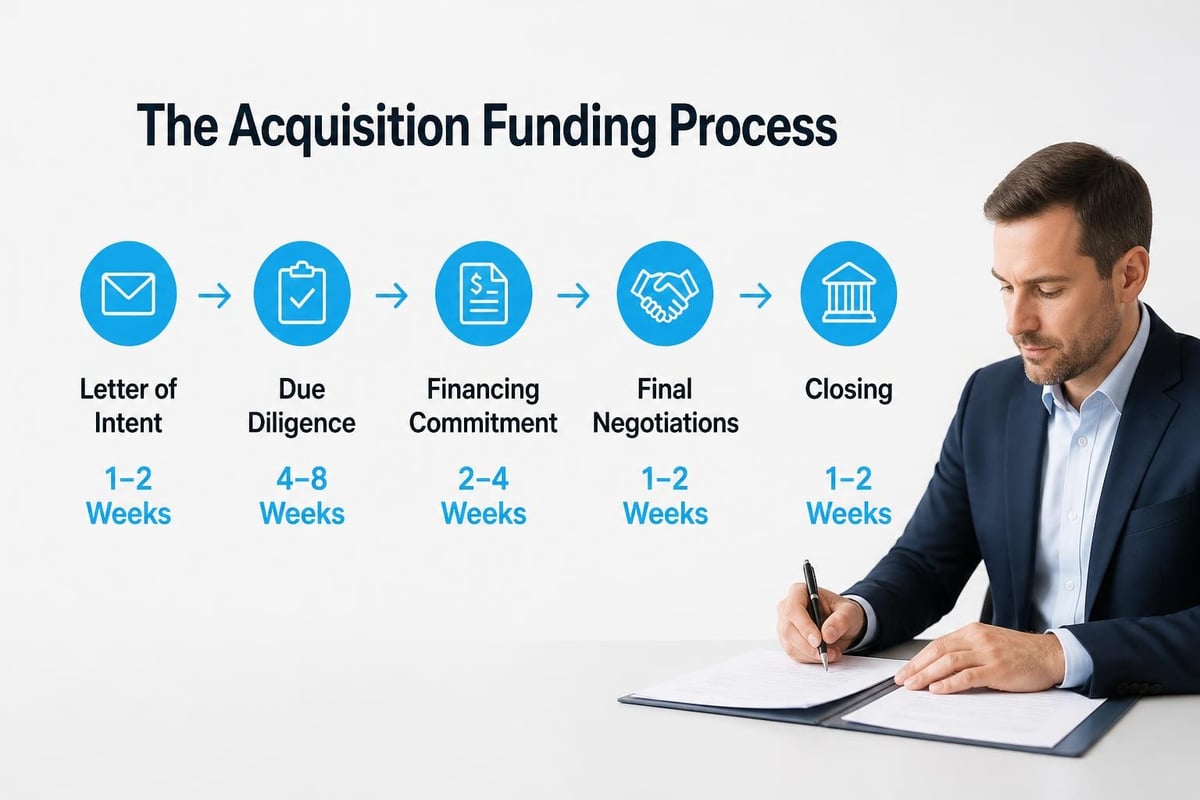
The underwriting process involves extensive due diligence, including reviewing three to five years of financial statements, tax returns, customer concentration analysis, and accounts receivable aging. Buyers should expect 60-90 days from application to closing for bank-financed acquisitions.
| Financing Element | Typical Range | Key Determinant |
|---|---|---|
| Loan-to-Value (LTV) | 50-70% | Asset quality and liquidity |
| Interest Rate | Prime + 1.5-3.5% | Buyer credit, deal structure |
| Term Length | 5-10 years | Asset life and cash flow stability |
| Equity Required | 20-30% | Transaction risk profile |
Alternative Acquisition Funding Structures
When traditional bank financing proves insufficient or inappropriate, buyers turn to creative financing arrangements that bridge gaps in the capital structure. These alternatives often move faster than bank processes and accommodate transaction complexities that challenge conventional lenders.
Seller Financing
Seller notes represent one of the most common forms of alternative acquisition funding. The seller extends credit to the buyer for a portion of the purchase price, typically 10-30%, payable over three to seven years. This structure benefits both parties: buyers reduce upfront capital requirements while sellers demonstrate confidence in the business transition.
Seller financing works particularly well when:
- The buyer cannot qualify for full bank financing
- Transition risk concerns lenders due to customer relationships tied to the current owner
- The seller seeks tax deferral by spreading gain recognition across multiple years
- Earnout provisions align purchase price with post-closing performance
Lenders often view seller financing favorably because it aligns the seller's interests with transaction success and provides a subordinated capital cushion protecting the senior debt position.
Revenue-Based Financing and Merchant Cash Advances
Businesses with strong recurring revenue streams but limited collateral assets sometimes explore revenue-based financing for acquisition capital. These instruments repay through a fixed percentage of future sales rather than scheduled monthly payments. While expensive compared to traditional debt, revenue-based structures offer flexibility during integration when cash flows fluctuate.
For established businesses seeking acquisition capital alongside working capital needs, working capital financing solutions can supplement traditional acquisition debt by funding post-closing operations while the buyer secures longer-term acquisition facilities.
Leveraged Buyout Financing
Leveraged buyouts (LBOs) represent the most debt-intensive form of acquisition funding, typically used by private equity firms and experienced operators acquiring established companies with predictable cash flows. LBO structures maximize financial leverage to amplify equity returns, often supporting debt loads of 60-80% of the purchase price.
The Harvard Business School overview of LBO modeling explains how financial sponsors structure these transactions to achieve target internal rates of return (IRR) of 20-30% or higher. Success depends on rigorous cash flow projections, operational improvement plans, and well-timed exit strategies.
Private Credit in LBO Transactions
Traditional bank reluctance to provide high-leverage acquisition funding has fueled explosive growth in private credit markets. Non-bank lenders including business development companies (BDCs), credit funds, and direct lenders now provide much of the capital supporting middle-market LBOs.
According to Bain & Company's private equity analysis, private credit now funds a significant portion of sponsor-backed acquisitions, offering faster execution and more flexible terms than syndicated bank deals. These lenders charge higher interest rates-often SOFR plus 6-9%-but accept creative structures including payment-in-kind (PIK) interest toggles and covenant-light terms.
The trade-off between cost and flexibility defines the choice between bank and private credit acquisition funding:
| Feature | Bank Debt | Private Credit |
|---|---|---|
| Interest Rate | Lower (SOFR + 2-4%) | Higher (SOFR + 6-9%) |
| Closing Speed | 60-90 days | 30-45 days |
| Covenant Structure | Tight maintenance covenants | Covenant-lite or incurrence |
| Prepayment Flexibility | Minimal penalties | Often restricted with fees |
| Documentation | Heavily negotiated | More standardized |
Strategic Considerations in Structuring Acquisition Deals
Smart buyers approach acquisition funding as a strategic exercise that extends beyond simply securing enough capital to close. The financing structure impacts everything from purchase price negotiations to post-acquisition integration and ultimate exit options.
Asset Purchase vs. Stock Purchase Implications
The legal structure of the acquisition dramatically affects available financing options and lender comfort. Asset purchases allow buyers to select specific assets and liabilities, creating cleaner collateral packages that lenders prefer. Stock purchases transfer entire entities including unknown liabilities, requiring more extensive due diligence and often supporting lower leverage ratios.
Tax considerations also drive structure decisions. Asset purchases generally benefit buyers through stepped-up basis depreciation, while sellers often prefer stock sales for favorable capital gains treatment. Reconciling these competing interests frequently involves purchase price adjustments or seller financing to bridge the tax-efficiency gap.
Due Diligence and Lender Requirements
Acquisition funding approval requires thorough due diligence that validates both strategic rationale and financial projections. Deloitte's M&A outlook research emphasizes that lenders scrutinize quality of earnings, working capital requirements, and integration risk when evaluating acquisition financing requests.
Buyers should prepare comprehensive due diligence packages including:
- Three to five years of audited or reviewed financial statements
- Normalized EBITDA calculations adjusting for non-recurring expenses
- Customer and supplier concentration analysis
- Key employee retention agreements
- Environmental site assessments for real estate-intensive businesses
- Litigation searches and intellectual property verification
The quality and completeness of due diligence materials directly correlate with lender confidence and, ultimately, financing terms offered.

Industry-Specific Acquisition Funding Considerations
Certain industries present unique opportunities and challenges for acquisition funding. Lenders develop specialized expertise in sectors with distinctive cash flow patterns, asset profiles, or regulatory frameworks.
Manufacturing and Distribution
Manufacturing acquisitions often secure favorable financing terms due to tangible asset bases including machinery, inventory, and real estate. Equipment-intensive operations support asset-based lending structures where advance rates reach 80-85% against eligible accounts receivable and 50-60% against inventory. Real estate holdings provide additional collateral value, sometimes supporting separate commercial mortgage facilities.
However, lenders scrutinize customer concentration, technological obsolescence, and environmental liabilities more heavily in manufacturing deals. Buyers should budget for Phase I and potentially Phase II environmental assessments as standard due diligence.
Professional Services and Recurring Revenue Businesses
Service businesses with high recurring revenue but minimal tangible assets require different acquisition funding approaches. Software-as-a-service (SaaS) companies, managed service providers, and subscription-based businesses often secure financing based on annual recurring revenue (ARR) multiples rather than asset values.
Lenders providing acquisition funding for these businesses focus on:
- Customer churn rates and lifetime value metrics
- Recurring revenue percentage vs. project-based income
- Gross margin sustainability and scalability
- Key person dependencies and employee retention
The intangible nature of these assets sometimes necessitates higher equity contributions or supplemental seller financing to reach closing.
Healthcare and Regulated Industries
Acquisitions in healthcare, financial services, and other regulated sectors involve additional complexity around licenses, regulatory approvals, and compliance frameworks. Lenders require specialized industry knowledge and often engage consultants to validate regulatory standing.
Change-of-control provisions in contracts, licenses, and regulatory certifications can delay closings and complicate acquisition funding. Buyers should identify these requirements early in the process and budget additional time for regulatory approvals when structuring financing timelines.
Optimizing Your Acquisition Funding Strategy
Successfully funding a business acquisition requires thoughtful planning, relationship building, and strategic positioning. Buyers who approach financing proactively rather than reactively secure better terms and higher approval odds.
Building Lender Relationships Before You Need Them
The time to establish banking relationships is well before you identify an acquisition target. Lenders prefer working with borrowers they know, and existing relationships accelerate approval processes significantly. Business owners contemplating future acquisitions should:
- Open banking relationships with acquisition-focused commercial lenders
- Maintain clean, organized financial records demonstrating operational competence
- Share strategic plans and growth objectives with your banker
- Consider smaller financings that establish track records before pursuing acquisitions
These relationship-building efforts pay dividends when acquisition opportunities emerge and speed matters.
Matching Financing Sources to Deal Characteristics
No single financing source suits every acquisition. Small deals under $1 million often rely on Small Business Administration (SBA) 7(a) loans offering high leverage and long terms, while middle-market transactions exceeding $10 million tap institutional term loan markets or private credit.
Strategic buyers should assess each opportunity's unique characteristics-asset composition, cash flow stability, growth trajectory, and integration complexity-then match appropriate capital sources to those attributes. A $3 million acquisition of a stable, asset-rich manufacturing business calls for traditional bank financing, while a $5 million purchase of a high-growth SaaS platform with minimal assets might require a blend of seller financing, revenue-based debt, and equity investment.
Timing and Market Considerations
Acquisition funding markets fluctuate with broader economic cycles, interest rate environments, and regulatory shifts. The current market in 2026 reflects both opportunities and challenges for buyers seeking acquisition capital.
Rising base rates have increased borrowing costs but also created valuation pressure on sellers, potentially offsetting higher financing expenses with lower purchase prices. Meanwhile, abundant private capital continues seeking deployment in quality middle-market acquisitions, providing well-positioned buyers with multiple financing options.
Savvy buyers monitor market conditions and time acquisitions to capture favorable financing windows. Working with advisors who track lending markets provides valuable intelligence about when to accelerate or pause acquisition pursuits based on capital availability.
Preparing Your Financing Package for Success
Presentation matters when seeking acquisition funding. Lenders review dozens of opportunities monthly, and professional, comprehensive packages stand out from incomplete or poorly organized submissions.
Essential Components of a Winning Financing Proposal
A complete acquisition funding package includes both buyer and target company information organized for efficient lender review:
Buyer Materials:
- Personal financial statement and credit authorization
- Business ownership structure and experience summary
- Strategic rationale for the acquisition
- Integration plan and growth projections
- Equity commitment confirmation
Target Company Materials:
- Three to five years of financial statements and tax returns
- Quality of earnings analysis or internal financial review
- Customer concentration and contract summaries
- Employee census and key person identification
- Asset listings with estimated current values
Transaction Materials:
- Letter of intent or purchase agreement
- Sources and uses of funds statement
- Pro forma financial projections for combined entity
- Debt service coverage calculations
- Exit strategy or succession plan
Professional presentation signals seriousness and competence. Buyers should engage accountants to prepare normalized financial statements and consider working with business brokers or M&A advisors who understand lender expectations.
Common Pitfalls to Avoid
Even strong acquisition opportunities fail to secure financing when buyers make preventable mistakes. Common pitfalls include:
- Inadequate equity contribution: Lenders view insufficient buyer equity as lack of commitment or inability to support the business through challenges
- Overly aggressive projections: Unrealistic growth assumptions undermine credibility; conservative projections with upside scenarios work better
- Incomplete due diligence: Rushing to close without thorough investigation creates lender concern about unknown risks
- Poor integration planning: Failing to articulate how you will successfully operate the acquired business raises execution risk flags
- Weak personal credit: Business acquisitions typically require personal guarantees, and poor personal credit can override strong deal fundamentals
Avoiding these mistakes improves approval odds and supports more favorable financing terms.
The Role of Advisors in Acquisition Financing
While some buyers navigate acquisition funding independently, most benefit from professional guidance through the complex process. Advisors bring market knowledge, lender relationships, and transaction experience that accelerate closings and improve terms.
Business Brokers and M&A Advisors
Experienced M&A advisors help structure transactions for optimal financing outcomes. They understand how lenders evaluate deals and can position acquisitions to maximize leverage while minimizing buyer equity requirements. Advisors also manage deal processes, coordinating between buyers, sellers, lenders, and attorneys to keep transactions moving toward closing.
The best advisors maintain active lender relationships and can quickly identify which financing sources best match specific transaction profiles. This market intelligence proves invaluable when time pressure demands fast financing commitments.
Financial and Legal Professionals
Accountants provide quality of earnings analyses, tax structuring advice, and pro forma financial modeling that lenders require for approval. Attorneys draft purchase agreements, review contracts, and identify legal issues affecting financing, such as change-of-control provisions or environmental liabilities.
While advisory fees add transaction costs, professional guidance typically delivers better outcomes through improved deal structures, stronger financing terms, and reduced execution risk. The investment in experienced advisors usually pays for itself through better pricing and fewer post-closing surprises.
Acquisition funding combines art and science, requiring both analytical rigor and relationship building to secure the capital needed for transformative business growth. Whether you are pursuing a strategic add-on, a competitive consolidation, or your first business acquisition, understanding financing options and lender expectations positions you for success. Enterprise Finest Solutions helps business owners navigate funding options and connect with appropriate capital sources, offering the expertise and lender network that turns acquisition opportunities into completed transactions.
Written by
Enterprise Finest Solutions
Content creator and writer sharing insights and stories.