Account for Business: Setup, Management & Best Practices
Learn how to open, structure, and manage an account for business. Expert guide covers bank accounts, accounting systems, reconciliation, and controls.
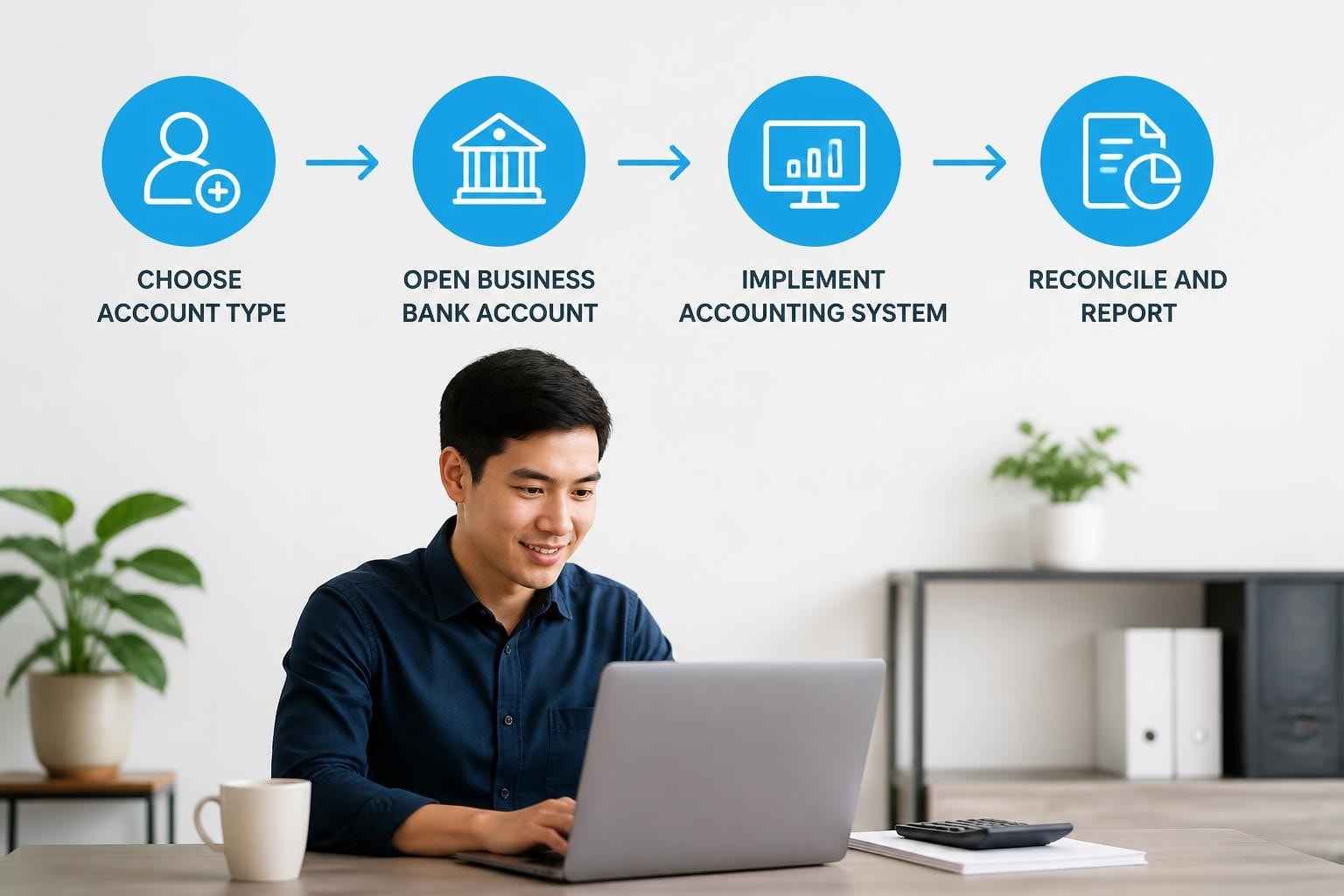
Every business, regardless of size or industry, needs a solid foundation for managing its finances. Setting up and maintaining a proper account for business operations is not just a regulatory requirement-it's the cornerstone of financial visibility, tax compliance, and informed decision-making. Whether you're launching a new venture or refining your existing financial infrastructure, understanding how to structure, manage, and reconcile business accounts will determine your ability to track performance, secure funding, and scale sustainably.
Understanding the Account for Business Landscape
When business owners talk about setting up an account for business purposes, they're typically referring to two interconnected systems: business banking accounts and accounting records. Both are essential, and both must work together seamlessly.
A business bank account separates personal and business finances-a separation that's legally required for corporations and LLCs, and strongly recommended for sole proprietors and partnerships. This separation protects personal assets, simplifies tax preparation, and establishes credibility with vendors, customers, and lenders. According to the FDIC's guide to opening bank accounts, business accounts require specific documentation including business formation documents, an Employer Identification Number (EIN), and ownership verification.
The accounting side of an account for business involves the systematic recording, classification, and reporting of all financial transactions. This includes revenue, expenses, assets, liabilities, and equity. Your accounting system becomes the authoritative record of your company's financial position and performance.
Types of Business Banking Accounts
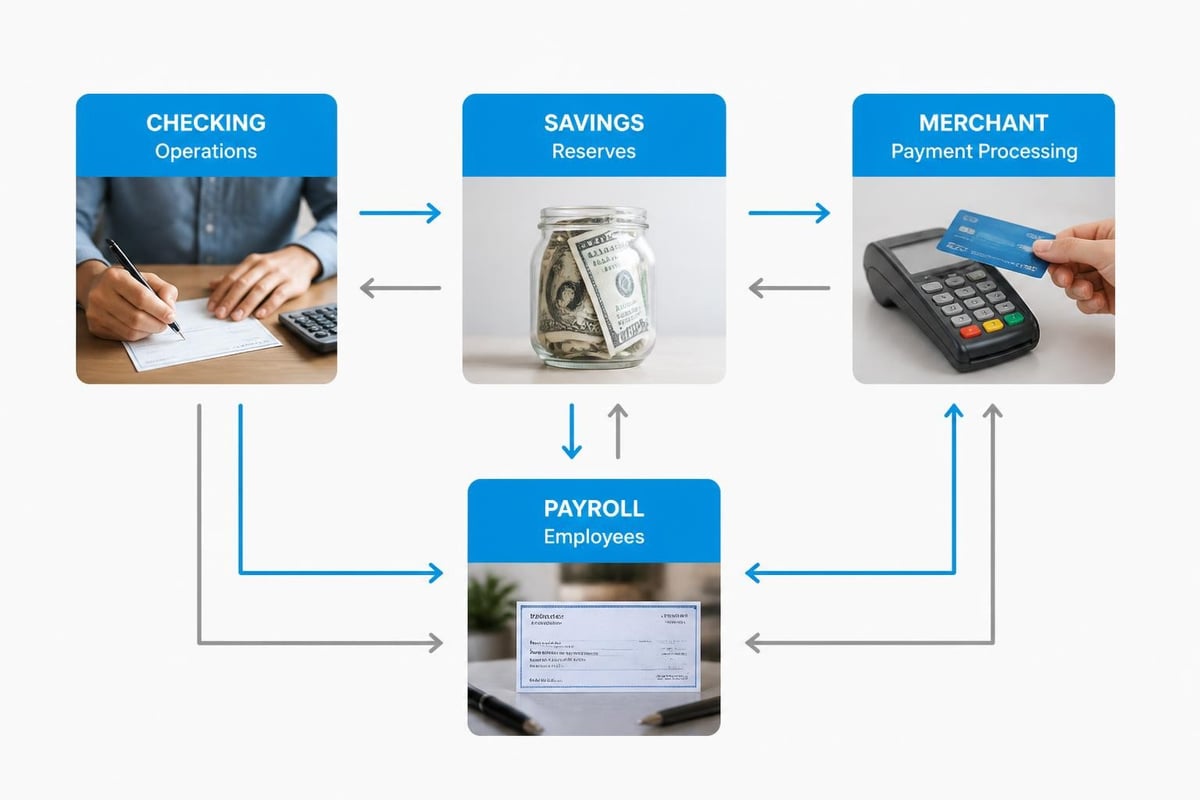
Business owners should consider opening multiple types of accounts to optimize cash management and financial control:
- Business checking accounts for day-to-day operations, vendor payments, and customer deposits
- Business savings accounts for emergency reserves, tax obligations, and strategic cash reserves
- Merchant services accounts for accepting credit card and electronic payments
- Payroll accounts (optional) to segregate payroll funds and simplify reconciliation
Each account type serves a specific purpose within your overall financial architecture. The Small Business Administration provides comprehensive guidance on structuring these accounts during the business launch phase.
Choosing the Right Accounting Method
The method you choose to account for business transactions fundamentally affects how you recognize revenue and expenses, prepare financial statements, and calculate tax obligations. The two primary methods are cash-basis and accrual accounting.
Cash-Basis Accounting
Cash-basis accounting recognizes revenue when cash is received and expenses when cash is paid. This method is straightforward, aligns with actual cash flow, and is permitted for most small businesses without inventory. Many sole proprietors and small service businesses use cash-basis accounting because it's intuitive and requires less complex bookkeeping.
However, cash-basis accounting doesn't capture accounts receivable or accounts payable, which can distort your true financial position. A business might appear profitable in a month when large customer payments arrive, even if those revenues were actually earned months earlier.
Accrual Accounting
Accrual accounting recognizes revenue when earned (regardless of when cash is received) and expenses when incurred (regardless of when cash is paid). This method provides a more accurate picture of business performance and financial position because it matches revenues with the expenses incurred to generate them.
Accrual accounting is required for businesses with inventory, C corporations, and companies exceeding certain revenue thresholds. It's also essential when seeking business financing, as lenders and investors need to see your true revenue pipeline and obligations. The IRS Publication 583 provides authoritative federal guidance on choosing and implementing accounting methods.
| Feature | Cash-Basis | Accrual |
|---|---|---|
| Revenue recognition | When cash received | When earned |
| Expense recognition | When cash paid | When incurred |
| Complexity | Simple | More complex |
| Financial accuracy | Lower | Higher |
| Required for inventory | No | Yes |
| Better for financing decisions | No | Yes |
Setting Up Your Business Accounting System
Implementing a robust system to account for business transactions requires selecting appropriate tools, establishing a chart of accounts, and creating processes for consistent data entry.
Modern accounting software has transformed how small businesses manage their finances. Cloud-based platforms offer real-time access, automated bank feeds, integration with payment processors, and built-in reporting. Popular options include QuickBooks Online, Xero, FreshBooks, and Wave, each with different feature sets suited to various business types and sizes.
Your chart of accounts is the organizational framework for all financial data. It categorizes every transaction into specific accounts within the five main account types: assets, liabilities, equity, revenue, and expenses. A well-designed chart of accounts balances detail (enough categories to provide meaningful insights) with simplicity (not so many categories that data entry becomes burdensome or inconsistent).
Essential Components of Business Accounting Systems
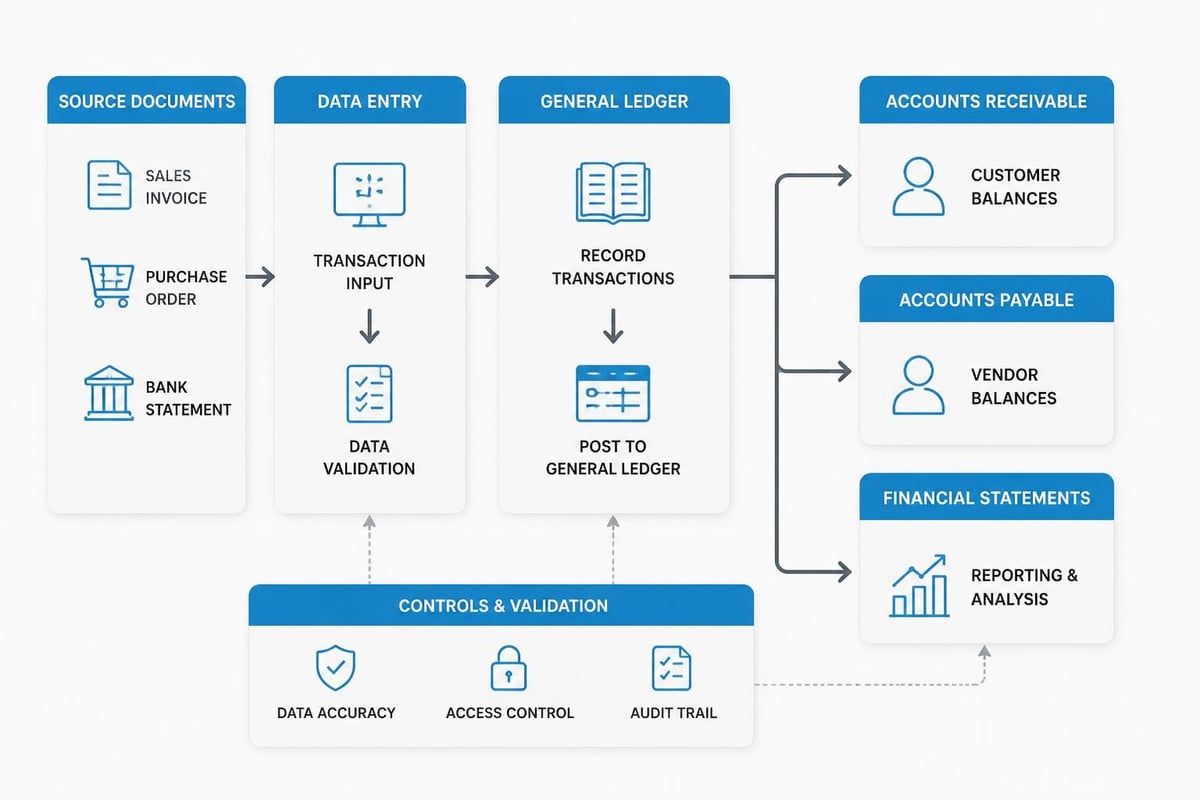
General ledger: The master record of all financial transactions, organized by account. Every debit and credit flows through the general ledger, which becomes the source for all financial reports.
Accounts receivable: Tracks money owed to your business by customers. Managing receivables effectively ensures steady cash flow and reduces the risk of bad debts.
Accounts payable: Records money your business owes to vendors and suppliers. Proper payable management helps maintain vendor relationships and optimize payment timing for cash flow.
Payroll records: Documents all employee compensation, withholdings, and employer tax obligations. Payroll errors can result in significant penalties, making accuracy critical.
Businesses seeking working capital solutions should maintain particularly clean accounting records, as lenders evaluate financial performance when considering working capital financing applications. Revenue consistency, expense management, and cash flow patterns all directly influence funding eligibility and terms.
Account Reconciliation and Financial Controls
Reconciliation is the process of verifying that your accounting records match external documentation-primarily bank statements, but also credit card statements, merchant processor reports, and loan statements. Regular reconciliation catches errors, detects fraud, and ensures your financial reports reflect reality.
According to Imperial College London's reconciliation best practices, effective reconciliation involves comparing balances, investigating and documenting discrepancies, adjusting records as needed, and retaining evidence of the reconciliation process.
Monthly Reconciliation Process
The account for business reconciliation should follow a consistent monthly workflow:
- Obtain statements: Download or receive bank statements, credit card statements, and other financial account documentation
- Compare transactions: Match each transaction in your accounting system to the corresponding entry on the bank statement
- Identify discrepancies: Flag transactions that appear in one record but not the other
- Investigate differences: Determine whether discrepancies result from timing differences (outstanding checks, deposits in transit), errors, or unauthorized transactions
- Make adjustments: Record any necessary corrections in your accounting system
- Document completion: Note the reconciliation date, ending balances, and any unresolved items requiring follow-up
This systematic approach ensures your account for business records remain accurate and reliable. The COSO framework on internal control emphasizes reconciliation as a critical detective control that identifies errors and fraud after they occur.
Implementing Financial Controls
Internal controls protect business assets, ensure accounting accuracy, and reduce fraud risk. Even small businesses benefit from basic controls:
- Segregation of duties: Different people should handle cash, record transactions, and reconcile accounts
- Approval workflows: Require authorization for purchases, expense reimbursements, and disbursements above specified thresholds
- Physical security: Restrict access to checkbooks, credit cards, and accounting system credentials
- Regular reviews: Owners or managers should periodically review financial reports, bank statements, and unusual transactions
Strong controls become especially important as businesses grow and add employees with access to financial systems and assets.
Financial Reporting and Statement Preparation
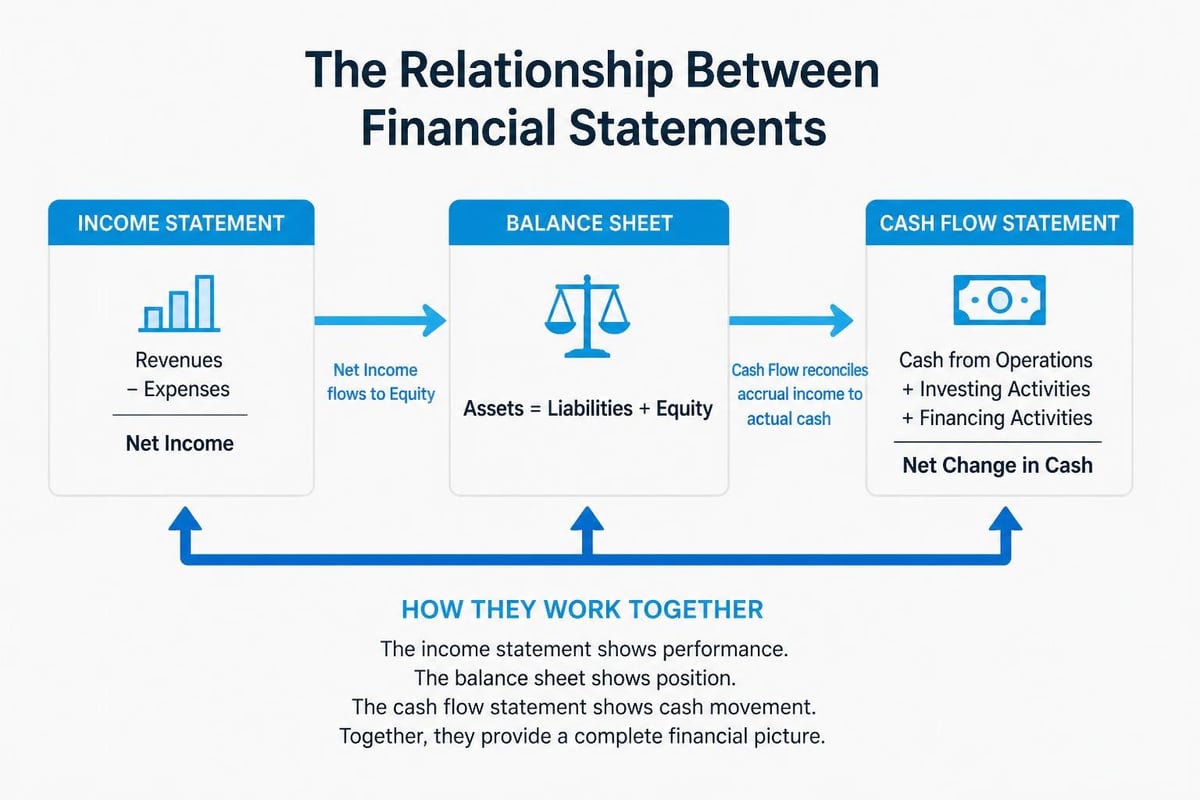
The ultimate purpose of maintaining an accurate account for business operations is to generate meaningful financial reports that inform decision-making. The three core financial statements work together to tell your business's financial story.
Balance Sheet
The balance sheet presents your business's financial position at a specific point in time. It lists all assets (what the business owns), liabilities (what the business owes), and equity (the owners' residual interest). The fundamental accounting equation-Assets = Liabilities + Equity-must always balance.
A strong balance sheet shows adequate working capital (current assets exceeding current liabilities), manageable debt levels, and positive equity. Lenders analyze balance sheets to assess creditworthiness and collateral availability.
Income Statement
The income statement (also called profit and loss statement or P&L) shows revenue, expenses, and net income over a specific period-typically monthly, quarterly, or annually. This statement reveals whether your business is profitable and how efficiently it converts revenue into profit.
Business owners should review income statements regularly to identify trends in revenue growth, cost control, and profitability. Declining gross margins might signal pricing pressure or rising costs of goods sold. Increasing operating expenses as a percentage of revenue could indicate efficiency problems.
Cash Flow Statement
The cash flow statement tracks actual cash movement through the business, categorized into operating activities (day-to-day business), investing activities (capital expenditures and asset sales), and financing activities (debt and equity transactions). This statement is particularly important for businesses using accrual accounting, where net income doesn't equal cash generated.
| Statement | Time Period | Key Question Answered |
|---|---|---|
| Balance Sheet | Point in time | What does the business own and owe? |
| Income Statement | Period of time | Is the business profitable? |
| Cash Flow Statement | Period of time | Is the business generating cash? |
The AICPA Financial Reporting Framework for SMEs offers practical guidance for owner-managed businesses preparing financial statements without the complexity of full GAAP compliance.
Tax Compliance and Record Retention
Maintaining a proper account for business purposes is inseparable from tax compliance. Your accounting records substantiate the revenue, deductions, and credits you claim on tax returns. Poor records invite audits, trigger penalties, and may result in disallowed deductions.
The IRS requires businesses to maintain records that support entries on tax returns. These records must be available for inspection if the IRS audits your return. Generally, businesses should retain tax records for at least three years from the filing date, though certain situations require longer retention periods.
Essential Tax Records
- Income documentation: Sales receipts, invoices, 1099 forms, bank deposit records
- Expense documentation: Receipts, invoices, canceled checks, credit card statements
- Asset records: Purchase documentation, depreciation schedules, disposal records
- Employment records: Payroll registers, W-2 and W-4 forms, payroll tax returns
- Business formation documents: Articles of incorporation, operating agreements, EIN confirmation
Digital record-keeping has simplified retention requirements. Scanning and securely storing documents electronically reduces physical storage needs while ensuring records remain accessible. The U.S. Chamber of Commerce GAAP guide provides practical context for small businesses on when GAAP compliance matters and how it affects tax reporting.
Professional Support and Ethical Considerations
While many business owners handle their own accounting, particularly in the early stages, there comes a point where professional assistance becomes valuable. Accountants, bookkeepers, and financial advisors bring expertise, efficiency, and objectivity that can improve accuracy and free up owner time for revenue-generating activities.
When engaging accounting professionals, understanding ethical standards and independence requirements protects both parties. The AICPA's plain-English guidance on professional ethics addresses important considerations when accountants prepare or review business accounts, particularly regarding independence and conflicts of interest.
When to Engage Professional Help
Consider professional accounting support when:
- Your business complexity exceeds your accounting knowledge or available time
- You're preparing financial statements for lenders, investors, or potential buyers
- Tax planning opportunities could significantly reduce your tax burden
- You're experiencing cash flow problems and need expert analysis
- Internal control weaknesses have led to errors or fraud
Professional support doesn't mean completely outsourcing financial oversight. Business owners should remain engaged with their financial data, review reports regularly, and ask questions when results don't align with expectations.
Advanced Account Management Strategies
As businesses mature, their approach to account for business functions should evolve beyond basic compliance toward strategic financial management. Advanced strategies optimize cash, improve forecasting, and support growth objectives.
Multi-entity accounting becomes relevant when businesses operate divisions, subsidiaries, or related entities. Each legal entity typically requires separate accounts and financial statements, with consolidated reporting at the parent level. Proper inter-company accounting ensures transactions between entities are recorded correctly and eliminated during consolidation.
Department or project accounting tracks financial performance by segment, enabling managers to evaluate profitability by product line, location, or project. This granular visibility informs resource allocation, pricing decisions, and strategic planning.
Budget vs. actual analysis compares actual financial results to budgeted projections, highlighting variances that require management attention. Regular variance analysis improves forecasting accuracy and accountability.
Businesses pursuing growth through capital investment should maintain particularly strong financial records and reporting, as financing partners evaluate these materials when considering applications for expansion capital. Clean books, consistent revenue, and well-documented business performance strengthen financing proposals and may improve available terms.
Industry-Specific Accounting Considerations
Different industries face unique accounting challenges that affect how businesses should account for business transactions and structure their financial systems.
Inventory-intensive businesses (retail, manufacturing, distribution) must implement inventory accounting systems that track units, costs, and valuation. Inventory methods (FIFO, LIFO, weighted average) affect both balance sheet values and cost of goods sold calculations.
Service businesses with project-based work need job costing systems that accumulate labor, materials, and overhead by project. Accurate job costing reveals project profitability and informs future pricing.
Seasonal businesses experience significant revenue and cash flow fluctuations throughout the year. These businesses must carefully manage cash reserves during slow periods and plan for seasonal working capital needs.
Subscription and recurring revenue businesses must account for deferred revenue (cash received for services not yet delivered) and recognize revenue over the subscription period.
Understanding your industry's accounting norms helps ensure your account for business systems capture relevant metrics and comply with industry-specific regulations. The ACCA technical guidance offers professional resources on industry accounting considerations and financial statement preparation.
Technology Integration and Automation
Modern businesses increasingly leverage technology to streamline how they account for business operations. Automation reduces manual data entry, improves accuracy, and enables real-time financial visibility.
Bank feed integration automatically imports bank and credit card transactions into accounting software, dramatically reducing manual entry while ensuring completeness. Most cloud-based accounting platforms offer direct bank connections that update daily.
Receipt capture apps photograph expense receipts and extract key data (vendor, date, amount, category) using optical character recognition. This technology reduces lost receipts and improves expense documentation.
Payroll integration connects payroll processing with general ledger accounting, ensuring payroll expenses, liabilities, and tax withholdings flow correctly into financial statements.
Payment platform integration links payment processors (credit card terminals, e-commerce platforms, invoicing systems) with accounting software, automatically recording revenue and reducing reconciliation time.
While automation delivers significant benefits, businesses must maintain appropriate controls and oversight. Automated transactions still require periodic review, and system access should be restricted to authorized personnel.
Establishing and maintaining a proper account for business operations requires intentional system design, consistent processes, and ongoing attention to accuracy and compliance. From selecting the right banking structure and accounting method to implementing controls and generating meaningful reports, each element contributes to financial visibility and business success. When your business needs capital to pursue growth opportunities, manage seasonal fluctuations, or invest in equipment and expansion, strong financial records significantly improve your financing options. Enterprise Finest Solutions helps small and medium-sized businesses connect with flexible funding solutions tailored to their revenue, performance, and capital needs.
Written by
Enterprise Finest Solutions
Content creator and writer sharing insights and stories.